From Boing Boing
A really cool Filckr set of old Penguin book covers. A real stroll down memory lane for us long-time Penguin fans!
I have added javascript code to our ALEPH version 16 web OPAC to create a permanent link and a link to create a del.icio.us link. It works in the search results, full record display, and the holdings display. ALEPH allows the creation of permanent links. That was the basis for the javascript. It was modified by Nathan Fixler at the SUNY Office of Library and Information Services. I can read and sometimes even modifiy javascripts but this particlular code was beyond my skill level.
The catalog is at http://seneca.sunyconnect.suny.edu:4600/FM if you want to try it.
Here is one example of a tag created at del.icio.us:
http://del.icio.us/babyboomerlibrarian/Morrisville_Libraries_LIS
Let me know what you think about this.
TALLAHASSEE, FL—A national report released today reveals that 99 percent of all U.S. public libraries provide free public access to computers wired to the Internet, compared to 25 percent 10 years ago. Librarians overwhelmingly (71 percent) report that the most important impact of this service is providing Internet access to those who otherwise would not have it. This is the first time that impact has been quantified on a national scale.
The report also reveals that despite increased demand for library computers, libraries typically have not seen a corresponding increase in budgets and many are challenged to provide enough computers or fast-enough connection speeds to meet demand.
The national survey provides longitudinal data regarding public library Internet connectivity and public access computing services and resources, but also explores the impacts and benefits that communities derive from public library connectivity. The case sites focused primarily on successfully networked public libraries and the issues, solutions, and approaches that these libraries faced and resolved in order to develop sustainable and high quality public access computing and Internet services.
Hosts and writes for blog that serves as users’ daily guide to the events of the day and notable stories on the network and the Web; uses news judgment and a lively prose style to present a singular perspective, writing and reporting original items and drawing other NPR reporter/correspondents and listeners into analysis and discussion; may also host a podcast of the day’s top on-air stories; and may serve as a public representative of National Public Radio, Inc.

For your viewing enjoyment, in light of the recent Warner Brothers/You Tube alliance, is "Ray of Light" from SJCPL Staff Day 2003. It's taken three years, but now I feel much more comfortable posting this and I did get permission from SJCPL administration. This video was borne out of a time that we wanted to show the staff how important every single person is to the mission of the library. Ity's not books, or snazzy technology, or a beautiful building, folks, it's people that make the library go round in my book.
Bruce Sterling's uproariously funny story "I saw the best minds of my generation destroyed by Google" has just been published in the New Scientists -- it's a short short story about the life of a teenager when today's tools of ubiquitous computer control and surveillance are perfected. Like all great science fiction, this doesn't so much predict the future as it predicts the present:
I tried hard to buy us another spray can. I'm a street poet, so really, I tried. I walked up to the mall-store register, disguised in my Dad's business jacket, with cash in hand. They're cheap, aerosol spray cans. Beautiful colours of paint, just screaming to get sprayed someplace public where everybody has to see what's on our minds. The store wouldn't sell me the can. The e-commerce system simply would not allow that transaction. The screen just went gray and stayed gray.
That creepy "differential permissioning" sure saves a lot of trouble for grown-ups. Increasing chunks of the world are just... magically off limits. It's a weird new regime where every mall and every school and every bus and train and jet is tagged and tracked and ambient and pervasive and ubiquitous and geolocative... Jesus, I love those words... Where was I?
Yesterday, USBCELL launched the premier product for the company: the AA USB-rechargable battery.
This rechargeable battery can charge from any USB port without the need for any recharging devices, cradles or cables. Simply pop the lid to reveal a built in connector and charger, plug into any powered USB port on your desktop, laptop, keyboard or games console, to charge the battery.
USBCELL can be used exactly like a normal battery meaning there is now no need to purchase huge packs of alkaline batteries, or invest in or carry a clunky charger. Read more at their site...
Sadly, this UK-based company doesn't appear to be processing orders from outside areas. But, according to their site, they will be soon.USBCELL is a product of Moixa Energy Ltd., which is a spin out of Moixa Energy Holdings founded, by Simon Daniel and Chris Wright. Their mission is to invent and deliver technologies that provide consumers with better solutions for their mobile or home power requirements that are more usable, economic and environmentally friendly.

There's one place you may not have thought to store your valuable computer information. Just look up.
Hollow lava tubes on the Moon could be used as a giant digital library. That's one commercial possibility for the Moon put forth in a white paper by a NASA scientist.
In addition to being able to relay information to Earth like geosynchronous satellites, a lunar-based system could also process and store information, says David McKay.
The lunar computers could be buried in lunar soil, put at the bottom of craters or set into lava tubes, which are subsurface caves in which lava used to flow. Previously, scientists have suggested using lava tubes for human habitation.
Commercial data stored on Earth can be destroyed by natural disasters, wars or fires. In 500 BC, the Royal Library of Alexandria in Egypt housed records of the ancient world, and the entire library or at least some collections were ruined in a fire. The benefits of lunar storage are that there is no oxygen to erode the material, constant sub-freezing temperature and the Moon is currently free of all of the havoc wreaked by humankind.
Astronauts on lunar missions could set up the data communication and storage system if they return to the Moon.
The Moon could be used like Noah's ark, hosting a collection of plant and animal material, proposes McKay, who made headlines a decade ago when he and others announced that Martian meteorite ALH 84001 had rod-like structures that appeared to be fossilised microbes.
Families could even pay a fee to preserve photographs in the lunar library for future civilizations. McKay calls it the "ultimate time capsule."
Kelly Young
“Providing a similar navigation to the Web site, the NYTimes.com mobile site provides a version of NYTimes.com that is easily read and navigated on mobile phones. The site is not dependent on carriers. Any consumer who has a Web-enabled phone and pays for a Web data plan will be able to access the mobile site.”

After plenty of rumorings, it doesn't look like Amazon will be able to keep mum on the subject for long, since they're expected to launch "Unbox" today. The word on prices isn't exactly wonderful: rentals should go for about 4 bucks, while permanent downloads are hovering at $15. TV shows are matching the $2 iTunes pricepoint, and should be available the day after they air. As for studios, Amazon is purported to have Warner Bros., Fox, Paramount, MGM, Lionsgate, Sony and Universal all signed up, but Disney is said to be holding out for iTunes at this point. Picture quality is supposed to be DVD-ish, and videos will be playable in Amazon's Windows-only Unbox player (pictured), or on your TV or portable device. So far the amazon.com/unbox URL is redirecting to a plain-vanilla DVD page, but if all this word on the street proves true we should be seeing it up in the next few hours.

Google has announced a new service, "Google News Archive Search", which enables users to scour through archives of more than 200 years old historical content from newspapers, magazines, and other publications.
According to Google, the service is aimed at allowing users to explore history 'as it unfolded.' With this service, users can see how viewpoints/ideas/events changed over time. The archive search presents stories on particular subjects in the order in which they happened, so that users can go back to particular dates and understand how things changed or evolved over time. There is also a facility for users to search archives of particular publications.
An addition to Google News, the archival search is available as a link on the News page - as an alternative to searching the wider Web. Initially, the service is available only in US English. However, the company plans to introduce other languages eventually.
The databases included in this service are part of what some might call the "dark Web" as they cannot be indexed by standard search engines. The archival service is geared to provide users with content from both free as well as subscription-based news services.
Reportedly, Google has partnered with a number of sources for its new service, and the list reads thus: Wall Street Journal, New York Times, Washington Post, Time, Guardian Unlimited, Factiva, Lexis-Nexis, HighBeam Research, Thomson Gale, and AccessMyLibrary.com.
The Wiki-based Global Textbook Project’s goal is 1,000 wiki-created textbooks on “topics typically encountered in the first two years of a university’s undergraduate programs.” May the drive-by concept kick in and work out!
The new project’s organizers promise “several innovations to improve the quality of the books” and already enjoys international participation. Rick Watson (photo), the Georgia professor initiating the effort, has already masterminded XML: Managing Data Exchange.

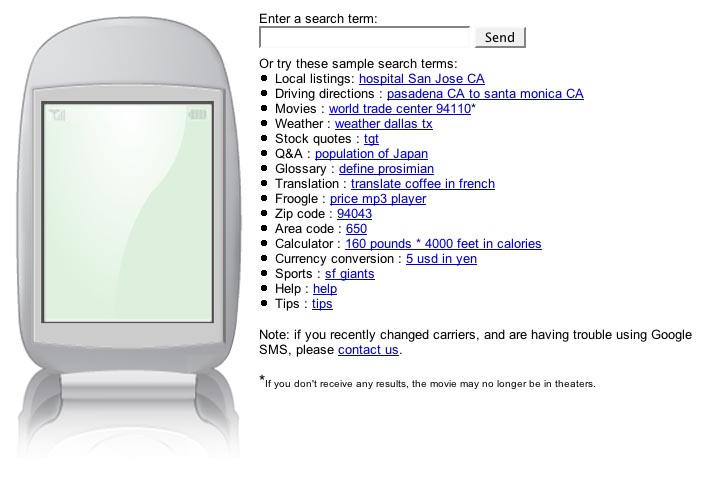

You've heard of e-ink devices, like the Sony Librie, or e-reader, or whatever. But you've never seen a real working prototype of an electronic reader based on a flexible e-paper, that rolls up like a scroll. And you've never seen a video of said device being explained by a Norwegian named Hans to an Austrailian guy named Max...Mad Max. Whatever, I don't care what his real name is. What we care about is the prototype's 5-inch screen that runs at 320 by 240 pixels. The screen, by E-Ink corporation, only uses power to change states, so battery life is measured in page turns. Video below demos the device.
Now you can offer private-labeled email, IM and calendar tools to all of your users for free, so they can share ideas and get things done more effectively. You can design and publish your organization's website, too. It's all hosted by Google, so there's no hardware or software for you to install or maintain.
Google is launching another attack on the corporate world, offering up a suite of business applications on Monday.
The suite includes Gmail with 2GB of storage, Google Calendar, Google Talk and Page Creator. It's an extension of a service the company launched in February that lets organizations use Gmail with their own e-mail address.
Google still makes most of its money from search-related advertising. But with beta versions of spreadsheet and word-processing programs in the works, it's clear the company is aiming for bigger markets.
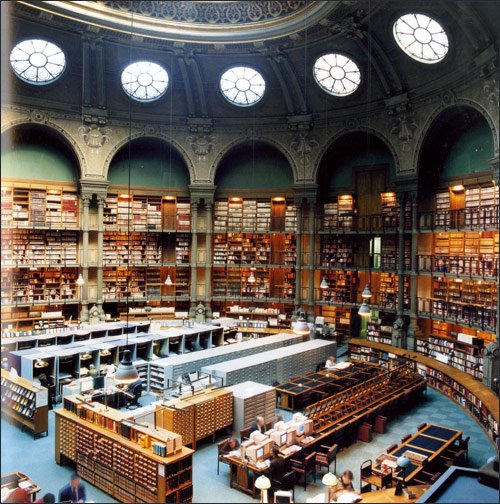
Yesterday I came across a truly gorgeous book of photographs by Candida Höfer titled, Libraries, a title which pretty much says it all, because that is just exactly what it is, one rich, sumptuous, photo of a library interior after another. It’s like porn for book nerds. Seriously. They are gorgeous photos, nearly all without visitors and just begging to be entered.

The aim of BritLit is to help teachers from around the world to exploit English literature in the ELT classroom. Here you can find a range of materials based around the works of various authors.
Each BritLit resource kit contains a range of materials to help students understand the context of the literature as well as the language and the works themselves.
Many of the packs contain complete texts, tasks for students , teachers' notes as well as audio recordings of interviews with the authors and readings of the text.

The OTR.Network is a new online resource for Old Time Radio (OTR) enthusiasts. We have over 11,000 OTR shows available for instant listening, and we add at least 100 more every week. Oh yeah, did we mention it's free?
The University of California is joining Google Inc.'s book-scanning project, throwing the weight of another 100 academic libraries behind an ambitious venture that's under legal attack for alleged copyright infringement.
The deal to be announced Wednesday covers all the libraries in UC's 10-campus system, marking the biggest expansion of Google's effort to convert millions of library books into digital form since a group of authors and publishers sued last fall to derail a project launched 20 months ago.
"We think this is a pretty significant step forward," said Adam Smith, the group product manager overseeing Google's book-scanning initiative.
UC joins three other major U.S. universities Stanford, Michigan and Harvard that are contributing their vast library collections to Google's crusade to ensure reams of knowledge written on paper makes the transition to the digital age. The New York Public Library and Oxford University also are allowing portions of their libraries to be scanned.

"Ex Libris will continue to develop and enhance its existing products based on market trends and requirements generated by our customers. The financial backing of Francisco Partners will enable us to explore acquisition opportunities for complementary products in the library automation and e-resource markets."
BookCrossing - In the real world, bookcrossing is 'the practice of leaving a book in a public place to be picked up and read by others, who then do likewise.' BookCrossing aims to turn this concept virtual, and exactly that.
Best for: Book lovers
Check out Connotea.This site provides the ability to create your own tags, bookmarks and more related to research. It also provides the detailed citation information and allows you to see what others have found that may be related to your area of research.
The front page looks strange at first glance but what it is actually providing is a look at what other Connotea users are currently reading about. The size and colorization indicates recent usage and how frequently a tag is used.
Along with the services it provides, it incorporates brief (2 minutes or so) tutorials targeted at specific areas or needs. Take a look and see what you think.
The site is provided by the Nature Publishing Group (http://www.nature.com/index.html)

Coolgorilla is dedicated to bringing you free iPod software. That's right, every download on this site is free and won't cost you a penny. So if your looking to turn your iPod into a phrasebook to help you learn another language, turn it into an interactive encyclopaedia crammed full of facts about your favourite sport or just have some fun and use it to play games you've come to the right place.


Henry Jenkins is the Director of the MIT Comparative Media Studies Program and the Peter de Florez Professor of Humanities. He is the author and/or editor of nine books on various aspects of media and popular culture, including Textual Poachers: Television Fans and Participatory Culture, Hop on Pop: The Politics and Pleasures of Popular Culture and From Barbie to Mortal Kombat: Gender and Computer Games. His forthcoming books include Convergence Culture: Where Old and New Media Collide and Fans, Bloggers and Gamers: Exploring Participatory Culture.
A new and relatively simple method for discovering the date when centuries-old art prints and books were produced has been developed at Penn State. The method could reveal long-sought information about thousands of undated works printed on hand-operated presses before the development of modern printing methods in the mid-19th century, including works by Rembrandt and Shakespeare. "The discovery that the wood blocks and metal plates used for printmaking deteriorate at a clocklike rate means that we can now use the prints as a 'print clock' for determining the date a work was printed," said Blair Hedges, professor of biology at Penn State and author of the paper describing the research, which will be published in the scientific journal Proceedings of the Royal Society A: Mathematical, Physical and Engineering Sciences.
 Opera has released version 9 of their feature-laden browser and it really looks good! This latest iteration integrates tabbed browsing, thumbnail previews, integrated search, BitTorrent and much more. Plus, it's a free download!
Library catalogs are at a cross-roads, and it is time to consider a new and improved vision for these tools. If the library catalog and its utility do not evolve, then the utility of a library will increasingly become irrelevant. Libraries and librarians bring a certain expertise to the acquisition, evaluation, and dissemination information. This expertise is not limited to books, journals, and videos, so why should the most significant electronic public face to a library -- its catalog -- be limited in such a way?
"Wikipedia's founder, Jimmy Wales, has asked that college students refrain from citing Wikipedia as a source of academic research.
Yes, some actually are...and then complaining to him when teachers give them failing grades for doing it.
While speaking at the Annenberg School for Communication at the University of Pennsylvania, Wales said that he receives about 10 e-mails a week from complaining college students. While Wales thinks Wikipedia is useful for many things, he said that he would like to make it known that he does not recommend it to college students for serious research.
He also expressed little sympathy for any college student who would still rely on an encyclopedia for academic info. He did say, however, that Wikipedia has considered putting out a fact sheet on the site. It would explain the nature of Wikipedia and why it's not always a definitive source. Teachers could hand it out, he said.
Aside from the obvious accuracy debate, the mere nature of Wikipedia as a constantly changing open source encyclopedia goes against the purpose of academic attribution.
Wales' comments were reported by The Chronicle of Higher Education."

Want to find those IRS forms to get in your taxes on time? Need to figure out where to send your DMV fees, or find the phone number for your local parks and rec department? Google U.S. Government Search launches today -- it's a site on which you can 1) search across a huge index of U.S. Federal, state and local government websites via a single search box, and 2) stay up to date through personalized content feeds from government agencies and press outlets. Off you go.
This will allow the faculty to remain in blissful ignorance, believing that—despite the low pay—they are spreading knowledge in the world, while at the same time convincing your parents to continue to pay for several more years of school, drunken orgies, and Prada bags. Your classmates who do not follow the above rules will constitute the “low hanging fruit,” easily picked off and tormented by mean-spirited unfulfilled teachers for their own amusement. You, however, will rise above the fray, secure in your superious ability to act smart, even if you don’t understand the text you are passing off as your own.
"Put on your seatbelt and prepare for highs, lows and plenty of twists and turns. BMW, in conjunction with Random House, brings you BMW Audio Books, a unique series of specially- commissioned short stories showcasing the work of some of the finest contemporary writing talent. Each gripping audio book is yours to download for free. Listen to them on your MP3 player, your laptop or ideally, in the car. So sit back, hit play and enjoy the ride."

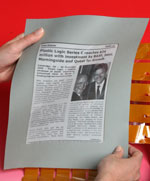
Amazon, the world's biggest bookseller, is in talks with Cambridge company, Plastic Logic, about the end of books as we know them.
Plastic Logic has come up with the ultimate in e-books, overcoming the problem of reading an inflexible page on a screen - something which was never going to usurp the traditional book.
News of the Amazon/Plastic Logic link was given to a Cambridge audience on Thursday night when Hermann Hauser delivered the RSA Lecture at Magdalene College.
His theme was: "What makes a good entrepreneur" and one of Cambridge's hottest entrepreneurial endeavours at the moment is Plastic Logic, which is making microchips cheap as chips by printing them with plastic ink as opposed to etching in silicon.
"The reason why Amazon doesn't sell e-books at the moment is because people don't like reading on a screen, but now they can curl up with an e-book," Dr Hauser said.
This past week, Plastic Logic has been showing off its new product concepts at a trade show in San Francisco, under the heading 'Life is Flexible'.
All the concepts incorporate PL's radical new flexible display technology, and, in the company's words: "They illustrate the inevitable transformation we will see in everyday products as a result of plastic electronics over the next decade."
Adding a deck? Remodeling your kitchen? From simple to detailed, conceptual to realistic, Google SketchUp (free) lets you populate the world with true 3D objects. Want to build a fully dimensioned 3D model that can be used as the basis for your next do-it-yourself project? Google SketchUp's expanded feature lets you build in as much detail as your project requires.
The U.S. House of Representatives definitively rejected the concept of Net neutrality on Thursday, dealing a bitter blow to Internet companies like Amazon.com, eBay and Google that had engaged in a last-minute lobbying campaign to support it.
By a 269-152 vote that fell largely along party lines, the House Republican leadership mustered enough votes to reject a Democrat-backed amendment that would have enshrined stiff Net neutrality regulations into federal law and prevented broadband providers from treating some Internet sites differently from others. More at the above link.
 This year, for the first time, we planted "heirloom" tomatoes - tomatoes from seeds your grandfather might have grown. I can't tell you how wonderful these are! So sweet and flavorful. On the left is a "Purple Giant" and on the right is a "Rainbow".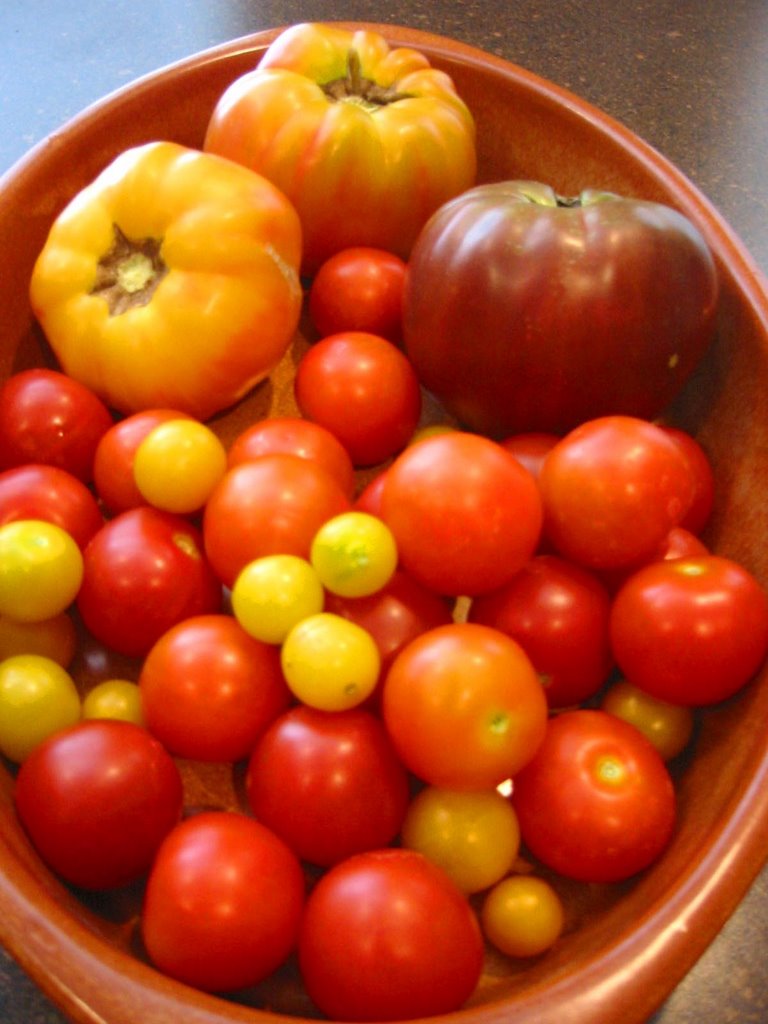
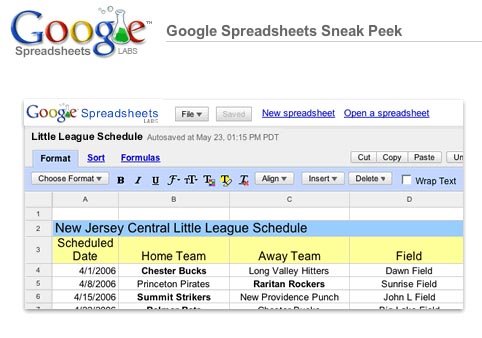
Create basic spreadsheets from scratch.
You can start from scratch and do all the basics, including changing the number format, sorting by columns, and adding formulas.
Upload your spreadsheet files.
Upload spreadsheets or worksheets from CSV or XLS format – all your formulas and formatting will come across intact.
Familiar desktop feel makes editing a breeze.
Just click the toolbar buttons to bold, underline, change the font, change the cell background color and more. (...)
Choose who can access your spreadsheets.
Just enter the email addresses of the people you want to share a given document, and then send them a message.
Share documents instantly.
People with whom you share a given spreadsheet can access it as soon as they sign in.
Edit with others in real time.
Multiple people can edit or view your spreadsheet at the same time as you – their names will appear in an on-screen chat window.
Here is a link to a downloadable PDF of an eBook Users Survey (PDF) conducted by the International Digital Publishing Forum. The survey delves into 3 areas: Past eBook Experience, eBook Features and Suggested Improvements. The researchers appeared to target eBook users in that they sent invitations to customers of major eBook retail sites, so it's perhaps no surprise that 82% have purchased an eBook in the past month. However, even though many respondents complain about the high prices of eBooks, only 8% borrowed an eBook from a library in the last month. Also, I was a bit surprised to find that a large majority of respondents (79%) prefer to read their eBooks on Personal Digital Devices like Palms. The main improvements suggested in the survey to increase eBook use and satisfaction are lower prices, more selection and interoperability between eBook devices and software.
"I think you'll see a fundamental shift in the balance of power towards individuals. Individuals will declare what kinds of vendors they want sponsoring their content, and then those vendors will have the privilege of appearing, discreetly, around the user's content. There will be much less "advertising" and much more communication to interested customers. Advertisers will have to learn to listen, not just to track and segment customers. So the message to marketers is...
... If you can't sell your product (assuming it's already in the market), fix the product! Don't try to change the situation by advertising."


...because as a marketer for the NJ State Library, I am always coming across interesting articles, new concepts and great ideas that I think anyone trying to market their library might be interested in having a chance to read. Plus I wanted to create a forum where we could all start to share our ideas and thoughts and help each other to find answers to problems we are encountering in journey to tell the public about our libraries.Great work, Nancy, and we look forward to your posts. Marketing has never been more important to libraries than it is right now!


The purpose of this Guide is to provide you with a general roadmap of some of the legal issues specific to podcasting. EFF has produced a very practical and helpful guide for issues related to blogging generally. This Guide is not intended to duplicate efforts by EFF, and in many cases refers you to that guide for where crossover issues are addressed. Our goal is to complement EFF's Bloggers FAQ and address some of the standalone issues that are of primary relevance to podcasters, as opposed to bloggers.
 With over 30 million blogs currently on line and thousands more popping up each week, how do you find blogs relevant to your interest? Sphere's advanced search algorithm helps you discover high-quality, relevant, and timely blog posts that match what you're looking for.
Worldwide spending on the emerging wireless tracking technology is set to reach $504 million this year, up more than one-third from 2004, market researcher Gartner said Tuesday. Adoption will accelerate by 2007, with spending pegged to hit $3 billion by the end of the decade.
RFID, or radio frequency identification, has been hailed for its promise as a superior way to keep tabs on merchandise in warehouses and retail outlets. Scanning of data-laden chips on pallets and products would help keep inventories in order and assure buyers that they're not paying money for counterfeit goods.
Today we're launching a feature of Google Scholar which will make it easier for researchers to keep up with recent research. From quantum computing to copper binding in prion protein. It's not just a plain sort by date, but rather we try to rank recent papers the way researchers do, by looking at the prominence of the author's and journal's previous papers, how many citations it already has, when it was written, and so on.
Scholarly endeavors are about learning what has already been done and building on it. We hope this feature will help researchers worldwide learn from and build on the latest advances.

If you have a book, desk, and a display equipped with RFID chips, now you can read the whole contents through a large display just by putting the book on the desk ; antenna reads the chip information and delivers them to the display. Of course, you can actually use your hands - if you want - for a touch screen or a remote control.
 Nabaztag is a plastic box shaped like a rabbit, with pastel ears and facial features akin to Hello Kitty, it has a few flashing lights, a rudimentary speaker, one button and a name derived from the Armenian word for rabbit.
''A device like this changes the actual environment of the recipient, kind of like a bouquet of flowers. Once they get enough of them out there, I would love to see a global piece of installation art created by moving all their ears at once.