Changing a Cultural Icon:
The Academic Library as a Virtual Destination by Jerry D. Campbell, Chief Information Officer and Dean of University Libraries at the University of Southern California, Los Angeles.
This makes a compelling case that the model for academic libraries has changed and the library as we know it has less and less relevancy to today's users.
http://www.educause.edu/apps/er/erm06/erm0610.asp
Wednesday, January 25, 2006


Tuesday, January 24, 2006
LivePlasma Movie, Music Discovery Engine

Liveplasma.com, an online site for music and, more recently, movies, graphically "maps" shoppers' potential interests. A search for music by Coldplay, for example, brings up a graphical representation of what previous customers of Coldplay music have purchased, presented in clusters of circles of various sizes.
The bigger the circle, the greater the popularity of that band. The circles are clustered into orbits representing groups of customers with similar preferences.
"This is a way of showing recommendations that are vastly more useful than textual links," said Whit Andrews, a research vice president at Gartner Inc., a market research company in Stamford, Conn.

Apple has expanded its iTunes U program, which allows colleges and universities to post audio and video educational content online using a content management system based on iTunes.
Google Imagery Improves
From the GoogleBlog...
We're always trying to improve the imagery in Google Earth and Google Local, but our latest update is bigger than usual. Not only have we added extensive 6-inch imagery for many parts of the U.K., but we've updated the Google Local database to match the coverage we have in Google Earth, and (drum roll, please) ... we've added two more zoom levels in Google Local's Satellite mode! Now for many areas around the world you can see a lot more detail than you could before.
Take a look at people standing at the gates of Buckingham Palace in London, or jump over the pond and see the Statue of Liberty in New York, and then maybe drop down to the southern hemisphere and check out the boats sailing past the Sydney Opera House.
We're always trying to improve the imagery in Google Earth and Google Local, but our latest update is bigger than usual. Not only have we added extensive 6-inch imagery for many parts of the U.K., but we've updated the Google Local database to match the coverage we have in Google Earth, and (drum roll, please) ... we've added two more zoom levels in Google Local's Satellite mode! Now for many areas around the world you can see a lot more detail than you could before.
Take a look at people standing at the gates of Buckingham Palace in London, or jump over the pond and see the Statue of Liberty in New York, and then maybe drop down to the southern hemisphere and check out the boats sailing past the Sydney Opera House.
NCSU Debuts New Catalog
During ALA Midwinter there was quite a bit of chatter about North Carolina State University Libraries new catalog. High points, in my opinion, are relevance ranking, spelling help, and clean user friendly design. Here is an announcement from LJ Academic Newswire, 19-Jan-2006:
More links:
NCSU Libraries Unveils Revolutionary, Endeca-Powered Online Catalog
North Carolina State University Libraries (NCSU) has taken an important step in making catalogs more robust and user-friendly, deploying the Endeca ProFind™ platform to add capabilities patrons expect from web browsing. Patrons can now search results ranked by relevance, and refine navigation by topic, author, genre, language, material type, format, and availability. Sorting options include publication date, title, author, call number, and popularity. Also, the application displays a “breadcrumb” of the refinements selected to allow backtracking and broadening of search results. Users can also browse by subject without searching at all. Endeca’s technology is used in TLC’s CARL•X library system that has been installed in a few public libraries, but NCSU worked directly with the company, which mainly sells its software to retailers. “Endeca was very interested in talking to libraries,” Andrew Pace, NCSU’s head of systems, told the LJ Academic Newswire. “They knew a lot about searching. We knew a lot about metadata. We did it in six months.” He said the technology “costs less than an ILS, but what you’d expect to buy a high end web search technology.”
Pace known by many of his peers for his colorful denunciations of OPACs, said he began examining Endeca and similar products offered by AquaBrowser and RLG last year. “We don’t have any relevance in Sirsi,” he noted. The last thing cataloged is at the top of the list, which is not great when you add 5000 government documents in a batch load. We’re hoping to expose those titles that users wouldn’t be able to find.” While other libraries may be using Endeca technology, “the thing that’s really first for [our library] is the [Library of Congress] classification browsing. We took LC subject headings and broke them up into their four component parts.” Previously, he noted, the system had to be down for three days to reindex the library’s keyword index of 1.5 million bibliographic records. “Endeca does that in about four hours.” How will users respond to the system? “I almost hope it’s met with deafening silence from the users,” Pace said. “It’s about time it made more sense. Nobody calls up Barnes & Noble and Wal-Mart and asks them how to do a search.”
More links:
NCSU Libraries Unveils Revolutionary, Endeca-Powered Online Catalog
Friday, January 20, 2006
The Library Gives Me a Headache
Dr. Betsy Barefoot, Co-Director for the Policy Center on the First Year of College, and Associate Professor of Educational Leadership at Brevard College in Brevard, North Carolina, has an article in the online Chronicle Review, titled "Bridging the Chasm: First Year Students and Library. It is password protect, but us this link and scroll down for the article.
The campus library may historically be the centerpiece of institutional life on college and university campuses, but many first-year students think it is largely irrelevant to their lives. The reasons include the students' characteristics, attitudes, and prior experiences; the nature of first-year college courses; the lack of instruction on information literacy; and, perhaps most important, the availability of information 24/7 from online sources. Why walk to the library when all the information you could ever need is available at your fingertips in the comfort of your residence-hall room? Or so goes first-year student logic.
Library offers e-Books to reverse declining circulation
Morton Grove Library in Illinois eying e-books as way to reverse declining adult-circulation.
“(Library Director) Schapiro said the e-books will give the library a way to respond to a decline in adult circulation. While the drop has not been drastic, it has been noticeable, he said.
“Over the last couple of months we’ve been noticing a steady decline in our adult circulation. It doesn’t mean there are fewer people coming in,” he said.
Thursday, January 19, 2006
Google, Yahoo Still Favorites in North America
From Search Engine Watch - Survey: Google, Yahoo Still Favorites in North America, For the second year running, a Keynote Systems study says Google provides the most satisfying search...Link
Wednesday, January 18, 2006
Take the Test: "Are you a Librarian?"
From "It's All Good"
Over on PUBLIB, there has been a discussion of a quiz called, "Are You a Librarian?" After more than three decades in the profession, I scored a 72%, good enough for their ranking of "Assistant Librarian." I quote from my results:
"You seem to be a librarian, but you are not as knowledgeable as your more devoted colleagues in some of the library lore, trivia, technical details and social knowledge that can give depth and perspective to ones professional identity; but your practical knowledge of your job may be quite excellent."
On the other hand, I outscored 99% of the other quiz takers of my age and gender.
One drawback is that you don't find out which questions you answered wrong. Otherwise, this is a fun way to waste fifteen minutes or so. Twenty, if you blog about it afterwards!
Score your book's title! Will it sell?!
Want to know if you've got a killer title for your novel? Now, for the first time in literary history, you can put your title to the scientific test and find out whether it has what it takes for bestseller success.
Title Scorer.
Title Scorer.
Tuesday, January 17, 2006
Bizarre attempt at internet censorship
Web Censorship for Dummies. Annalee Newitz, AlterNet. Posted January 3, 2006. Here's an interesting story about CP80, a lobbying group pushing the "Internet Channel Initiative," a "technology solution" designed to limit pornography. Their idea is to put all pornography on one "channel" (i.e., port) and so be able to limit access to that port. However, this television metaphor doesn't fly because ports are used to differentiate types of communication protocols (http, smtp, etc.), not kinds of content. But beyond the technological problems with their initiative, check out the corporate sponsors -- amazon, iTunes, Best Buy, Sony Musci Store, Hickory Farms(?!) etc. This is even more troubling because these companies have alot of power and pull and they obviously aren't even thinking about the free speech implications of this "initiative", only the bottom line. This is the epitome of corporate irresponsibility. I think these companies should be at the top of the "do not shop at" list!...
Firefox Garners 20% of Euro Market
The Mozilla Firefox browser has achieved a market share of more than 20 percent in Europe, according to the latest figures released by French Web metrics firm XiTi.
XiTi, which based its figures on a sample of 32.5 million Web site visits that took place on Jan. 8, said that Finland has the highest proportion of Firefox users, followed by Slovenia and Germany. It found that the open-source browser is used by 38, 36 and 30 percent of users in these countries, respectively.
From CNET News
XiTi, which based its figures on a sample of 32.5 million Web site visits that took place on Jan. 8, said that Finland has the highest proportion of Firefox users, followed by Slovenia and Germany. It found that the open-source browser is used by 38, 36 and 30 percent of users in these countries, respectively.
From CNET News
Using building tops to advertise on Google Maps

Advertisers are slowly discovering the potential of Google Maps. Expect to see more of this in the future.
Friday, January 13, 2006
Learn who is linking to The Centered Librarian
I have added a button in the right panel that shows who has placed a link to us on their site. Yahoo indicates 93 links, though some are redundant. At least we have some audience!
Wednesday, January 11, 2006
5 Trends in Consumer Generated Content in 2006
From iMedia Connection
Here are five trends in consumer generated content from the last year that will have a profound impact on our internet experience in 2006 and beyond:
1. Social networking comes of age
2. Wikipedia becomes the number one reference site
3. Flickr and tagging take off
4. Blogs, blogs, blogs
5. Video search goes viral
Here are five trends in consumer generated content from the last year that will have a profound impact on our internet experience in 2006 and beyond:
1. Social networking comes of age
2. Wikipedia becomes the number one reference site
3. Flickr and tagging take off
4. Blogs, blogs, blogs
5. Video search goes viral
Friday, January 06, 2006
Google to offer video, software downloads
Google will reveal a new video and software download service on Friday, The Wall Street Journal (WSJ) reported Thursday, citing sources.
"We aren't commenting on any new planned services," a Google spokeswoman said. "All we're saying is that we have a number of exciting announcements that we will make on Friday at the Consumer Electronics Show."
As part of a major upgrade to Google's video-search service, consumers will be able to pay to download and view videos, such as TV shows, on their computer from Google content partners. Google plans to announce partnerships with major players, including CBS and the National Basketball Association, the report said.
Google will also announce Google Pack, a bundle of software from Google and others consumers will be able to download and install on their computers, according to the report. The bundle will include Firefox, a version of Norton AntiVirus, Adobe Acrobat Reader and RealPlayer.
"We aren't commenting on any new planned services," a Google spokeswoman said. "All we're saying is that we have a number of exciting announcements that we will make on Friday at the Consumer Electronics Show."
As part of a major upgrade to Google's video-search service, consumers will be able to pay to download and view videos, such as TV shows, on their computer from Google content partners. Google plans to announce partnerships with major players, including CBS and the National Basketball Association, the report said.
Google will also announce Google Pack, a bundle of software from Google and others consumers will be able to download and install on their computers, according to the report. The bundle will include Firefox, a version of Norton AntiVirus, Adobe Acrobat Reader and RealPlayer.
Library Thing - Catalog your books on line
Library Thing is an on line cataloging service that currentlt hosts almost 1.5 million volumes. You can catalog up to 200 books free or as many as you want for $10/year. Really neat commentary and reviews by users. You can set up a virtual book shelf with covers.
- Easy. Catalog your books online.
- Social. Show everyone your library, or keep it private. Find people with the same books you own. Read reviews and get recommendations from readers like you.
- Tagged. Tag your books as on Del.icio.us and Flickr (eg., wwii, magical realism, sexuality, christian living, cats).
- Powerful. Search Amazon, the Library of Congress and 30 other world libraries.
- Safe. Export your data. Import from almost anywhere too.
- Free. Enter 200 books for free, as many as you like for $10 (year) or $25 (life).
- Bloggy. Put a widget on your blog to show people what you're reading.
Tuesday, January 03, 2006
Amazon Connect
Amazon Connect
Amazon Connect is a new program currently open to a select group of authors. This program allows authors to post messages directly to their readers on a wide variety of subjects. Currently, messages will appear on the detail page of an author’s book as well as on her/his profile page. As part of the program, authors may create a profile page with personalized information.
Google to release its own PC and OS
According to the LA Times:
Google will unveil its own low-price personal computer or other device that connects to the Internet.
Sources say Google has been in negotiations with Wal-Mart Stores Inc., among other retailers, to sell a Google PC. The machine would run an operating system created by Google, not Microsoft's Windows, which is one reason it would be so cheap — perhaps as little as a couple of hundred dollars.
Google will unveil its own low-price personal computer or other device that connects to the Internet.
Sources say Google has been in negotiations with Wal-Mart Stores Inc., among other retailers, to sell a Google PC. The machine would run an operating system created by Google, not Microsoft's Windows, which is one reason it would be so cheap — perhaps as little as a couple of hundred dollars.
Wednesday, December 21, 2005
2005 Year End Google Zeitgeist
It turns out that looking at the aggregation of billions of search queries people type into Google reveals something about our curiosity, our thirst for news, and perhaps even our desires. Considering all that has occurred in 2005, we thought it would be interesting to study just a few of the significant events, and names that make this a memorable year. (We’ll leave it to the historians to determine which ones are lasting and which ephemeral.) We hope you enjoy this selective view of our collective year.
Monday, December 19, 2005
15 years of the World Wide Web
(CNN) -- Spark looks at the top 10 "Web moments" since the World Wide Web was born 15 years ago, and asks viewers to vote for the one they think had the most impact in the Web's history.
Link
Link
Google Launches Music Search
Google has introduced a new feature that provides information about music and musical artists in response to music related search queries. The new feature works directly from any Google web search form, and results are returned as "one box" results at the top of the search result page next to a musical notes icon. As with other types of "one box" results, which can be triggered when searching for news, products, images and so on, music results are displayed when Google determines that a query might be related to a band or artist name, a song name, album or song lyrics.
Read more about it here
Read more about it here
Wednesday, December 14, 2005
RSS Toilet paper

A crazy new product out of Taiwan seems to be aimed at the feed dependent of us out there. The 'rsstroom reader' is a bathroom gadget that prints news feeds onto your T-P - that's right, your TOILET PAPER! The best part is the "biometrics" toilet seat that'll figure out who you are based on your weight and prints the news you want - not your roommates tabloid garbage. Going to the rsstroom will never be boring again!

Friday, December 09, 2005
Google Transit Launched

Yet another iteration of Google Maps has launched and allows you to plan an itinerary using Google Maps. It even gives travel times.
Wednesday, December 07, 2005
Personal Media Barcode Solution
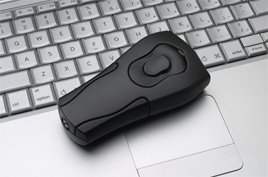
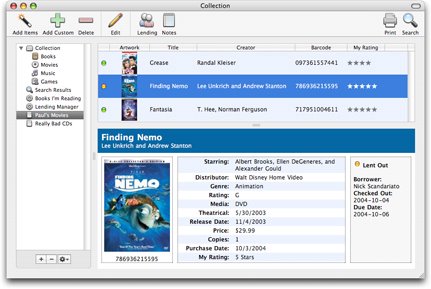
Media Collector makes organizing your media fast and easy with revolutionary AutoFill technology. One click provides you with detailed product information and artwork in an easy-to-use collection manager that makes it easy to browse, organize, and share your collections.
Media Collector utilizes barcode technology to its fullest potential to enable you to effortlessly organize, sort, search, browse, and share your media collections. Just like iTunes automatically enters information about your CDs, IntelliScanner barcode readers automatically locate the details you want with a simple scan.

Google Librarian is the ultimate guide to Google made especially for Librarians and information professionals. We understand that your quest for information is not limited to books, and extends to electronic media. Google Librarian was created to help you - the librarian - master the art of online searching and harness the infinite power of Google and its services. We provide you with tips, tricks, strategies, lesson plans, tutorials, and easy to understand explanations to make your Google experience the best. As an added bonus, we will also track Google development and keep you up-to-date with the latest Google innovations.
Tuesday, December 06, 2005
New OCLC report available
Perceptions of Libraries and Information Resources (2005) summarizes findings of an international study on information-seeking habits and preferences.
The Perceptions report provides the findings and responses from the online survey in an effort to learn more about:
Library use
Awareness and use of library electronic resources
The Internet search engine, the library and the librarian
Free vs. for-fee information
The "Library" brand
The report is available here.
The Perceptions report provides the findings and responses from the online survey in an effort to learn more about:
Library use
Awareness and use of library electronic resources
The Internet search engine, the library and the librarian
Free vs. for-fee information
The "Library" brand
The report is available here.
Monday, December 05, 2005
Wikipedia in the news
Wikipedia has been getting alot of press lately. Several scandals have prompted Wikipedia founder Jimmy Wales to modify posting ground rules.
Here are links to some recent articles:
A false Wikipedia 'biography' in USAToday
Adam Curry gets podbusted on cnet
Snared in the Web of a Wikipedia Liar from the New York Time
Growing pains for Wikipedia on cnet
Here are links to some recent articles:
A false Wikipedia 'biography' in USAToday
Adam Curry gets podbusted on cnet
Snared in the Web of a Wikipedia Liar from the New York Time
Growing pains for Wikipedia on cnet
Friday, December 02, 2005
Contrasting Keynotes - Gorman again at odds with Tech Librarians
From:
Jim Ashling
Ashling Consulting
And from:
Dick Kaser
ITI V.P., Content
Jim Ashling
Ashling Consulting
Contrasting keynotes
There couldn’t have been a greater contrast between David Weinberger’s keynote address and one immediately following by ALA President, Michael Gorman. While Weinberger paced up and down the platform, gesturing and occasionally shouting in his enthusiasm for a new order (or rather, a lack of order), in another room, Gorman sat quietly at the desk, spoke calmly and deliberately, without a PowerPoint presentation, espousing his opinion that the function of the library remains the same as it always has: the preservation of human knowledge. In addition, to assist users find the information they want and, given the failure of the US education system, to look after the health of users’ literary skills.
Speaking purely personally and not on behalf of the ALA, Gorman said, “Digitisation, particularly Google Print is a mistake. It is a waste of money to digitise material that nobody uses.” Further, he does not like at all the idea that readers should be able dip into works that can only be fully understood when read completely and sequentially.
Gorman also criticised Google’s name change from Google Print to Google Book Search. He believes that library catalogs are perfectly adequate for book searches and Amazon is fine for book purchases.
The remainder of the panel, two librarians and a Google spokesman, didn’t share these views. Elisabeth Niggemann, die Deutsche Bibliothek is keen to grow the body of digital content whether by corporations or through government funding as exemplified by The European Library project. (More on the European Library will appear in the January Information Today International Column).
Glenda Myers from the University of Witwatersrand was generous, even overflowing, in her praise of Google, saying that in her remote and poorer part of the world, Google was opening access to literature that could never have been provided before.
Google’s John Lewis Needham pointed out three factors about Google that change everything to do with search that none of the earlier speakers had mentioned: the price (free), the speed (fast) and the age of the Google user and Google developer communities (20 to 30).
Looks to me that the score at the end of round one is: New Order 3, Tradition 1.
And from:
Dick Kaser
ITI V.P., Content
The emphasis on quick search and the retrieval of nuggets of information defies the thoughtful process of the scholarly tradition and libraries' role in preserving and providing access to the human record of recorded knowledge, he said.
With the emphasis on quick search, Gorman said, "We've gone from cataloging to this sort of reduction of full texts . . . and a new age of amateurism [blogs] . . . and a belief in the great myth that everything is available on the Internet and everyone can find what they want."
This, he said, creates a "perilous" environment for libraries, and even challenges the basis of our civilization by reverting to a pre-Gutenberg situation in which "everything is written on water, it just flows away."
What about Google's digitization of library collections?
"It's a huge misallocation of resources," he said. "There are lots of ways to find books, and digitizing whole texts is a waste of time. The chances of a snippet from a book showing up on the first screen of search results [as far as most users go] is fairly low. It would be better if Google would help solve the scholarly communication issue or fund the digitization of archives."
Wednesday, November 30, 2005
Blackberry again in jeopardy
RICHMOND, Va. Nov 30, 2005 — A federal judge ruled Wednesday that a $450 million settlement between a small patent holding firm and the maker of BlackBerry e-mail devices, Research in Motion Ltd., is not valid.
The ruling by U.S. District Judge James R. Spencer is a victory for NTP Inc., an Arlington company that has argued the technology behind the popular BlackBerry infringes on its patents.
Canada's RIM had sought to uphold an agreement reached earlier this year, though NTP said it was never finalized.
Top Stories
Spencer could next consider reissuing an injunction that threatens to shut down U.S. BlackBerry service. However, analysts and industry observers expect RIM will be backed in a corner and forced to settle for a sum as high as $1 billion.
The Nasdaq market had halted trading of BlackBerry's shares about 10:45 a.m. pending an important announcement.
The ruling by U.S. District Judge James R. Spencer is a victory for NTP Inc., an Arlington company that has argued the technology behind the popular BlackBerry infringes on its patents.
Canada's RIM had sought to uphold an agreement reached earlier this year, though NTP said it was never finalized.
Top Stories
Spencer could next consider reissuing an injunction that threatens to shut down U.S. BlackBerry service. However, analysts and industry observers expect RIM will be backed in a corner and forced to settle for a sum as high as $1 billion.
The Nasdaq market had halted trading of BlackBerry's shares about 10:45 a.m. pending an important announcement.
Service offers free Internet Television

Veoh is an Internet Television Network that is able to reach anyone with a broadband Internet connection and a PC or a Mac. All you need to watch is download and install the Veoh software (~ 5MB, installs in under one minute).
Veoh allows anyone to create and broadcast their own TV show or a Channel full of shows. Not small streaming videos, but FULL-Screen, TV-Quality video. Veoh does not transcode the content, but rather offers it in it’s native encoding, and does not limit the file sizes/length of video. Veoh’s goal is to become the platform for producers of all sizes (from individuals to studios and everyone in between) to have a democratized TV broadcasting system.
Veoh is unregulated so it is a true FREE SPEECH television network, politically unbiased and unaffiliated.
Show publishers can publish an unlimited number of shows , with unlimited length, and reach an unlimited number of people, without paying a cent in storage or bandwidth charges . Veoh utilizes a homegrown P2P network (similar to Bit Torrent, but built with content security features and better at penetrating firewalls) to dissipate the costs of delivering these large files. Veoh will make money through advertising and sale of premium content.
Veoh provides a social network around the content, making it easy for the audience to interact with the publishers and with each other. You can link directly to your Veoh show from MySpace , any other social network, or from your own website or blog. You can also forward shows to your friends , and get shows forwarded to you.
Veoh has over 10,000 shows available for immediate consumption. If you’re worried about being exposed to Adult content, Veoh has a built-in family filter that is on by default. You can choose what rating not to go above.
Veoh integrates with the Video iPod allowing users to watch their Veoh videos on the iPod. In fact, Veoh has over 3,000 free videos for the iPod (enough to fill one up completely), and more videos being added hourly. Other portable video devices will be supported shortly.
Firefox 1.5 available for download

Firefox 1.5 came out earlier today. I've been using it for an hour now, and boy is it nice. If you're still using Microsoft's Explorer or Safari, now's a great time to switch -- better ad-blocking, better usability, better security, and better standards-compliance. And it's free! Link
Monday, November 28, 2005
Samsung unveils largest flexible LCD
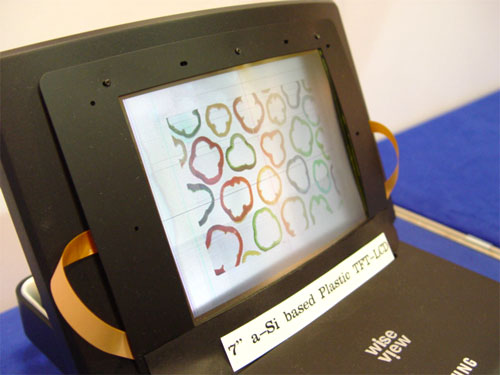
Samsung Electronics has created a flexible LCD screen that measures 7 inches diagonally, another technology that may one day be used in products such as e-books.
The display is functionally similar to the LCD (liquid crystal display) panels used inside TVs and notebooks, but with a crucial difference. Instead of containing glass substrates, the screen features a substrate of flexible plastic, allowing the display to bend. The plastic will not break when flexed, according to Samsung, and its pliancy paves the way for flexible color screens.
Wednesday, November 23, 2005
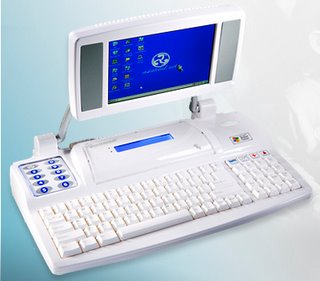
iT is a compact, ultra-simple, portable desk top computer complete with everything necessary to connect to the Internet, home entertainment devices, printer, USB card reader for reading the memory cards of digital cameras and many other USB peripherals.
It has been developed, designed and manufactured to be distributed free in order to enhance the lives of the millions of people in the world who - for economic reasons - are not connected to the Internet. A way to move them out of the digital underclass.
Why free, you may ask? There are 14 "hotkeys" on the keyboard, and every time you press one, you'll be directed to a different sponsor's website.
Tuesday, November 22, 2005
EDUCAUSE study on students and IT
The EDUCAUSE Center for Applied Research (ECAR) has made available its 2005 study on students and information technology. Here's the link to the PDF.
The title is: ECAR Study of Students and Information Technology: Convenience, Connection, Control and Learning.
The title is: ECAR Study of Students and Information Technology: Convenience, Connection, Control and Learning.
Library of Congress plans world digital library
Library of Congress plans world digital library: "The Library of Congress is kicking off a campaign on Tuesday to work with other nation's libraries to build a World Digital Library, starting with a $3 million donation from Google Inc."
Monday, November 21, 2005
RSS to SMS
immedi.at just went in to beta with their online service that allows you to subscribe to RSS feeds and receive pings to the Instant Messanger of your choice.
While most content might not be important enough to warrant subscribing to an RSS-to-SMS tool, getting to IM just might be more relevant, especially when you don't have the time to regularly check your RSS reader, but want to be notified when something of top importance happens.
immedi.at works with all major IM carriers including MSN Messenger, Yahoo Messenger, Google Talk, Jabber, and AIM/ICQ.
Use immedi.at to be notified instantly when:
* news on a certain topic is posted
* your competitor does something of interest
* something interesting happens with a favorite sports team
* your name or company is written about
* you receive new email
While most content might not be important enough to warrant subscribing to an RSS-to-SMS tool, getting to IM just might be more relevant, especially when you don't have the time to regularly check your RSS reader, but want to be notified when something of top importance happens.
immedi.at works with all major IM carriers including MSN Messenger, Yahoo Messenger, Google Talk, Jabber, and AIM/ICQ.
Use immedi.at to be notified instantly when:
* news on a certain topic is posted
* your competitor does something of interest
* something interesting happens with a favorite sports team
* your name or company is written about
* you receive new email
Thomson Gale adds Podcasts
Thomson has announced the addition of podcasts to various Gale InfoTrac databases.
To enable them to jump on the podcasting trend, Thomson is using the more liberal interpretation of the concept of "podcast" - meaning any online audio, as opposed to the stricter initial conception of the term, which is defined as a technology that allows users to subscribe to a set of feeds to listen to regularly updated syndicated audio Web content (pcwebopedia).
Podcast feeds are being added to the General Reference Center, Student Resource Center, Opposing Viewpoints Resource Center, History Resource Center, and more. Weekly presidential radio addresses by George W. Bush from January 2005 to the present will be podcast beginning November 8, 2005. New presidential radio addresses will be added weekly.
While this addition marks the first podcast ever loaded to Thomson Gale reference databases, the company says it will add more podcasts in the coming months.
To enable them to jump on the podcasting trend, Thomson is using the more liberal interpretation of the concept of "podcast" - meaning any online audio, as opposed to the stricter initial conception of the term, which is defined as a technology that allows users to subscribe to a set of feeds to listen to regularly updated syndicated audio Web content (pcwebopedia).
Podcast feeds are being added to the General Reference Center, Student Resource Center, Opposing Viewpoints Resource Center, History Resource Center, and more. Weekly presidential radio addresses by George W. Bush from January 2005 to the present will be podcast beginning November 8, 2005. New presidential radio addresses will be added weekly.
While this addition marks the first podcast ever loaded to Thomson Gale reference databases, the company says it will add more podcasts in the coming months.
TiVo to offer TV recordings transfer to iPod and PSP
TiVo today announced an enhancement to its current TiVoToGo feature that will allow TiVo subscribers to easily transfer recorded television programming to their iPod or PSP devices. The enhancement will include exclusive capabilities such as TiVo auto-sync that will allow subscribers to choose if they want new recordings of their favorite programs easily transferred to their portable devices via their PC. Every morning the devices can be loaded with new programs recorded the night before. TiVo said it plans to make the feature available to its entire standalone TiVo Series2 subscriber base as early as the first quarter of next year. Subscribers will need to purchase certain low-cost software to facilitate the transfer of content from the PC to these portable devices.
Map of Public Libraries affected by Hurricanes
This map presents information on the libraries that were substantially damaged by hurricanes Katrina and Rita. Libraries with minor damage are not included. The Map
Friday, November 18, 2005
It's Good To Be An RFID Vendor
As this article from Internet News indicates, it’s good to be in the RFID business these days. Beginning on New Year’s Day, Wal-Mart is requiring that their suppliers must tag their goods before they hit their stores. And of course, those suppliers will be seeking out vendors to help them tag these goods. In addition, the Department of Defense is requiring the tagging of all supplies (except liquids) bound for Iraq. Again, vendors have a major business opportunity here. Simply put, RFID technology has been gathering steam and should be a major technology to follow in 2006.

Thursday, November 17, 2005
First album to be released in flash memory format only
As flash memory falls in price and as we all become more accustomed to buying music in digital format, Barenaked Ladies is releasing BARENAKED ON A STICK! ... a USB flash memory drive containing songs, videos, and exclusive content from the Barenaked Ladies, and will go on sale November 22, 2005! Essential for any BNL fan's collection, the 128mg USB flash memory drive (about the size of your pinky finger) is a fast and easy way to share music, videos, pictures and other data. It is PC/Mac compatible, re-usable and incredibly low priced at $29.98 (close to the same cost of the device on its own with no special content). It will be available on Amazon.com and Werkshop.com (Nettwerk's online merchandise store), and will also be sold at all BNL shows this winter.
Can audiobooks and other digital content be far behind?
Can audiobooks and other digital content be far behind?
Sherlock Holmes serialized as originally published in The Strand

Stanford is republishing several of the Sherlock Holmes stories in serial installments as they originally appeared printed and illustrated in "The Strand" magazine. You can subscribe to get them either as paper copies or electronically, and either way is completely free. It starts in January, but you signups are open now. Here is the site.
Monday, November 14, 2005
AOL unveils free Web TV
Time Warner Inc.'s AOL said on Monday it planned to launch a free Internet television service by early 2006, in one of the technology and media industry's most ambitious designs to reach TV viewers online.
Yahoo and Google threaten to bypass traditional media outlets by linking computer users with TV shows online, striking partnerships with programmers or creating content. What they lack AOL now possess in abundance -- the shows themselves.
Yahoo and Google threaten to bypass traditional media outlets by linking computer users with TV shows online, striking partnerships with programmers or creating content. What they lack AOL now possess in abundance -- the shows themselves.
In its first year, in an exclusive deal, the advertising-supported service, In2TV, will feature approximately 3,400 hours of programming from 4,800 episodes spanning 100 series of Warner Bros.-produced shows from the past.
They include past prime time hits "Welcome Back Kotter," "Growing Pains" and "Kung Fu" organized under six channels divided by comedy, drama, animation, action, classic and superhero/villain genres. Two more channels may launch in 2006.
Over time, Warner Bros. could add up to 14,000 episodes from 300 series it has cleared with rights holders, executives said. AOL is also in talks with "every major provider" to offer shows not owned by Time Warner, Kevin Conroy, executive vice president of AOL media networks said in an interview.
Thursday, November 10, 2005
Study: teenagers favor IM to e-mail
Instant messaging is emerging as a favorite communication tool among teenagers and young adults, with a good number of them sending more IMs than e-mails, a new survey says.
Nearly 66 percent of 13- to 21-year-olds say they send more IMs than e-mails, compared with 49 percent last year, according to an America Online-commissioned study of instant messaging trends.
Overall, 38 percent of users say they send as many or more IMs than e-mails.
IM is getting popular at work as well, with 58 percent of people using it to communicate with colleagues; 49 percent for getting answers and making business decisions. And some are also using it to deal with clients or "to avoid a difficult in-person conversation." A majority of users at work, 77 percent, feel instant messaging has had a positive effect on their work lives. About 13 percent say they have their IM screen name printed on their business card.
Full Article
Nearly 66 percent of 13- to 21-year-olds say they send more IMs than e-mails, compared with 49 percent last year, according to an America Online-commissioned study of instant messaging trends.
Overall, 38 percent of users say they send as many or more IMs than e-mails.
IM is getting popular at work as well, with 58 percent of people using it to communicate with colleagues; 49 percent for getting answers and making business decisions. And some are also using it to deal with clients or "to avoid a difficult in-person conversation." A majority of users at work, 77 percent, feel instant messaging has had a positive effect on their work lives. About 13 percent say they have their IM screen name printed on their business card.
Full Article
Load Content into iPod without a Computer
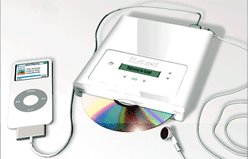
From Gizmodo:
Aren't we all past the point where we need to rip our CDs? The whole "Rip, Mix, Burn" era peaked in 2002 and anyone with CDs at this point should probably just keep listening to the Technics 100-disk changer and give it up. Anyway, the iLoad is a little thingie that rips CDs to your iPod. I'm thinking this is a proof-of-concept patent thing for future lawsuits—"PATENT 1,100,033,032,095 - A device that removes data from compact disks and transfers it to a portable music player"— but we'll see what comes of it. No specs or info yet, just a "Spam me" link.
Wednesday, November 09, 2005

From:"It's All Good"
Amazon Shorts are short literary works available for purchase--49 cents!--from well-known authors that have never been published anywhere else--and won't be for at least 6 months according to the FAQ. Amazon made a foray into original content a year or so ago when they showed made-for-Amazon short films over a period of weeks. With Amazon Shorts, the line between content seller and publisher just got a lot fuzzier.
In the FAQ:
What types of material can I list as an Amazon Short?
Any previously unpublished short-form work (2,000 - 10,000 words, fiction or nonfiction) you've created that your readers would find interesting. An Amazon Short could be a single short story, an update on a well-loved character, a compelling speech, additional material that enriches your published works, or even your commentary on your work or other subjects. Some authors have chosen to treat this as a "laboratory" for experimentation with new genres, themes, etc. We are open to creative ideas for new work.
This will drive collection development librarians nuts...
Tuesday, November 08, 2005
CBS, NBC To Launch 99-Cent On-Demand TV
LOS ANGELES (Hollywood Reporter) - A pair of separate deals announced Monday between CBS and Comcast, as well as NBC Universal and DirecTV, soon will allow viewers to pay to watch current primetime broadcast hits just hours after they air for free.
CBS and NBC will be charging 99 cents per episode to access such series as "CSI: Crime Scene Investigation" and the "Law & Order" spinoffs putting a twist on the traditional TV business model that will have untold implications for industry sectors ranging from affiliates to advertisers for years to come.
While unprecedented in the multichannel world, the new window became a hot commodity once Apple Computer Inc. and Walt Disney Co. made series programming like "Lost" available on video iPods last month. Having missed the first wave in the sea change transforming how viewers watch TV, Monday's deals are probably just the first of many that will put programming on as many different screens as possible, including mobile phones.
"As with the Disney iPod deal, I think this deal is symbolic of the new age," said Leslie Moonves, co-president and chief operating officer of Viacom Inc. and chairman of CBS.
CBS and NBC will be charging 99 cents per episode to access such series as "CSI: Crime Scene Investigation" and the "Law & Order" spinoffs putting a twist on the traditional TV business model that will have untold implications for industry sectors ranging from affiliates to advertisers for years to come.
While unprecedented in the multichannel world, the new window became a hot commodity once Apple Computer Inc. and Walt Disney Co. made series programming like "Lost" available on video iPods last month. Having missed the first wave in the sea change transforming how viewers watch TV, Monday's deals are probably just the first of many that will put programming on as many different screens as possible, including mobile phones.
"As with the Disney iPod deal, I think this deal is symbolic of the new age," said Leslie Moonves, co-president and chief operating officer of Viacom Inc. and chairman of CBS.
Monday, November 07, 2005
Author John Fowles dead

BRITISH novelist John Fowles, author of The French Lieutenant's Woman and The Magus, has died aged 79, his publisher said overnight.
"He died at the weekend. He had been ill for some time," said a spokeswoman at his publishers, Jonathan Cape.
Fowles, a novelist for more than 40 years, won international acclaim with publication in 1969 of The French Lieutenant's Woman, a vivid Victorian pastiche that was later turned into a critically acclaimed film with Meryl Streep and Jeremy Irons.
Fowles worked as a teacher before turning to writing full-time.
His first novel in 1963 was The Collector about a young butterfly collector who kidnaps a young woman.
Among his other successful books was the 1960s cult novel The Magus, a complex and disturbing tale set on a Greek island.
Penguin Books begin PodCasting

Welcome to the first ever Penguin podcast, with extracts, news and information from the best authors and books around.
In this issue we'll bring you Jamie Oliver chewing over the history of English cuisine, the authors of Freakonomics on how to choose (or how not to choose!) your baby's name, an extract of Zadie Smith's new bestseller On Beauty and music from Penguin Remixed.
Yahoo, TiVo to connect services

Starting today, consumers will be able to schedule recordings of TV shows on their TiVo box from a special Yahoo portal, the companies have announced. Subscribers would need a valid Yahoo account with a yahoo.com e-mail address as well as a valid TiVo user account.
Additional content sharing between Yahoo and TiVo, such as traffic, weather and user photos, is almost assured before the year is out, according to Associated Press reports.
Microsoft and Amazon join book digitization movement
Microsoft To Digitize 100,000 Books: "Software giant Microsoft Corp. said Friday it has signed a deal to scan and put online 100,000 books from the British Library."
Amazon to sell chapters of books: "Online retailer Amazon.com has unveiled 'two innovative programmes' to allow readers to access parts of books rather than buying the complete work."
Amazon to sell chapters of books: "Online retailer Amazon.com has unveiled 'two innovative programmes' to allow readers to access parts of books rather than buying the complete work."
Thursday, November 03, 2005

Writeboard is an on-line tool that lets you create web-based text documents, save every edit, roll back to any version and easily compare changes. You can use Writeboard alone or collaboratively. The cool part is that it creates an RSS feed for each document and then delivers document changes to your RSS Reader, thus giving you great control over document versioning.
Monday, October 31, 2005
E Ink debuts 10" flexible e-Paper
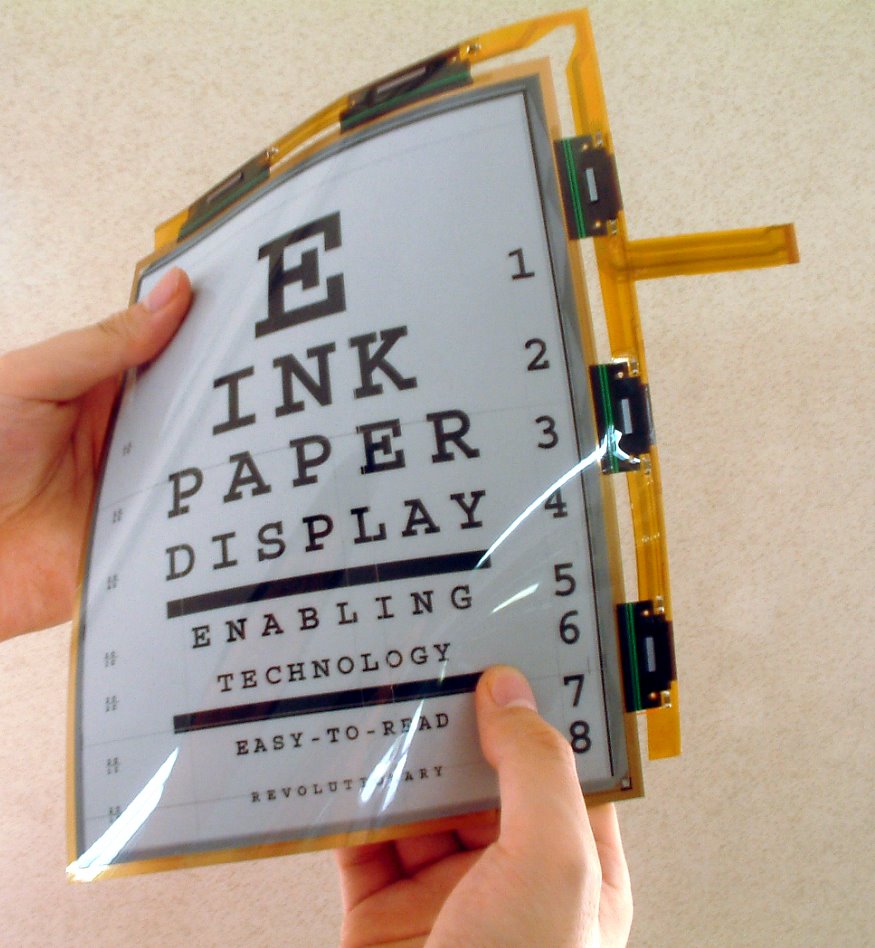
Tokyo, Japan - October 19, 2005 - E Ink Corporation in USA, the leading supplier of electronic paper display technology, today announced that LG.Philips LCD (NYSE: LPL, KRX: 034220), one of the world's leading innovators of thin-film transistor liquid crystal (TFT-LCD) technology, and E Ink have built a 10.1" flexible electronic paper display. The display will be shown at the FPD International trade show in Japan, attended by over 60,000 visitors each year.
Less than 300 microns thick, the paper-white display is as thin and flexible as construction paper. With a 10.1" diagonal, the prototype achieves SVGA (600x800) resolution at 100 pixels per inch and has a 10:1 contrast ratio with 4 levels of grayscale.
E Ink® Imaging Film is a novel display material that looks like printed ink on paper and has been designed for use in paper-like electronic displays. Like paper, the material can be flexed and rolled. As an additional benefit, the E Ink Imaging Film uses 100 times less energy than a liquid crystal display because it can hold an image without power and without a backlight.
LG.Philips LCD and E Ink selected a steel foil material that could be supplied by Sumitomo Corporation in high volume and which was developed by Nippon Steel Corporation (5401.JP), the leading steel company in Japan. The flexible foil is a super-thin, extremely flat, high-performance steel that can easily withstand the high temperatures of a TFT production process.
LG.Philips LCD combined both materials to manufacture the display panel at an existing pilot TFT line in Korea. LG.Philips and E Ink jointly designed the display electronics and produced the final prototype to achieve the world's largest high-resolution flexible electronic paper display.
”We all need flexible displays,“ said Russ Wilcox, CEO of E Ink, ”They are 80% thinner and lighter than glass displays, and they do not break like glass displays. You can roll them up and put them in your pocket. You can curve them around the outside of a cellphone. Or you can throw them in your briefcase like a newspaper. As Galileo famously told us, the world is not flat.“
Making Visible the Invisible at Seattle Public Library

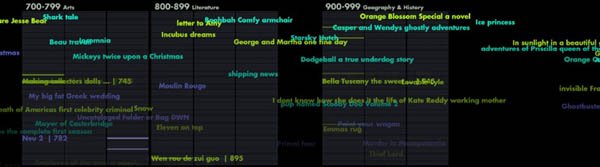
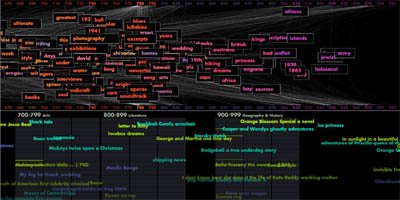

The circulation of checked out books and media transforms the library into a data exchange center. This flow of information can be calculated mathematically, analyzed statistically and represented visually. From a cultural perspective, the result may be a good indicator of what the community of patrons considers interesting information at any specific time. Visualizing the statistical information of the titles and their categories therefore provides a real-time living picture of what the community is thinking.
“Making Visible the Invisible” is an installation consisting of 6 large LCD screens located on a glass wall horizontally behind the librarians’ main information desk in the Mixing Chamber of the Seattle Central Library, a large open 19,500 sq ft space dedicated to information retrieval and public accessible computer research.
The screens feature real-time calculated animation visualizations generated by custom designed statistical and algorithmic software using data received each hour. This data consists of a list of checked-out items organized in chronological order. The item may be a book, a DVD, a CD, a VHS tape, etc. and from the list we can collect and aggregate titles, checkout time, catalog descriptors such as keywords, Dewey classification code if they are non-fiction items. There are approximately 36000 items circulating per day. Items with Dewey Decimal System labels provide for a way to get a perspective on what subject matters are of current interest at any given time as the Dewey system classifies all items according to 10 major categories: 000 Generalities; 100 Philosophy & Psychology; 200 Religion; 300 Social Science; 400 Language; 500 Natural Science & Mathematics; 600 Technology & Applied Sciences; 700 Arts; 800 Literature; 900 Geography & History. These are then subdivided into 100 segments. There are 4 visualizations at this time.
Google throws bodies at OpenOffice
With rival Microsoft in mind, Google plans to hire programmers to improve OpenOffice.org, a demonstration of its affinity for open source initiatives and one the company believes also shows sound practical sense.
OpenOffice has its roots in Sun Microsystems' StarOffice suite of programs. Five years ago, Sun turned its proprietary software into an open-source project. Only recently, however, has the competitor to Microsoft's Office attracted serious attention.
Now Google believes it can help OpenOffice--perhaps working to pare down the software's memory requirements or its mammoth 80MB download size, said Chris DiBona, manager for open-source programs at the search company.
OpenOffice has its roots in Sun Microsystems' StarOffice suite of programs. Five years ago, Sun turned its proprietary software into an open-source project. Only recently, however, has the competitor to Microsoft's Office attracted serious attention.
Now Google believes it can help OpenOffice--perhaps working to pare down the software's memory requirements or its mammoth 80MB download size, said Chris DiBona, manager for open-source programs at the search company.
Thursday, October 27, 2005
Sprint to roll out national WiMax network

Sprint intends to deploy a national, non-fixed WiMax network with as much, if not more coverage than the existing CDMA network. WiMax will effectively act as a replacement to CDMA data, providing FIOS-like speeds via massive towers that resemble TV towers in major cities.
This will enable Sprint to not only be a national ISP, but to remove common conceptions of fixed ISP. The WIMax modem technology Sprint is attempting to deploy will ensure that a broad range of WiMax devices will share an account... for example, WiMax deployments could fit in a PDA that would share bandwidth allocations with home internet that would share bandwidth allocations with your HDTV.
Sprint intends to compete directly with Cable, Satellite, ISPs, and traditional Wireless. By bundling all telecommunication services ever envisioned, Sprint will tackle everyone by offering everything.
Spray-on Computers

Spray on nano-computers could be the wave of the future. Scientists at several universities in Scotland are starting research on “Specks”, tiny nano-computers the size of a grain of sand. When put together, these “Specks” can combine to form programmable wireless networks that can communicate with each other, and with outside networks.
The coolest part, though, could be the potential to use an ordinary spray can to spread the “Specks” onto a surface. Although these nano-computers may not have a great deal of promise for the average consumer, imagine the promise this could have for businesses such as healthcare, automotive and construction just to name a few. For example, they could be used as lighting and temperature sensors in buildings, placed in aircraft wings to detect failures or used to sensitise medicine bottles to ensure that people take their prescribed medication at the correct times.
Wednesday, October 26, 2005
Publishers to build own online book network
It was only matter of time, really...
Reuters article available here.
German publishers, keen to defend their copyrights as Internet search engines seek to put the world's literature online, aim to set up their own Web-based database allowing readers to browse, borrow or buy books.
Reuters article available here.
Study Guides Come to iPod

iPreppress on Wednesday announced a collaboration with SparkNotes to bring 11 study guides of classic American and British literature to the iPod. They’re priced at US$4.95 each.
Aimed at high school and college students, study guides include The Adventures of Huckleberry Finn, The Catcher in the Rye, the Great Gatsby, Hamlet, To Kill a Mockingbird, Lord of the Flies, The Odyssey, Pride and Prejudice, Romeo and Juliet, the Scarlet Letter and A Tale of Two Cities.
The study guides feature the same content as SparkNotes study guides, including context, plot overview, summary and analysis, and more. What’s more, the study guides include quizzes and audio hyperlinks.
The content works with video-capable iPod, iPod nano, iPod photo and third-generation iPod and higher and iPod mini models.
DVDs vanish off library shelves
Thieves in Gwinnett County have lifted enough DVDs from public library shelves to fill more than two video stores and wipe out nearly half the system's collection.
The thefts got so bad — nearly 17,000 discs in all — the library board quietly shut down the 5-year-old program last month and began selling off the remaining inventory.
McCloy and others want the program back. But the library board isn't likely to relent.
"The economics don't add up right now," English said.
The lost discs have already cost the taxpayer-funded library system about $250,000, administrators estimated. They say better DVD security would cost at least $150,000 a year, money the system can't afford for a collection that accounts for less than 4 percent of all checkouts.
Gwinnett's collection included only children's titles, such as those featuring Barney and Wiggles, and educational selections from producers like National Geographic. The only feature-length movies were "Cinderella" and similar titles.
Librarians first started noticing DVDs were missing a couple of years ago. Parents arrived home from the library with DVD cases that turned out to be empty. Or DVDs would be missing from shelves, even though the library's computer system showed they had not been checked out.
Library workers didn't catch on to the scope of the problem until early 2004. A routine inventory showed the DVDs were missing at a higher rate than books, CDs, magazines and other materials.
Suspicious, administrators called the system's 12 branches and asked librarians to look inside the cases to see if they still contained discs. Many were empty.
In all, thieves made off with 44 percent of the system's roughly 39,000 DVDs. Theft rates for other types of materials, such as books, are less than 2 percent, marketing director Cindy Murphy said.
The thefts got so bad — nearly 17,000 discs in all — the library board quietly shut down the 5-year-old program last month and began selling off the remaining inventory.
McCloy and others want the program back. But the library board isn't likely to relent.
"The economics don't add up right now," English said.
The lost discs have already cost the taxpayer-funded library system about $250,000, administrators estimated. They say better DVD security would cost at least $150,000 a year, money the system can't afford for a collection that accounts for less than 4 percent of all checkouts.
Gwinnett's collection included only children's titles, such as those featuring Barney and Wiggles, and educational selections from producers like National Geographic. The only feature-length movies were "Cinderella" and similar titles.
Librarians first started noticing DVDs were missing a couple of years ago. Parents arrived home from the library with DVD cases that turned out to be empty. Or DVDs would be missing from shelves, even though the library's computer system showed they had not been checked out.
Library workers didn't catch on to the scope of the problem until early 2004. A routine inventory showed the DVDs were missing at a higher rate than books, CDs, magazines and other materials.
Suspicious, administrators called the system's 12 branches and asked librarians to look inside the cases to see if they still contained discs. Many were empty.
In all, thieves made off with 44 percent of the system's roughly 39,000 DVDs. Theft rates for other types of materials, such as books, are less than 2 percent, marketing director Cindy Murphy said.
Tuesday, October 25, 2005
Google Database Service

Apparently this will be debuted at Google's invite only Zeitgeist conference today. Philipp has more.
Interesting "Browse" of Amazon Books!
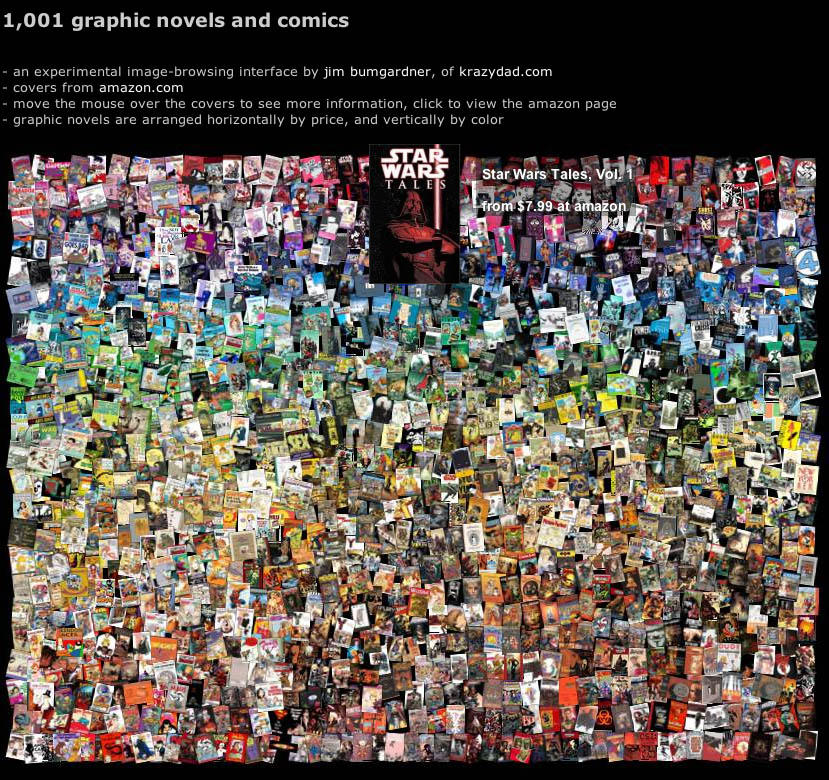
An experimental image-browsing interface by jim bumgardner, of krazydad.com displays book covers from amazon.com. Move your mouse over the covers to see more information, click to view the amazon page. The graphic novels are arranged horizontally by price, and vertically by color. Cool!
Monday, October 24, 2005
Study: iPod users are prolific influencers

And we’re better looking, too.
Market research firm Intelliseek reports that iPod users are among the most likely on the Internet to create and spread consumer-generated media. The company also thinks this will increase with the proliferation of Apple’s new video-enabled iPod hardware.
iPod users are twice as likely to have authored a weblog than consumers who don’t have MP3 players, according to Intelliseek’s 2005 Consumer-Generated Media and Behavior Study.
Intelliseek also reports that iPod users are 2.5 times as likely to exchange text messages on cell phones, three times as likely to take photos with a camera phone, and three times as likely to download video clips and movies to their computer. They’re more likely to own Digital Video Recorders (DVRs), PDAs, digital cameras, laptops and cell phones, too.
The study looked at the habits of 660 online consumers and was conducted in August, 2005. The full study — which focuses on all consumer generated media, not just that which is iPod-related — will be released in November.
Stanford and Apple Present "Stanford on iTunes"
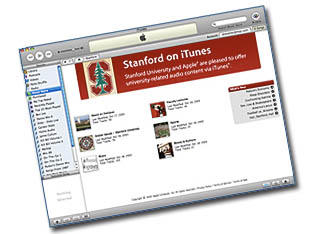
Stanford University is making hundreds of Stanford podcasts available free to anyone through iTunes Music Store. The podcasts include lectures by the university's professors, music from its students, and play-by-play descriptions of its football games.
Check it out!
Stanford on iTunes
Friday, October 21, 2005
ALA 2006 to be in New Orleans
The following statement has been issued by American Library Association (ALA) President Michael Gorman:
"We realize that many sections of the city, and particularly the Ninth Ward, have suffered tragic damage, and that many New Orleans residents have lost their homes forever. If we truly care about the residents of New Orleans, however, the best thing that the association and its members can do is to go to New Orleans and lead the reconstruction by example. Our conference will help to provide the jobs and tax revenues needed if residents are to reestablish their lives and for the city to fully restore services, including library services. We speak often of how libraries build communities, and we now have chance to show the country and world that librarians build communities, too.
I hope that you will join me in New Orleans. I am certain that we will have an extraordinarily productive and enjoyable conference, as we enjoy the welcome and celebrate the rebirth of a city we all love."
World Usability Day
November 3, 2005 is World Usability Day (WUD), an event that will spread the word about making products and services easier to use:
http://www.worldusabilityday.org
Part of WUD will be the Accessibility Channel -- an exciting, 24-hour global conversation about accessibility and usability:
http://www.inclusive.com/WUD_access
From World Usability Day (WUD) website:
http://www.worldusabilityday.org
Part of WUD will be the Accessibility Channel -- an exciting, 24-hour global conversation about accessibility and usability:
http://www.inclusive.com/WUD_access
From World Usability Day (WUD) website:
* On November 3,2005, people in more than 80 locations, and 30 countries around the world will celebrate World Usability Day. The theme is "Making It Easy!"
* Every citizen and customer has a right to expect products and services that are easy to use. World Usability Day events will highlight how this can be achieved.
* From cell phones, to call centers, to customer service websites and more, there are countless opportunities to "Make It Easier to Use."
* World Usability Day events are designed increase awareness of every citizen's and customer's right to expect things that work right. Events will also emphasize the responsibility to drive the development of usability improvements.
Thursday, October 20, 2005
Cellphones learn to recognize their owners' faces

Oki Electric Industry Co. Ltd. this week began marketing a technology that inexpensively adds face recognition to camera-equipped cellphones. Oki's "Face Sensing Engine" (FSE) "middleware" decodes facial images within 280mS on a 100MHz ARM9 processor, and can restrict access to mobile devices by recognizing their owners, the company says.
Oki says its FSE technology can help protect sensitive personal information such as phone numbers and email addresses from unwanted access, in the event of loss or theft of a mobile device. The use of face recognition, based on the mobile device's built-in digital camera, eliminates the need for users to enter passwords to use their devices, and provides a faster and more natural method of authentication. Oki points out.
FSE can acquire facial images from within a larger image. It works by locating and mapping key facial features -- such as eyes, eyebrows, and mouth -- and adapts to changing facial conditions such as winking and smiling, according to Oki.
Oki lists the following key features of its FSE technology:
- Compact system footprint -- requires approximately 260KB on an ARM9 processor
- Fast image processing -- requires approximately 280mS on a 100MHz ARM9 processor
- Face recognition algorithm automatically adjusts to ambient lighting conditions
- Supported processor architectures -- ARM9, SH Mobile, and others
- Supported software platforms -- Symbian, uITRON, Linux, BREW, WIPI, Windows, Solaris, and others
Humorous slipcovers for books

Flapart sells funny book-covers to wrap around your reading material to impress strangers on the subway. Covers include "Coroner by Correspondence" and "Fast Track to Prison - Exploring the Many Benefits of Life Behind Bars." LINK
Google sued by Association of American Publishers
The Association of American Publishers (AAP) today announced the filing of a lawsuit against Google over its plans to digitally copy and distribute copyrighted works without permission of the copyright owners. The lawsuit was filed only after lengthy discussions broke down between AAP and Google’s top management regarding the copyright infringement implications of the Google Print Library Project.
The suit, which seeks a declaration by the court that Google commits infringement when it scans entire books covered by copyright and a court order preventing it from doing so without permission of the copyright owner, was filed on behalf of five major publisher members of AAP: The McGraw-Hill Companies, Pearson Education, Penguin Group (USA), Simon & Schuster and John Wiley & Sons.
The suit, which seeks a declaration by the court that Google commits infringement when it scans entire books covered by copyright and a court order preventing it from doing so without permission of the copyright owner, was filed on behalf of five major publisher members of AAP: The McGraw-Hill Companies, Pearson Education, Penguin Group (USA), Simon & Schuster and John Wiley & Sons.
Friday, October 14, 2005
Latest ePaper entry
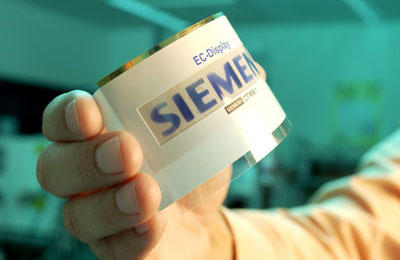
Latest to show their own ultrathin display solution is Siemens, who claims their new color screens are quite actually paper thin, and that they actually cost relatively little to manufacture—$52 US per square meter. That’s still a bit much for newspaper use, of course, so it looks like they want us to hold out until 2007 on this one, when they suppose it’ll be a little more affordable in mass market pricing.
Wednesday, October 12, 2005
Google's Librarian Center
Librarians and Google share a mission: to organize the world's information and make it universally accessible and useful. We support librarians like yourself who work each day to further that mission. This page is a first step toward improving and expanding that support.
Check it out:
http://www.google.com/services/librarian_center.html
Average age of newspaper readers: 55
Newspaper readership is down. Fewer young people are picking them up, and the average age of a newspaper reader is now 55, according to a Carnegie Corporation study. Many papers have been losing circulation at alarming rates across all age groups.
Link to article.
Link to article.
OCLC's Presentation/Publication Bank
A handy collection of conference presentations and publications on library/information science subjects.
Japanese restaurants introduce RFID Payment System
Beef Bowl Chain Nakau introduced an RFID-based Payment System (JCB's QuickPay) on October 5. Customers can just show their RFID-chipped wallet phones to a paymenet machine to quickly pay for their meals. They are likely the first Beef Bowl Restaurant Chain to introduce RFID payment.
Beef bowls are one of the most popular fast food in Japan and they cost around $5.
Beef bowls are one of the most popular fast food in Japan and they cost around $5.
Tuesday, October 11, 2005
Beloit College Student Mindset Lists
In the coming weeks, millions of students will be entering college for the first time. On average, these members of the Class of 2009 will be 18 years old, which means they were born in 1987. Starbucks, souped-up car stereos, telephone voicemail systems, and Bill Gates have always been a part of their lives.
Each August, as students start to arrive, Beloit College releases the Beloit College Mindset List, which offers a world view of today's entering college students. It is the creation of Beloit’s Keefer Professor of the Humanities Tom McBride and Director of Public Affairs Ron Nief.
For the class of 2008:
75 more...and links to seven other class "Mindsets"
Each August, as students start to arrive, Beloit College releases the Beloit College Mindset List, which offers a world view of today's entering college students. It is the creation of Beloit’s Keefer Professor of the Humanities Tom McBride and Director of Public Affairs Ron Nief.
For the class of 2008:
1. Andy Warhol, Liberace, Jackie Gleason, and Lee Marvin have always been dead.
2. They don't remember when "cut and paste" involved scissors.
3. Heart-lung transplants have always been possible.
4. Wayne Gretzky never played for Edmonton.
5. Boston has been working on the "The Big Dig" all their lives.
75 more...and links to seven other class "Mindsets"
Stealth Surfer USB Flash Drive

This is a product that caters to the extremely paranoid, but nevertheless it is a pretty good idea. StealthSurfer is a Windows PC compatible key-sized USB device that is preloaded with Firefox, Anonymizer, RoboForm, and Thunderbird software configured and integrated for optimum privacy. When using StealthSurfer, all your sensitive Internet files such as cookies, history, and cache are stored on the StealthSurfer device instead of your computer.
A Comprehensive Privacy Solution – ALL integrated under one hood! Preloaded with:
- Firefox - high-speed browser with enhanced security
- Anonymizer - anonymous surfing complete network security and IP masking
- RoboForm - one-click form-fill with secure user ID/password management application
- Thunderbird - portable e-mail accessHushmail - high security web based e-mail solution
Monday, October 10, 2005
Digital Divisions
There are clear differences among those with broadband connections, dial-up connections, and no connections at all to the internet
Sixty-eight percent of American adults, or about 137 million people, use the internet, up from 63% one year ago. Thirty-two percent of American adults, or about 65 million people, do not go online, and it is not always by choice. Those who are currently offline have had varying levels of exposure to the online world. One in five American adults say they have never used the internet or email and do not live in an internet-connected household. At the other end of the spectrum, 53% of home internet users have high-speed access, creating a new divide among internet users.
Pew Report Link
Sixty-eight percent of American adults, or about 137 million people, use the internet, up from 63% one year ago. Thirty-two percent of American adults, or about 65 million people, do not go online, and it is not always by choice. Those who are currently offline have had varying levels of exposure to the online world. One in five American adults say they have never used the internet or email and do not live in an internet-connected household. At the other end of the spectrum, 53% of home internet users have high-speed access, creating a new divide among internet users.
Pew Report Link

The Lulu Blooker Prize is the world's first literary prize devoted to "blooks": books based on blogs or websites. Awarded in three categories:Fiction, Non-Fiction and Comics.
Blooks are the world's fastest-growing new kind of book and an exciting new stage in the life cycle of content, if not a whole new category of content. Learn more
The Lulu Blooker Prize is sponsored by Lulu, the world's fastest-growing provider of print-on-demand books, including an increasing number of blooks. However, the judges of the short-listed books are independent of Lulu and no favor will be shown to books published on Lulu.
Thursday, October 06, 2005
Google formally declares war on Microsoft
GOOGLE HAS confirmed that it will launch free spreadsheet and word-processing software online and take on Microsoft in one of its biggest markets.
Under the deal, Google will allow web users to access Sun's OpenOffice from a toolbar.
The other day, when Sun's Scott McNealy and his former employee now Google chief Eric Schmidt met up, Sun was wary about doing that.
When asked point blank, McNealy said it was something to be investigated. However Sun's Australian spokesman Paul O'Connor was a little more forthright about the deal which he said was "huge".
He bubbled that the deal was a wake-up call for Microsoft.
"At the moment most people are used to having to pay for software packages, but at the end of the day, the value is in the content and services – not in the software itself," he said.
More at the Brisbane Courier Mail, here.
Under the deal, Google will allow web users to access Sun's OpenOffice from a toolbar.
The other day, when Sun's Scott McNealy and his former employee now Google chief Eric Schmidt met up, Sun was wary about doing that.
When asked point blank, McNealy said it was something to be investigated. However Sun's Australian spokesman Paul O'Connor was a little more forthright about the deal which he said was "huge".
He bubbled that the deal was a wake-up call for Microsoft.
"At the moment most people are used to having to pay for software packages, but at the end of the day, the value is in the content and services – not in the software itself," he said.
More at the Brisbane Courier Mail, here.
Retired Librarian Wins $1.6 million on slot machine

Jacquelyn Sherman had not had much luck since Hurricane Katrina sent her fleeing from her New Orleans home.
That changed on Tuesday, when the money flooded in.
The 57-year-old retired librarian won $1.6 million playing the slot machine at Evangeline Downs in Opelousas, Louisiana.
Said Ms. Sherman, "You just don't realize what done happened until the person next to you hits you and says, Well, you done did it."
LINK to article.
Wednesday, October 05, 2005

Tuesday, October 04, 2005
America's Fall in R&D: "Nobody Cares"
From "Business Week" via Greg Lee:
There's a major university in the [San Francisco] Bay Area that you would have thought was one of the best-funded universities in the world. And one of our fellows at National is a professor there. And he said they just got a new gift of a network analyzer from Agilent. It's worth about $110,000 and they put it on a metal cart, and professors will hide it away and hoard it. And to use it, you have to sign up for it days in advance, and they roll it around from lab to lab.
And then he was invited over to China to give a speech and was given a tour of Tsinghua University. And he was shocked and amazed that every lab had one of those very same Agilent network analyzers. Some of them had never been used or turned on, but they had them just in case they ever needed one. The funding is incredible, and meanwhile we're sitting here thinking we're doing fine.
LINK to article.
There's a major university in the [San Francisco] Bay Area that you would have thought was one of the best-funded universities in the world. And one of our fellows at National is a professor there. And he said they just got a new gift of a network analyzer from Agilent. It's worth about $110,000 and they put it on a metal cart, and professors will hide it away and hoard it. And to use it, you have to sign up for it days in advance, and they roll it around from lab to lab.
And then he was invited over to China to give a speech and was given a tour of Tsinghua University. And he was shocked and amazed that every lab had one of those very same Agilent network analyzers. Some of them had never been used or turned on, but they had them just in case they ever needed one. The funding is incredible, and meanwhile we're sitting here thinking we're doing fine.
LINK to article.
B&N, thanks in no small part to the seductive smell of coffee, has become the new public library.
Put it this way: When was the last time you couldn't find a seat at your local branch? When was the last time you went to the library on a Saturday night? For fun. Just to browse. Please, if you're that guy, don't write. It's OK. I'm sure there's someone out there for you.
In fact, public libraries are struggling in the Internet age when millions have easy access to information without leaving home or office. Having noticed the marketing success of Starbucks, some universities, and even a few high-school libraries, are now offering coffee. Vendors can be found in libraries at Virginia Commonwealth University, the University of Richmond, the University of Tennessee, the University of Pittsburgh and Auburn University, to name a few.
Students reportedly are clamoring for the library. Who'da thunk? Brew it and they will come.
LINK to article.
In fact, public libraries are struggling in the Internet age when millions have easy access to information without leaving home or office. Having noticed the marketing success of Starbucks, some universities, and even a few high-school libraries, are now offering coffee. Vendors can be found in libraries at Virginia Commonwealth University, the University of Richmond, the University of Tennessee, the University of Pittsburgh and Auburn University, to name a few.
Students reportedly are clamoring for the library. Who'da thunk? Brew it and they will come.
LINK to article.
Thursday, September 29, 2005
RSSor
In very very very beta, RSSor is a del.icio.us clone (seriously, look at it!) for feeds. The concept is interesting. Tag a feed and a unique page is created for the content for the feed (ie, the the "page" for Library Stuff content) You can then add blog posts to del.icio.us or Furl (I love that!), comment on each post post (which didn't seem to be working this morning [lots of other 404's on the site as well]).
One of the slickest aspects of RSSor is that the main site or your feed tags is an aggregator. Very neat and useful. I wonder how often the feeds update.
Again, this tool is in very early beta and needs to work out a bunch of kinks, but there are a few interesting pieces to it. Another similar to look at is Feed Maerker which has been in development for about a year. (link via Oishii)
Read more about it here
One of the slickest aspects of RSSor is that the main site or your feed tags is an aggregator. Very neat and useful. I wonder how often the feeds update.
Again, this tool is in very early beta and needs to work out a bunch of kinks, but there are a few interesting pieces to it. Another similar to look at is Feed Maerker which has been in development for about a year. (link via Oishii)
Read more about it here
Tuesday, September 27, 2005
Read on your iPod

iPodulator is a new web service that lets you convert a web page or RSS feed into the proper text format that can be transfered viewed on your iPod. The service works with 3G and 4G iPods and iPod minis.
“Enter a URL above (starting with http://) and hit ‘iPodinate.’ Some sites may not work, like Digg.com. It will take a moment to process. The URL can be a web page or an RSS feed. This will give you a plain text formatted version of the site you enter, perfect for reading on your iPod. Note: the page will look badly formatted on your computer. Don’t worry, it will look great on your iPod. To save it to your iPod: After hitting ‘iPodinate,’ use the ‘Save As’ command in your web browser to save this file to the ‘Notes’ folder of your iPod or save it to someplace on your computer for later copying to the ‘Notes’ folder. That’s it!”
Monday, September 26, 2005
Slawesome lets you send emails with your voice
Slawesome is voice for your email. It basically allows you to send voice mail (whether that’s love mail, hate mail, music mail or street noise - I don’t know what I’m talking about - mail) to any email address in the world. You have some vocal love that needs to be shared? Slawesome’s the tool for the job.
Friday, September 23, 2005
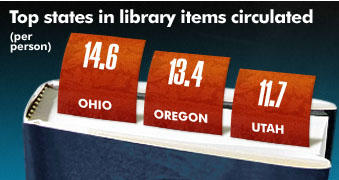
Microsoft's nightmare inches closer to reality
Yet another article
In an extensive memo called "The Web is the Next Platform" that was introduced as evidence in Microsoft's antitrust trial five years ago, Microsoft engineer Ben Slivka described a "nightmare" scenario for the software giant.
"The Web...exists today as a collection of technologies that deliver some interesting solutions today, and will grow rapidly in the coming years into a full-fledged platform (underlined for emphasis in the original memo) that will rival--and even surpass--Microsoft's Windows," Slivka wrote.
Microsoft, however, didn't heed the warning. Instead, it embarked on a strategy--championed by Jim Allchin, who today heads up development of the next version of Windows--that was fanatically focused on the operating system.
In an extensive memo called "The Web is the Next Platform" that was introduced as evidence in Microsoft's antitrust trial five years ago, Microsoft engineer Ben Slivka described a "nightmare" scenario for the software giant.
"The Web...exists today as a collection of technologies that deliver some interesting solutions today, and will grow rapidly in the coming years into a full-fledged platform (underlined for emphasis in the original memo) that will rival--and even surpass--Microsoft's Windows," Slivka wrote.
Microsoft, however, didn't heed the warning. Instead, it embarked on a strategy--championed by Jim Allchin, who today heads up development of the next version of Windows--that was fanatically focused on the operating system.
Google becoming a very real threat to Microsoft
Try imagining a future where developers will write to Web platforms without thinking about an individual computer or operating system. That once was Netscape's dream. If this does come to pass, Google could build an ecosystem around itself in much the same way Microsoft did with Windows. If Microsoft's latest moves can't clear out its corporate arteries, the future could be all Google, all the time.
Link to article.
Link to article.
Thursday, September 22, 2005
GoogleTV is hiring
Google is laying the groundwork to enter the TV business, judging from a job posting for a GoogleTV product manager.
Google's anticipated entry into TV land has been an evolving process, which has included the debut of a prototype earlier this year to search TV programming. And on Wednesday, Google's TV efforts were a topic of discussion on several blogs that pointed to the job posting on Google's site.
According to the posting, Google is looking for someone to help get its search and advertising technologies into products that enhance viewers' TV experience. Google said it is seeking someone to "identify key market trends that are shaping user behavior when watching television."
Google's anticipated entry into TV land has been an evolving process, which has included the debut of a prototype earlier this year to search TV programming. And on Wednesday, Google's TV efforts were a topic of discussion on several blogs that pointed to the job posting on Google's site.
According to the posting, Google is looking for someone to help get its search and advertising technologies into products that enhance viewers' TV experience. Google said it is seeking someone to "identify key market trends that are shaping user behavior when watching television."
Wednesday, September 21, 2005
Librarians Protected in Patriot Act Case
HARTFORD, Conn. -- A federal appeals court has ruled that the names of Connecticut librarians who had been asked to help in an FBI terrorism investigation under the Patriot Act will remain secret pending arguments from prosecutors.
The American Civil Liberties Union is seeking the identity of the librarians who received an FBI demand for records about library patrons.
On Tuesday, the U.S. 2nd Circuit Court of Appeals in New York put on hold a lower court's decision that had lifted a gag order shielding the identity of librarians.
U.S. District Court Judge Janet Hall in New Haven had ruled earlier this month in favor of the ACLU, which argued that the gag order prevented its client from participating in a debate over whether Congress should reauthorize the Patriot Act.
Prosecutors said the gag order prevented only the release of the client's identity, not the client's ability to speak about the Patriot Act.
Prosecutors also argued that revealing the identity of the librarians would be "an alarm bell" that could tip off suspects and jeopardize a federal investigation into terrorism.
Hall rejected many of the same FBI arguments in her ruling to lift the gag order.
"The government may intend the nondisclosure provision to serve some purpose other than the suppression of speech," Hall wrote. "Nevertheless, it has the practical effect of silencing individuals with a constitutionally protected interest in speech and whose voices are particularly important in an ongoing national debate about the intrusion of governmental authority into individual lives."
The Patriot Act, passed shortly after the Sept. 11 attacks, removed the requirement that the records sought be those of someone under suspicion. Now, anyone's records can be obtained if the FBI considers them relevant to a terrorism or spying investigation.
The American Civil Liberties Union is seeking the identity of the librarians who received an FBI demand for records about library patrons.
On Tuesday, the U.S. 2nd Circuit Court of Appeals in New York put on hold a lower court's decision that had lifted a gag order shielding the identity of librarians.
U.S. District Court Judge Janet Hall in New Haven had ruled earlier this month in favor of the ACLU, which argued that the gag order prevented its client from participating in a debate over whether Congress should reauthorize the Patriot Act.
Prosecutors said the gag order prevented only the release of the client's identity, not the client's ability to speak about the Patriot Act.
Prosecutors also argued that revealing the identity of the librarians would be "an alarm bell" that could tip off suspects and jeopardize a federal investigation into terrorism.
Hall rejected many of the same FBI arguments in her ruling to lift the gag order.
"The government may intend the nondisclosure provision to serve some purpose other than the suppression of speech," Hall wrote. "Nevertheless, it has the practical effect of silencing individuals with a constitutionally protected interest in speech and whose voices are particularly important in an ongoing national debate about the intrusion of governmental authority into individual lives."
The Patriot Act, passed shortly after the Sept. 11 attacks, removed the requirement that the records sought be those of someone under suspicion. Now, anyone's records can be obtained if the FBI considers them relevant to a terrorism or spying investigation.
Google to offer free Wi-Fi
Google, the online search leader, confirmed Tuesday it has begun a limited test of a free wireless Internet service, called Google WiFi.
The existence of the Wi-Fi service, which offers high-speed connections to the Internet over short distances, is confirmed by public pages on the company’s Web site and was first reported in a Silicon Valley newspaper in July.
Google spokesman Nate Tyler said the current test is limited to two public sites near the company’s Mountain View, California, headquarters -- a pizza parlor and a gym -- located in the heart of Silicon Valley.
“Google WiFi is a community outreach program to offer free wireless access in areas near our headquarters,” Tyler said.
“At this stage in development, we’re focused on collecting feedback from users. We’ll determine next steps as the product evolves,” he said.
Free wireless communications would take Google even further from its Internet search roots and move it into the fiercely competitive world of Internet access providers and telecommunications companies.
Tyler said the project was started as part of a Google engineer’s “20 percent time project.”
Google encourages its engineers to spend 20 percent of their work time developing independent projects. Several of Google’s new products have grown out of such projects, including Google News, contextual advertising program AdSense and social-networking test project Orkut.
The existence of the Wi-Fi service, which offers high-speed connections to the Internet over short distances, is confirmed by public pages on the company’s Web site and was first reported in a Silicon Valley newspaper in July.
Google spokesman Nate Tyler said the current test is limited to two public sites near the company’s Mountain View, California, headquarters -- a pizza parlor and a gym -- located in the heart of Silicon Valley.
“Google WiFi is a community outreach program to offer free wireless access in areas near our headquarters,” Tyler said.
“At this stage in development, we’re focused on collecting feedback from users. We’ll determine next steps as the product evolves,” he said.
Free wireless communications would take Google even further from its Internet search roots and move it into the fiercely competitive world of Internet access providers and telecommunications companies.
Tyler said the project was started as part of a Google engineer’s “20 percent time project.”
Google encourages its engineers to spend 20 percent of their work time developing independent projects. Several of Google’s new products have grown out of such projects, including Google News, contextual advertising program AdSense and social-networking test project Orkut.
Tuesday, September 20, 2005
10,000 Articles Not Found On Other Search Engines
From the site:


"FindArticles is focused on delivering the best and most essential search results. There are different kinds of searches. You can cast a wide net and see what you catch, but we believe there's a better way. Why not rely on credible, freely available information you can trust? By working with the best sources, we have assembled all the essential publications covering a wide range of subjects — and are continually adding to our collection.
Our publications and subjects are organized by major categories: Arts & Entertainment, Automotive, Business & Finance, Computers & Technology, Health & Fitness, Home & Garden, News & Society, Reference & Education, and Sports.
Discover exactly what you need at FindArticles, using either browsing or searching techniques. Select a specific publication up front, or start with a general search and then include or exclude publications. Insert new search terms as needed to pinpoint the most relevant results. Then sort results by article date, length, relevance or publication name. It's all very easy to do here.
FindArticles has articles from thousands of resources, with archives dating back to 1984. That means you get to search for exactly what you need, from millions of articles not found on any other search engine. Please think of us any time you want to Find Articles."
Tuesday, September 13, 2005
Libravox: acoustical liberation of books in the public domain = free audiobooks
LibriVox is an open source audio-literary attempt to harness the power of the many to record and disseminate, in podcast form, books from the public domain. It works like this: a book is chosen, then volunteers read and record one or more chapters. We liberate the audio files through this webblog/podcast every week. LibriVox is a VOLUNTEER project: if you have problems with the quality of a recording, get busy and make another one; If you wish to listen, please enjoy; if you wish to record, please contact librivox.
Friday, September 09, 2005
Cool New On Line Music Service
Thursday, September 01, 2005
Katrina's Impact on Libraries
From the American Library Association.
In the aftermath of Hurricane Katrina's August 29 landfall on the Gulf
Coast, the fate of many of the region's libraries is still uncertain.
American Libraries will post news of any library-related damage on an
ongoing basis as we learn of it. Watch this site for updates.
Houston (Tex.) Chronicle, August 31:
Craig Nocaise, 21, a police officer, waited out the storm inside the Pass
Christian (Miss.) Public Library, a branch of the Harrison County Library
System, with 12 other town police. They noticed about a dozen of their
police cars circling the building on a current of water. Then one crashed
through the front door. Water poured in and rose quickly. When the back
glass door wouldn't open, the officers pulled their guns and fired at least
50 rounds into it before it shattered. They each then grabbed a cable line
and climbed onto the roof, where they spent the next three hours in
130-mile-an-hour winds. "We lost every patrol car," said Nocaise. "We still
haven't found some. They're probably in the Gulf somewhere." Asked more
about the experience in the library, Nocaise choked up and walked away.
Baltimore (Md.) Sun, August 31:
In Gulfport, Mississippi, Katrina chewed up such everyday items as
furniture, computers, and a piano and spat them back onto the city's
crumbling streets and beaches. In what was once the public library, wet
books formed a mound of soggy pulp.
Biloxi (Miss.) Sun-Herald, August 29:
In Gulfport, windows were blown out and the business district was partially
underwater. The damage was described by Fire Chief Pat Sullivan as
"massive." Waves were breaking across U.S. 90 and there was water standing
in the Gulfport Library.
Biloxi (Miss.) Sun-Herald, August 30:
Beauvoir, the Jefferson Davis home in Biloxi: The bottom floor of the
Presidential Library and the home itself were gutted. A Confederate flag,
though, still draped over the arm of Davis's statue in the library.
Jackson (Miss.) Clarion-Ledger, August 31:
The University of Southern Mississippi, Alcorn State University, and Jackson
State University, as well as private Tougaloo College, remained without
power and communication access on Tuesday afternoon. On Tuesday at JSU,
students slept on makeshift beds in the student union and library, where
generators could provide light.
"I would say 90 percent of the structures between the beach and the railroad
in Biloxi, Gulfport, Long Beach, and Pass Christian are totally destroyed,"
Gov. Haley Barbour said Tuesday. "They're not severely damaged, they're
simply not there. . . . I can only imagine that this is what Hiroshima
looked like 60 years ago."
Cincinnati (Ohio) Post, August 31:
Kentucky Gov. Ernie Fletcher declared a state of emergency Tuesday afternoon
because of the heavy Katrina-related rains. The order triggered
implementation of the Kentucky Emergency Management Plan, which coordinates
response and relief activities in response to the emergency. The heavy rain
exacerbated leaks at the three-year-old Boone County Justice Center in
Burlington, Kentucky. "I've never seen anything like it," said Union,
Kentucky, attorney Edwin Kagin. There was a leak in the fourth floor men's
bathroom, which deputy sheriffs closed down, he said, and a leak in the law
library. "I couldn't believe it. I was in the law library and I hear this
plunk, and there's a bucket catching water," he said.
Tyler (Tex.) Morning Telegraph, August 31:
Tyler Public Library sent its bookmobile to the hurricane shelter Tuesday
afternoon. It provided books, magazines, and other reading material to
evacuees from Louisiana.
Other sources:
Evacuees from New Orleans are also being sent to the Houston area. The
Harris County Public Library in Humble, Texas, north of Houston, has
announced that evacuees are being given full residential privileges by the
library.
Water Damage FAQ:
The ALA Library has a fact sheet with some links to sites on the proper
steps to take in cleaning up a library after a disaster.
Posted August 31, 2005.
In the aftermath of Hurricane Katrina's August 29 landfall on the Gulf
Coast, the fate of many of the region's libraries is still uncertain.
American Libraries will post news of any library-related damage on an
ongoing basis as we learn of it. Watch this site for updates.
Houston (Tex.) Chronicle, August 31:
Craig Nocaise, 21, a police officer, waited out the storm inside the Pass
Christian (Miss.) Public Library, a branch of the Harrison County Library
System, with 12 other town police. They noticed about a dozen of their
police cars circling the building on a current of water. Then one crashed
through the front door. Water poured in and rose quickly. When the back
glass door wouldn't open, the officers pulled their guns and fired at least
50 rounds into it before it shattered. They each then grabbed a cable line
and climbed onto the roof, where they spent the next three hours in
130-mile-an-hour winds. "We lost every patrol car," said Nocaise. "We still
haven't found some. They're probably in the Gulf somewhere." Asked more
about the experience in the library, Nocaise choked up and walked away.
Baltimore (Md.) Sun, August 31:
In Gulfport, Mississippi, Katrina chewed up such everyday items as
furniture, computers, and a piano and spat them back onto the city's
crumbling streets and beaches. In what was once the public library, wet
books formed a mound of soggy pulp.
Biloxi (Miss.) Sun-Herald, August 29:
In Gulfport, windows were blown out and the business district was partially
underwater. The damage was described by Fire Chief Pat Sullivan as
"massive." Waves were breaking across U.S. 90 and there was water standing
in the Gulfport Library.
Biloxi (Miss.) Sun-Herald, August 30:
Beauvoir, the Jefferson Davis home in Biloxi: The bottom floor of the
Presidential Library and the home itself were gutted. A Confederate flag,
though, still draped over the arm of Davis's statue in the library.
Jackson (Miss.) Clarion-Ledger, August 31:
The University of Southern Mississippi, Alcorn State University, and Jackson
State University, as well as private Tougaloo College, remained without
power and communication access on Tuesday afternoon. On Tuesday at JSU,
students slept on makeshift beds in the student union and library, where
generators could provide light.
"I would say 90 percent of the structures between the beach and the railroad
in Biloxi, Gulfport, Long Beach, and Pass Christian are totally destroyed,"
Gov. Haley Barbour said Tuesday. "They're not severely damaged, they're
simply not there. . . . I can only imagine that this is what Hiroshima
looked like 60 years ago."
Cincinnati (Ohio) Post, August 31:
Kentucky Gov. Ernie Fletcher declared a state of emergency Tuesday afternoon
because of the heavy Katrina-related rains. The order triggered
implementation of the Kentucky Emergency Management Plan, which coordinates
response and relief activities in response to the emergency. The heavy rain
exacerbated leaks at the three-year-old Boone County Justice Center in
Burlington, Kentucky. "I've never seen anything like it," said Union,
Kentucky, attorney Edwin Kagin. There was a leak in the fourth floor men's
bathroom, which deputy sheriffs closed down, he said, and a leak in the law
library. "I couldn't believe it. I was in the law library and I hear this
plunk, and there's a bucket catching water," he said.
Tyler (Tex.) Morning Telegraph, August 31:
Tyler Public Library sent its bookmobile to the hurricane shelter Tuesday
afternoon. It provided books, magazines, and other reading material to
evacuees from Louisiana.
Other sources:
Evacuees from New Orleans are also being sent to the Houston area. The
Harris County Public Library in Humble, Texas, north of Houston, has
announced that evacuees are being given full residential privileges by the
library.
Water Damage FAQ:
The ALA Library has a fact sheet with some links to sites on the proper
steps to take in cleaning up a library after a disaster.
Posted August 31, 2005.
Subscribe to:
Posts (Atom)