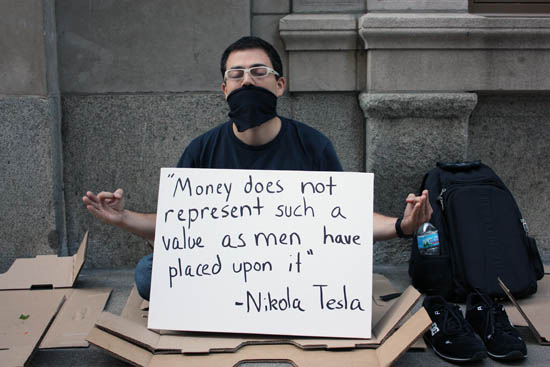
Susannah Breslin in Forbes, story and photos: "Is the Occupy Wall Street movement a revolution or a mess? That all depends on who you ask."
(Via Boing Boing.)
Susannah Breslin in Forbes, story and photos: "Is the Occupy Wall Street movement a revolution or a mess? That all depends on who you ask."
(Via Boing Boing.)
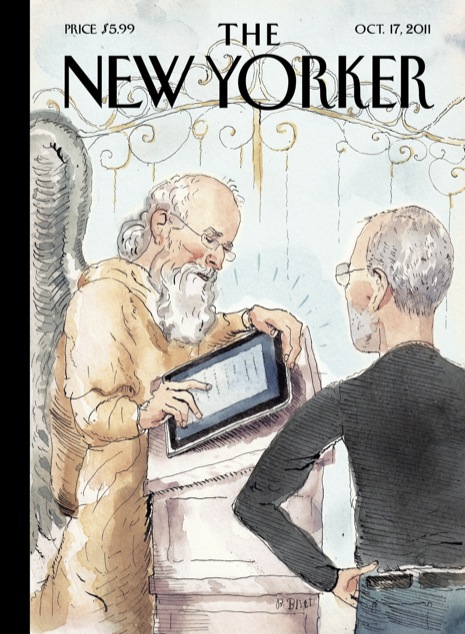
Steve Jobs was one of the best business strategists of our time. So what lessons can we take from Apple's moves over the years?

What industry category do you operate within? Break out of it. If you had to choose one option, what industry would you say Apple operates within? Computers, music, telephones, or retailing? In terms of revenue, the answer is phones. However, the name Apple first came to be associated with computers. When Apple released the iPod, Walt Mossberg, a product reviewer for the Wall Street Journal, interviewed Steve Jobs. Mossberg spoke to Jobs about his reasons for venturing into the music industry. Jobs explained that Apple is a digital products company, not simply a computer company.
Had Apple defined itself as a computer company, it would wave goodbye to 2/3 of its current revenue. Is this where your company is heading today?
"When you reach for the stars, you might not quite get one, but you won't come up with a handful of mud, either." So said the legendary advertising man Leo Burnett, although Steve Jobs could just as well have uttered these words. When attending a board meeting of what shall remain an unnamed Fortune 100 company, the chief of innovation announced 31 new revisions to their existing product portfolio. After his presentation, I asked him which of his announcements he felt best represented his iPad moment. "Two perhaps," he replied. Wrong answer. There's only room for one. Neither you, your company, nor the world has patience for 31 tweaks these days.
Will your next product release represent your iPad moment? If not, go back to the drawing board.
Even if you predict the future just one minute before it happens, you're still in good time. I'll never forget the Macromedia conference I attended in San Francisco during the late 1990s. Steve Jobs made a surprise visit on stage. That was the moment he threw the new Apple Newton message pad into the iconic Apple bin on stage. Apple was too early in the game and once the game began, they were too late. This was a lesson Steve Jobs learned the hard way. The Walkman came before the iPod, Microsoft's tablet arrived before the iPad, and the Blackberry arrived before the iPhone--though Apple's impeccable timing managed to beat them all.
Being first isn't necessarily best--understanding timing is the essence of a breakthrough.
"What do you want the stores to say to people when they walk in?" In my new book, Brandwashed, I quote the question Steve Jobs put to Bob Iger, the CEO of Disney, when he was asked for advice on the redesign of Disney's retail stores.
If your storefront, product, service, website, store fit-out could talk to the customer, what would it say?
Identify and attack your enemy in public. When Apple's iTunes program was already well ensconced on millions of PCs, Steve Jobs was asked what it was like to be a major Windows developer. He replied without hesitation, "It's like handing a glass of ice water to someone in Hell." Jobs never shied away from pointing out Apple's number #1 enemy in public. CEOs could learn from this.
Often behaviour that's too self-consciously politically correct can lead to a watered-down focus and profile, both internally and externally. An enemy can define who you are, and who you're not.
Don't read about your competitors to learn more--visit them. However, it is probably a good idea to conduct such a visit before they've become your competitor. During Steve Jobs's early days in the business, he did, in fact, pay a visit Sony. He wanted to learn about the Walkman, as well as get a sense of Sony's well-oiled operation. Jobs was heavily inspired by both. Indeed, many companies can boast of Jobs visiting them in the past--providing Apple with inspiration.
When did you last pay a visit to a potential competitor?
Don't take your success for granted--reset your watch every time. I've always been amazed by how some of the world's most successful organizations continue to work as tirelessly as they did when they first began. For example, take the rock group U2. Their most recent promotional tour was as intensive as the first one they embarked on 15 years ago, impressing even the most jaded rock journalists both then and now. Steve Jobs's unwavering enthusiasm for Apple was the same. Walt Mossberg recalls first seeing the iPad at Jobs's home, because, as Mossberg explained, "He was too ill at the time to go to the office."
Act entrepreneurial. Assume you have no equity--fight as hard for your product as you did the very first time you promoted it.
Every company should learn from their own mistakes and success stories. In reality, all companies experience a regular turnover in staff. So, the filing of experiences and the internal education often fail to capture invaluable knowledge for future reference. Apple managed to circumvent this by entrusting their HR department to employ academics and historians to document events (both good and bad), publish internal papers, and systematize the transfer of information to new Apple employees.
Have you systematically captured and transferred the good and bad experiences within your organisation?
Make your brand sticky. Gillette is the master of the "sticky" brand. Once you buy a Gillette razor, you are forced to buy Gillette's blades. Similarly, once you've installed Windows on your PC, it's almost impossible to avoid installing Office. True, you can buy an iPod shuffle for not much more than $100 but, beware, this is just the beginning--the chances are you'll soon be buying anything and everything that starts with a small "i."
Have you made your product or service sticky?
Treat your brand as a religion. If you've read any of my books or articles [hyperlink to past Fast Company article], you'll know all about my obsession with the parallels between religion and brands. This connection was something I first discovered as part of the $7 million fMRI studies I conducted for my book Buyology.
Most of the world's most influential religions represent several, if not all, of these foundational pillars: a powerful vision, sensory appeal, storytelling, grandeur, symbols, mystery, rituals, enemies, a sense of belonging, and evangelism. As I have come to learn, Apple is no exception.
How many of those 10 boxes can your brand tick?
(Via Fast Company.)
One day I seemed to shut the door between me and all publishers' addresses and book lists. I said to myself, Now I can write. Now I can make myself a vase like that which the old Roman kept at his bedside and wore the rim slowly away with kissing it. So I, who never had a sister and was fated to lose my daughter in infancy, set out to make myself a beautiful and tragic little girl.

NuCaptcha, a startup that develops a ‘human-friendly’ video captcha technology, is announcing a dedicated captcha produt for mobile devices, available for all mobile platforms including Android and IOS platforms.
For background, captchas are security questions you find on Web sites that require you to decipher and type words or numbers and detects whether the user is a human or a spambot. Most Captchas you see are transcription, text-based Captchas. Of course, captchas can often be confusing, and not user-friendly. NuCaptcha is trying to solve this pain point by offering site owners a more user-friendly alternative, called a video captcha.
NuCaptcha has spent the last few years optimizing its security so that 3 un-distorted letters can be used on “most” sites. Sites that need more security can add up to 8 letters if threats are detected through The NuCaptcha Behavior Analysis System.
The mobile version of NuCaptcha includes the same simplicity as the web version. But the new optimized mobile Captchas provides a consistent user experience on multiple devices. For example, when a user clicks on a mobile touch screen to solve a Captcha, it will fit perfectly into the space left by the keyboard so that the Captcha can be quickly and easily completed. NuCaptcha does not require Flash or JavaScript; and the company expects to release the HTML5 mobile version of its Captcha technology in early Q4 2011.
Currently serving millions of Captchas per month, NuCaptcha offers a Free, Pro and Enterprise offering, and users can determine the size, choice of videos, security level, and even optional branding, advertising and revenue generation through NuCaptcha’s Advertising Programs.
NuCaptcha faces competition from ReCaptcha, which Google acquired in 2009.
(Via TechCrunch.)

In 2008 Mark Boyle decided to try living for a year without money. His self-imposed rules were simple: he would close his bank account and not spend or receive money (including checks and credit cards). He would live off-grid—that meant he would produce his own energy for illumination, heat, food preparation, and communicating with the outside world. He sold his houseboat and used the proceeds (a few thousand dollars) to set things up. This included buying a $300 solar panel to keep his laptop and cell phone charged (he accepted incoming calls, which he could do without subscribing to a cell phone plan.) He obtained an old trailer for free from a woman who wanted to get rid of it. He made a deal with an organic farm to let him park the trailer on the land in exchange for a few hours work each day. He built a compost toilet near his trailer to harvest the “humanure” for his gardening needs. He set up a solar shower, which consisted of a black plastic bag and a rubber hose to bathe with. For heating the trailer he bought a wood-burning stove made from an upcycled propane tank, and for cooking he built a “rocket stove,” designed to produce high-heat using small pieces of wood. A bicycle provided transportation.

Remembering that I'll be dead soon is the most important tool I've ever encountered to help me make the big choices in life. Because almost everything - all external expectations, all pride, all fear of embarrassment or failure - these things just fall away in the face of death, leaving only what is truly important. Remembering that you are going to die is the best way I know to avoid the trap of thinking you have something to lose. You are already naked. There is no reason not to follow your heart. - Steve Jobs


A gem of a story, posted by The Futility Closet:
“For Children Three Years Old,” from Lessons for Children by Anna Laetitia Barbauld, Philadelphia, 1818:
There was a naughty boy; I do not know what his name was, but it was not Charles, nor George, nor Arthur, for those are all very pretty names: but there was a robin came in at his window one very cold morning — shiver — shiver; and its poor little heart was almost frozen to death. And he would not give it the least crumb of bread in the world, but pulled it about by the tail and hurt it sadly, and it died. Now a little while after, the naughty boy’s papa and mamma went away and left him, and then he could get no victuals at all, for you know he could not take care of himself. So he went about to every body — Pray give me something to eat, I am very hungry. And every body said, No, we shall give you none, for we do not love cruel, naughty boys. So he went about from one place to another, till at last he got into a thick wood of trees; for he did not know how to find his way any where; and then it grew dark night. So he sat down and cried sadly; and he could not get out of the wood; and I believe the bears came and ate him up in the wood, for I never heard any thing about him afterwards.
(Via Boing Boing.)