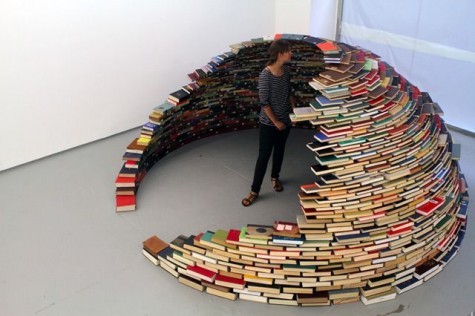
Friday, January 27, 2012

Another beautiful reading space (photo)

Click to enlarge

Assembling a yurt (video)


Putting up a yurt (also called a ger) is fast and easy, but its best done by an entire family. This yurt was moved by the family of Shagdarsuren Herelchuluun, on the east side of Lake Hovsgol, in northern Mongolia, not far from the Russian border.

Found at Boing Boing.

On fixing academic publishing

Nancy Sims, of the University of Minnesota Libraries, responds to The Atlantic's criticisms of JSTOR, an academic database that can be difficult and expensive to access: "There are things JSTOR does that I do have issues with. I wish it was doing more to provide more open access to the public domain materials it holds, for example. The JSTOR independent researcher program has all kinds of problems. But JSTOR is, for the most part, a pretty good element of the existing landscape."

(Via Boing Boing.)

The Universe Bound: Astronomical by Mishka Henner


We are all well aware that the reading of books can open up new worlds  but who knew you could fit the entire universe in a set of 12 books.

Mishka Henner does just that with Astronomical; twelve hefty volumes representing a scale model of our solar system from the Sun to Pluto with the width of each page representing one million kilometers!

The Sun pops up in Volume 1 and Pluto closes out the set on the last page of Volume 12 and there is a plethora of darkness in between and just like that the entire universe is contained between the covers.

The Sun


Details:
The first 10 sets retail for £100 and each is printed-on-demand.  Each volume is 5.5″ x 8.5″, perfect bound with white interior paper (50# weight), black and white interior ink, and white exterior paper (100# weight).

Here's a video preview:


ASTRONOMICAL - The Movie from Mishka Henner on Vimeo.

Thursday, January 26, 2012

Yosemite in HD (video)


Much better in full-screen mode.

Searching for Context: Modeling the Information-Seeking Process of College Students in the Digital Age

What is it like to be a college student in the digital age? Alison Head — lead researcher for the national study, Project Information Literacy, Berkman Fellow, and Research Scientist in University of Washington’s Information School — presents a working typology of the undergraduate information-seeking process, including students’ reliance on and use of Web sources.

MP3

OGG audio format!

More info on this event here (includes video clip)

Harvard University. Berkman Center for Internet & Society Podcast

(Via Celia's.)

Fritz Goro's Photos: The Art of Science (photostream)


Stephen Jay Gould once said that LIFE photographer Fritz Goro, who died in 1986, was "the most influential photographer that science journalism (and science in general) has ever known." LIFE.com has posted a gallery of his truly wonderful photos.

In the photo above Edwin Land, the president and co-founder of the Polaroid Corporation, demonstrates his company's "60-second film" in 1963. By allowing photographers to see (almost) immediately what they had shot, Polaroid revolutionized photography and foreshadowed the advent of digital photography and its emphasis on instant gratification.

Wednesday, January 25, 2012

Neil deGrasse Tyson Lists 8 (Free) Books Every Intelligent Person Should Read

Thanks for this ongoing interest in my book suggestions. From some of your reflections, it looks like the intent of the list was not as clear as I thought. The one-line comment after each book is not a review but a statement about how the book’s content influenced the behavior of people who shaped the western world. So, for example, it does no good to say what the Bible “really” meant, if its actual influence on human behavior is something else. Again, thanks for your collective interest.

1.) The Bible (eBook) - “to learn that it’s easier to be told by others what to think and believe than it is to think for yourself.”

2.) The System of the World by Isaac Newton (eBook) – “to learn that the universe is a knowable place.”

3.) On the Origin of Species by Charles Darwin (eBook – Audio Book) - “to learn of our kinship with all other life on Earth.”

4.) Gulliver’s Travels by Jonathan Swift (eBook – Audio Book) – “to learn, among other satirical lessons, that most of the time humans are Yahoos.”

5.) The Age of Reason by Thomas Paine (eBook – Audio Book) – “to learn how the power of rational thought is the primary source of freedom in the world.”

6.) The Wealth of Nations by Adam Smith (eBook – Audio Book) - “to learn that capitalism is an economy of greed, a force of nature unto itself.”

7.) The Art of War by Sun Tsu (eBook – Audio Book) - “to learn that the act of killing fellow humans can be raised to an art.”

8.) The Prince by Machiavelli (eBook – Audio Book) - “to learn that people not in power will do all they can to acquire it, and people in power will do all they can to keep it.”

Click this link for more commentary and links to free copies

Wednesday, January 18, 2012

Another collection of beautiful libraries (photostream)


Several more here.

Happy 130th Birthday, A. A. Milne: “Happiness” and the Origin of Winnie-the-Pooh

On rainy days and the simplicity of happiness.

One hundred and thirty years ago today, Alex Alexander Milne (1882-1956) took his first breath. Best known for authoring the Winnie-the-Pooh book series, among the most beloved children’s books with timeless philosophy for grown-ups, A. A. Milne was also a prolific poet. In 1924, two years before the first Winnie-the-Pooh book, he penned When We Were Very Young — a collection of poetry for young children, illustrated by E. H. Shepard. In the 38th poem of the book, titled “Teddy Bear”, the famed Winnie-the-Pooh character makes his first appearance. Originally named “Mr. Edward Bear” by Christopher Robin Milne, Milne’s own son, Winnie-the-Pooh is depicted wearing a shirt that was later colored red for a recording produced by Stephen Slesinger, an image that eventually shaped the familiar Disney character.

The third poem in the book is a short gem titled “Happiness” — a wonderful meditation on how little it takes to find happiness. (And, clearly, a giant missed opportunity for Apple.)

(Via Brain Pickings.)

A Brief History of Computing Platforms (video)

Tuesday, January 17, 2012

Carved book landscapes by Guy Laramee


Several nore here.

Amazing images of Saturn via Cassini


NASA's Cassini spacecraft is now a nearly a year into its extended mission, called Cassini Equinox (after its initial 4-year mission ended in June, 2008). The spacecraft continues to operate in good health, returning amazing images of Saturn, its ring system and moons, and providing new information and science on a regular basis. The mission's name, "Equinox" comes from the upcoming Saturnian equinox in August, 2009, when its equator (and rings) will point directly toward the Sun. The Equinox mission runs through September of 2010, with the possibility of further extensions beyond that. Collected here are 24 more intriguing images from our ringed neighbor.

Found via TYWKIWDBI.

Friday, January 13, 2012

Top 100 Library Stories of 2011


Via The Proverbial Lone Wolf Librarian

Friday Fun: The complete version of Baby Trashes Bar. (video)

The Light of Day (video)


It’s not hard to grow old but making peace with the challenges of aging is no easy task. Photographer Simon Biswas glimpses the conflict in a series of emotional video portraits that tell his subjects’ stories with honesty and dignity. His sitters regale us with fond memories of collecting Brooklyn Dodgers autographs and tragic losses like the death of a child. The Light of Day celebrates the experience of growing old and pays respect to those who have preceded us in making sense of life’s many unanswered questions.

Thursday, January 12, 2012

Phone Stacking (cool idea)


We have all been there. You are out in a restaurant or club with friends. The conversation is going well. And then a cell phone rings, is answered and the conversation is halted. Well, someone over at Tumblr has come up with a novel idea - "Phone Stacking".

The rules are simple and begin after ordering: Each person at the table is required to place their phone facedown, (for dramatic effect you can stack the cellphone pile in the center of the table) at the beginning of the meal. While eating, incoming email and text notifications will sound, and the first person who picks up his/her phone also picks up the entire bill. If no one gives into temptation, every participant is declared a winner and pays for his/her own meal.

There are variations and more info at the link.

Found at PSFK

On Gratitude: A most inspiring video


"You think this is just another day in your life. It’s not just another day — it’s the one day that is given to you, today. It’s given to you, it’s a gift. It’s the only gift that you have right now, and the only appropriate response is gratefulness. If you do nothing else but to cultivate that response to the great gift that this unique day is, if you learn to respond as if it were the first day in your life, and the very last day, then you would have spent this day very well.”