Friday, April 14, 2006

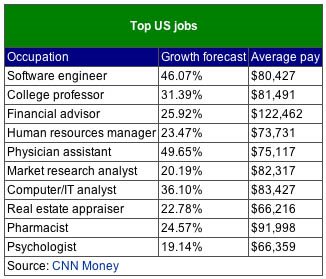
Money Magazine's best job list


Not really library related (except that "Librarian" didn't make the list), but I thought some might have kids researching a career or might be rethinking their own!

Will Apple challenge Sony's upcoming ebook due this summer?

From Macsimum News

Making a case for Apple challenging the upcoming Sony Reader ebook/tablet can be done on so many levels, that’s it’s virtually a no-brainer. Publishing is a core market of Apple’s, and they’ll certainly defend that position to the best of their ability. Whether Apple will decide to introduce an all new e-book device or simply add it to their iPod line-up, is neither here nor there.

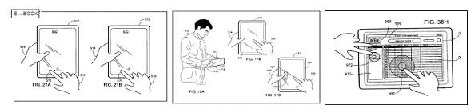
To back that up, the facts supporting this position were made abundantly clear throughout the first quarter of 2006. This is when the U.S. Patent and Trademark Office revealed a series of new Apple patents regarding touch screen technologies and a tablet PC doubling as an ebook.

Within those patents, Apple revealed a plethora of advanced features that would certainly dwarf those found in Sony’s first iteration of their Reader, such as giving the user the ability to access Apple’s online iTunes Music Store via simple touch screen commands. More specifically and in context to an ebook, patent number 20060026535 titled “Mode-based graphical user interfaces for touch sensitive input devices,” – describes initiating “page turns… .associated with an electronic book.” Further on, the patent goes on to describe a new multiple-page-swipe technology that will allow users to virtually-flip through pages quickly as they naturally do today with a magazine or technical book etc.

More at the link.

Thursday, April 13, 2006

TechEssence.Info The essence of technology for library decision-makers.

From Librarian in Black
"TechEssence is a brand spanking new site providing "accurate, understandable explanations of important information technologies for libraries." The site was started by Roy Tennant, and has contributions by Andrew Pace, Meredith Farkas, Dorothea Salo, Eric Lease Morgan, Jenn Riley, Jerry Kuntz, Marshall Breeding, and Thomas Dowling. Umm. Wow."

From TechEssence
You're busy. You don't have time for a lot of jargon, techie posturing, or attitudes. You've come to the right place. We don't put you down, we don't talk down to you, we just give it to you straight. Come here for accurate, understandable explanations of important information technologies for libraries. Go elsewhere for the hype.
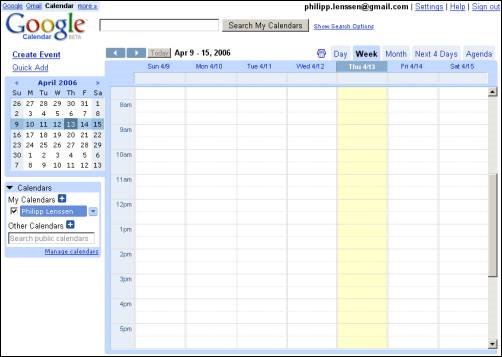
Google Calendar is up and running


From Google Blogscopeed
Wouldn't it be great to be able to keep track of all the events in your life, coordinate schedules with friends and family, and find new things to do -- all with one online calendar? We thought so, too.

  • Seeing the big picture
    With Google Calendar, you can see your friends' and family's schedules right next to your own; quickly add events mentioned in Gmail conversations or saved in other calendar applications; and add other interesting events that you find online.

  • Sharing events and calendars
    You decide who can see your calendar and which details they can view. Planning an event? You can create invitations, send reminders and keep track of RSVPs right inside Google Calendar. Organizations can promote events, too.

  • Staying on schedule
    You can set up automatic event reminders, including SMS notifications, and instantly bring up anything on your calendar with the built-in search tool.

Wednesday, April 12, 2006

EBay invests $2 million in social networking site

From Macworld

EBay has invested $2 million in social networking company Meetup, according to a form 8-k eBay filed with the U.S. Securities and Exchange Commission on Tuesday.

Last month Meetup announced that it was receiving investment from several sources — eBay among them — but did not specify the amount of the investment. Other investors announced at the time included Omidyar Network, Draper Fisher Jurvetson, Esther Dyson and Allen & Co.

In Tuesday’s 8-k filing, eBay disclosed the amount of its investment in Meetup, and cited investment in Meetup by eBay founder and Chairman Pierre Omidyar as the reason for disclosing the amount. Omidyar also sits on Meetup’s board of directors and “entities owned by” him hold more than a 10 percent equity share in Meetup, eBay stated in its filing.

Meetup.com is a site for people to link up with others who have common interests, hobbies or causes so they can set up and attend meetings and events in their local geographic regions.

EBay spokesman Hani Durzy said Wednesday that eBay invested in Meetup because the two companies share a common focus of connecting people and creating online communities, not because of Omidyar’s stake in the social networking company.

“We’ve been seeing examples of eBay members arranging local meet-ups in their areas, and since there is crossover we thought it was an interesting company so we chose to make an investment,” he said.

Google Confirms Licensing Search Engine, Hiring Creator

From Yahoo! News: "Google Inc. on Tuesday confirmed that it has licensed a search algorithm from an Australian university that says the technology delivers expanded results that make it more likely people will chose the right link to the most relevant Web page."

Tuesday, April 11, 2006

Add comments, notes and tables of contents to WorldCat records

Repost from LISNews

OCLC sent out an email to their customers today informing them of new features added to WorldCat. Namely, users can now add reviews, notes and tables of contents to WorldCat records. No word yet on when users will be able to post pictures of themselves reading the books or Google maps of book locations.

User-contributed content helps extend the OCLC cooperative to include record-enhancing information from non-cataloging library professionals as well as library users. For example, family members may add notes to records for genealogical materials about their families, or community members may comment on historical photographs or documents from digital collections about their communities that reside in the WorldCat database.

Ex Libris MetaLib customers Shibbolize user authentication

"The Ex Libris Group is pleased to announce that the Patron Directory Services (PDS) module was successfully ‘Shibbolized' by a number of MetaLib customers in Finland, the US, and the UK. ‘Shibbolizing' PDS -- adjusting the service to enable access via Shibboleth -- provides a seamless single sign-on (SSO) environment for MetaLib users."

Full press release available here.

Monday, April 03, 2006

MPAA has lost its collective mind

From The LA Times:
Major studios today will make mainstream movies available for downloading the same day they are released on DVD — a significant step in Hollywood's tentative migration to the Internet.

But movie fans will pay for the convenience: Downloadable flicks such as "Brokeback Mountain," "King Kong" and "Pride and Prejudice" may cost as much as twice what the DVD versions do and play only on a personal computer. New releases can't be rented online, just purchased.


The Motion Picture Association of America (MPAA) actually believes consumers will buy the overpriced, PC-only downloads for "convenience factor." What's so convenient about being charged twice the current retail price for movies you're less free to enjoy as you please on the devices you own?

Friday, March 31, 2006

Google hiring TV product manager

Google wants to hire an interactive-TV product manager, according to this job posting.

"In this role, you will provide leadership on product vision and execution of projects that enable using Google's search and advertising technologies to enhance users' television-viewing experience," the posting says. "You will identify key market trends that are shaping user behavior when watching television. These include, but are not limited to, the intersection of Internet and television technologies, video-on-demand, personal video recorders and (the) emergence of next-generation set-top-boxes with IP connectivity. You will then identify areas where use of Google's search and advertising technology can enhance this user experience and define appropriate products to deliver these user benefits."
Google launches 3D movie service


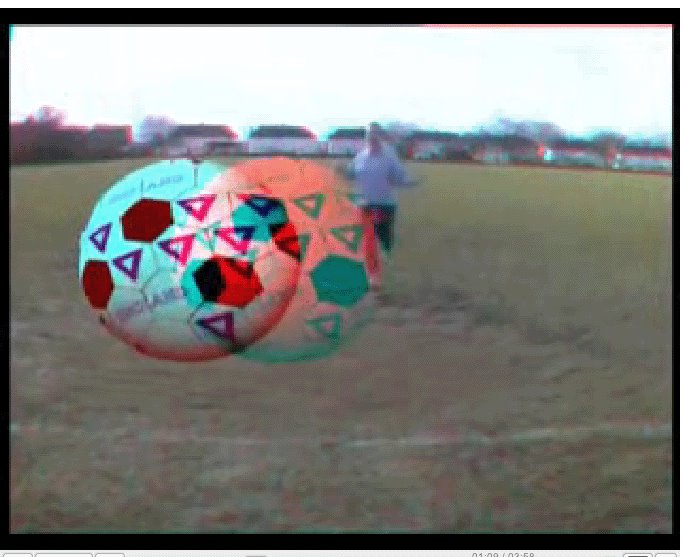
Grab your 3D glasses, Google has posted several 3D movies on their video site!

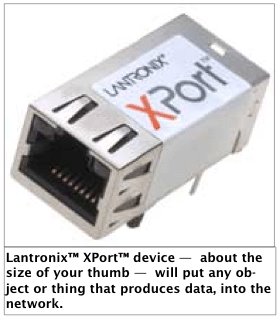
A Manifesto for Networked Objects


Here is a link to a downloadable PDF by Julian Bleecker, Ph.D. Research Fellow, Annenberg Center for Communication Assistant Professor, Interactive Media Division University of Southern California. Very informative discussion of "Blogjects".

"The Internet of Things has evolved into a nascent conceptual framework for understanding how physical objects, once networked and imbued with informatic capabilities, will occupy space and occupy themselves in a world in which things were once quite passive. This paper describes the Internet of Things as more than a world of RFID tags and networked sensors. Once “Things” are connected to the Internet, they can only but become enrolled as active, worldly participants by knitting together, facilitating and contributing to networks of social exchange and discourse, and rearranging the rules of occupancy and patterns of mobility within the physical world. “Things” in the pervasive Internet, will become first-class citizens with which we will interact and communicate. Things will have to be taken into account as they assume the role of socially relevant actors and strong-willed agents that create social capital and reconfigure the ways in which we live within and move about physical space. To distinguish the instrumental character of “things” connected to the Internet from “things” participating within the Internet of social networks, I use the neologism “Blogject” — ‘objects that blog.’"
Thursday, March 30, 2006

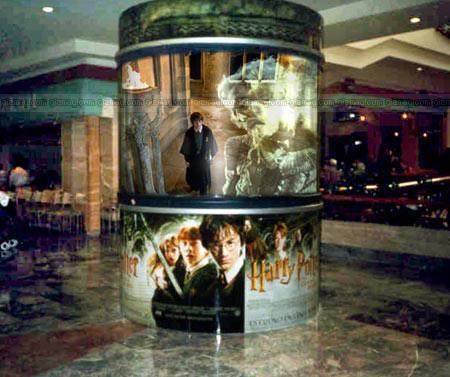
360 degree LCD television debuts


If you’re looking for a new centrepiece for your new entertaining area, the new 360 degree LED display from Dynascan offers exactly that – quite literally. Taiwanese-based Dynascan has been developing the 360 degree LED display for several years now and it is initially being used as an advertising medium in shopping centres and public areas, with an outdoor version just launched too. The first time you see one of the screens you’ll understand what the fuss is about – the quality, colour, contrast and definition is extraordinary and the screen is absolutely huge – the third generation of the new LED screens is being introduced at present with the largest being a 2.5 metre high, 5.46 metre circumference screen and capable of being viewed clearly from 30 metres away.

From GizMag

Wednesday, March 29, 2006

Oregon State University Wi-Fi Survey

This is a online survey done by researchers at Oregon State University on how people share and access open Wi-Fi networks and what matters the most when they use Wi-Fi. The latest cases in Illinois and Canada of people being fined or arrested for accessing an open Wi-Fi network show that the issue of open Wi-Fi access rules needs to be solved.

New Google interface in beta


Google is testing a new “green bars” interface to the left of search results, allowing easy linking to search results for the web, images, groups, froogle and local. The green bar is an indication of what appears to be a result count. The quick links have been moved from the top of search to the left sidebar. The green bars do communicate total results information, but that’s it. For the majority of searches, the number of results is not important to deciding whether or not to click on the link.

Tuesday, March 28, 2006

Soundogs.com - downloadable sound effects


Most of us have used downloadable stock photo services in the past. Soundogs offers a similar service for sound effects. Just as stock photos are a great tool for designers and multimedia creators, sounds can be used to quickly set the mood or form transitions between disparate elements. Whether physical sound effects ( e.g. crickets, birds, gunshots, explosions, doorbells, everything under the sun), more creative effects (zips, zonks, beeps, and wooshes), and instrumental music of all kinds and emotions, Sounddogs is the perfect source for sounds of all kinds. Most effects are in the $3-$5 range, making it reasonable to collect sounds for multimedia projects, theater, and the ever so fun practical joke. The sounds themselves are delivered as CD-quality AIFF or WAV files right after you order; no shipping delays. You can browse through the entire catalog and listen to low-quality full-length previews of everything. It's truly addictive (and useful)!

Friday, March 24, 2006

Teens and Technology

Presented to Public Library Association

This is a discussion of the eight realities of technology and social experience that are shaping the world of today's teens and twenty-somethings. It looks at the growing role of technology in teens' lives, the way they use their gadgets, their expectations about how to find and use information, and the social consequences of their use of technology.

Presentation available at the Pew Internet & American Life Project site

Tuesday, March 21, 2006

Cosmeo turns gray matter into great matter.


Cosmeo is a unique homework help tool brought to you by Discovery Channel. It is designed to help students master challenging concepts and inspires students to say, "I can."

Cosmeo can:
  • Facilitate learning with a constantly updated video library, including more than 30,000 video clips across all age and grade levels

  • Match videos to your state's curriculum standards

  • Make learning fun with a wide variety of interactive games, and homework help tools

  • Help students succeed with 15,000+ images and a library of teacher-selected websites for students to use for school projects and presentations

  • Make student's work stand out with an online encyclopedia of 27,000 full-text articles

  • Give teachers the ability to monitor usage and learn alongside your students

Thursday, March 16, 2006

AllPeers for media sharing via Firefox


AllPeers is almost ready to launch! This exciting new technology will allow you to share your media files via Firefox by utilizing BitTorrent technology.

With AllPeers, you just drag-and-drop your files right into the program. They're available for sharing instantly! Then decide exactly who you want to share which files with. No uploading, no waiting. Want to browse your existing library? Click on an album and you see the thumbnails immediately. And since your files are stored directly on your computer, it's all completely free.

Files are received instantly and are displayed in beautifully laid out albums of convenient thumbnail images. Browsing through new files, or finding old ones, is a breeze.

Go to the website and register to be notified when the download is available.

Wednesday, March 15, 2006

Blogjects in the world of interconnected things

On February 1st, a day before the LIFT06 conference, a workshop about ‘Blogjects and the new ecology of things’ has been held in Geneva. The purpose of this event was to discuss usage scenarios of Blogjects, the design issues they raises as well as their significance in various contexts. The description of the scenarios helped refine what would be the Blogjects features and capabilities.

This report (.pdf, 18.6Mb) summarizes all the topics discussed by presenting the main characteristics of Blogjects and four potential scenarios elaborated by the groups formed during the workshop.
As the Internet pervades more physical space and more social space it is likely that objects in the world will become able to connect to the network and participate in the web by disseminating and receiving data communications. As “things” participate within the Internet and once the Internet soaks through physical, geographic space a differentiated kind of Internet may arise. The Internet of Things sets up a different set of relations to social practice (we will be “in” a pervasive network) and a different set of relations to space (the Internet will be co-occupied by both social beings and things.) This shift generates new possibilities for integrating networked things into the Internet. This workshop addresses this shift by considering its characteristics in relation to an existing, prevalent set of practices and technologies currently in existence variously referred to as “the social web” and “Web 2.0.” We then proceeded into four groups to conduct design scenarios in order to further explicate our understanding of a world in which things are connected, networked participants within a pervasive, wireless, mobile Internet. We conclude that there is a significant opportunity for designing compelling usage scenarios for such a near-future Internet of Things world and recommend a follow on, intensive, multi-day workshop/retreat to continue contributing to this important topic.

Tuesday, March 14, 2006

Google partners with book publishers

MercuryNews.com | 03/13/2006 | Google to offer books online
Google is expanding its role in the publishing world from a search engine for books to a distributor making entire books available to read online. (Not the books they are scanning from libraries. This is a separate program directed at publishers and authors)

More info at Search Engine Watch

Item tagging in UPenn OPAC

The University of Pennsylvania library allows users to create their own personalized classification systems by enabling item tagging in their catalog.
Read all about it:
Library Stuff
ACRLog
PennTags

ALA 2006 New Orleans Wiki

From Librarian in Black

The goal of this wiki is to develop a guide to the conference that reflects the knowledge of our diverse membership. Anyone with knowledge about New Orleans, the ALA Conference and participating in ALA is encouraged to contribute to the wiki.

The conference will take place from June 22-28, 2006.

Bruce Sterling on "The Internet of Things"

Here is the complete text of Bruce Sterling's inspiring, cranky, visionary talk at last week's O'Reilly Emerging Tech conference. Bruce's talk made admirable sense out of what's going on with technology in the twenty-first century, what Web 2.0 and the rest all mean, and how they can be positioned against the history of other innovations. Fascinating stuff!

Monday, March 13, 2006

Compaq founder pushes for academic library online

From CNET News

CARLSBAD, Calif.--Ever wonder where Compaq founder Rod Canion is? He's with Questia Media, which wants to bring a university-class library to a high school near you.

The Houston-based company is gathering academic and textbook publishers like John Wiley and Sons and putting their works on the Web. For $20 a month, or $100 for a full-year subscription, individuals can get full access to peer-review articles, textbooks and other academic publications online. High schools can access the database too, for about 85 percent of the cost, said CEO Troy Williams.

At the moment, the roughly 150,000 Questia subscribers can download 65,000 books accessible through the site, he said.

A substantial portion of the material available through Questia is copyright and published with permission of the copyright holders. Still, the company must negotiate through a variety of contingencies with publishers. Giving high school libraries discount subscriptions, which all students at the school can access, is easy: Academic publishers generally want students to be interested in research, and the students wouldn't subscribe to most of the publications (or buy the textbooks) offered through Questia anyway, Williams said. The hope is that high schoolers who used the service through their school library will become individual subscribers eventually.

Selling subscriptions to college libraries is different. Many academic publishers rely on selling subscriptions to fellow institutions. Those deals, however, are being hammered out. Google, for example, has cut deals to publish the works in the libraries of a few select universities but the plan has run into controversy because of protests from authors, who claim that the university libraries do not have the legal right to let the search giant republish copyright material.

Thursday, March 09, 2006

"Google Reference" - a Wikipedia partnership?

From ZDNet

From the article
Last February (2005) Google offered to host Wikimedia projects on their servers, but just as quickly as that news surfaced it seemed to disappear. This "partnership" may be on the verge of getting more attention.

It's not news that googlepedia.com is registered to Google and just over a year ago they offered to host some of Wikimedia's projects. This page on Wikimedia even confirms they are in talks with Google but denounces rumors that hosting might include advertisements.

My curiosity was rekindled today when I noticed Google registered googlereference.net/org/info and googlereferencepages.com/net/org/info two days ago on March 6th. There are only a couple things I can guess would make sense being called "Google Reference" — one of them is an encyclopedia. What better reference is there than Wikipedia — the project Google offered to host last February?

Another possibility would be a repository strictly for manuals and reference guides. Companies that produce reference manuals could upload their information to a Google hosted repository so users can locate them easily. They could then be converted to a consistent searchable format — just like Google Video converts content to Flash.

RSS to your phone


Rasasa will keep you in touch with your favorite news sources. You probably know by now that RSS feeds are really handy and keep you up to date on all sorts of things. Rasasa helps you to keep track of all this news. It delivers the news to your messenger if you're online and to your mobile phone if you're offline... Or to your email box if you're in a 'quiet time'.

We Sing the News So You Don't Have To

The Aural Times: A great fun site that sings current news clips so you don't have to!

Tuesday, March 07, 2006

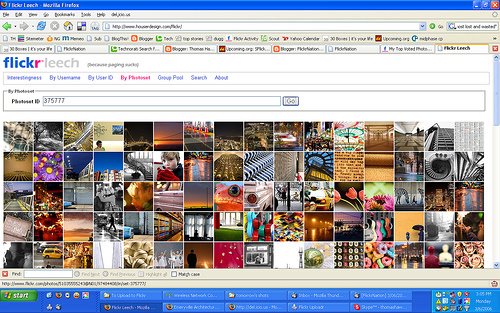
Flikrleech


Flickrleech allows you to pull up massive screenfuls of thumnails across interestingness, username, user ID, photoset, group pool, search, etc. You can keep it loaded in the background while you click through on great shots and view, fav, comment etc.

Tips on building a (Library) Community

There is
I have long been a fan of Guy Kawasaki - one of the original Mac evangelists. He has become a premier authority on marketing and business development. He has a post on his blog outlining a method to develop a "kick ass" community for your product or service. He outlines eight principles that are essential in community building, all of which are applicable to libraries.

There is also a PodCast on the sublect.

Friday, March 03, 2006

Wednesday, March 01, 2006

Amazon adds ProductWiki feature

Amazon has added the ability to create and edit a wiki for each of their product offerings. Customers can rate, comment on, or slam offerings as well as make recommendations. It also offers to notify you of any changes to the wiki.

From the description:
Wiki provides a way for you to share your knowledge about a topic. Wikis are written and edited by groups of people. When you contribute to a Wiki you join a community of other people knowledgeable in the topic. Unlike reviews where each person's opinion appears separately, a Wiki is a single file that is edited by many people.

You can create Wikis about a many different things on Amazon. For example, you might create a Wiki to describe a particular opera recording. Within that Wiki you could create links to Wiki entries defining words such as "soprano" and "coloratura". (See instructions that follow.)

You can view how a particular Wiki entry has changed over time, to see who has contributed what and when, and you can subscribe to be notified by email of any future updates to Wikis you are interested in.

Think of a Wiki as an encyclopedia entry that everyone who comes to the page will read. You should put in relevant factual information that you believe will be of value to others who visit the page. A Wiki is not the place to express your opinion; that's what Customer Reviews and Customer Discussions are for. As always, please treat the Amazon community with respect by not writing inappropriate or off-topic comments.

U. of Michigan Offers Free Blogs for Students, Employees

Recognizing the popularity—and potential—of blogs, the University of Michigan has launched
mblog, a program offering free blogs to UM students and employees...Link

Tuesday, February 28, 2006

Wikipedia on your iPod


From The Apple Blog

Encyclopodia is a free software project that brings the Wikipedia, which is one of the largest encyclopedias on the world, on the Apple iPod MP3-Player. It has been successfully tested on a third-generation iPod and on an iPod mini, but it should also work on other iPod generations.

Monday, February 27, 2006

READY-TO-KNOW

Google indexes 8 billion+ documents, images and items, and that same Google has announced it may scan up to 50 million books currently only available in old-world universities like Harvard, Stanford, Oxford, University of Michigan, and the NY Public Library, yet for consumers craving relevant information on everything and anything, there is still a massive information shortage.

And all this information should be available 'on the go', i.e. accessible in the offline AND online (wired and wireless) world: think of it as the Google effect (demanding and getting instant answers) permeating all aspects of daily life.

TRENDWATCHING.COM has dubbed this phenomenon READY-TO-KNOW: demanding consumers are in a constant 'Ready To Go, READY-TO-KNOW' state of mind, expecting any information deemed relevant to be available instantly, at their own terms. The latter is crucial: we're talking pull here, not push. Expect to see more click-and-know, more point-and-know, more text-and-know, more touch-and-know and more snap-and-know than ever before.

Examples and more here

Counter-Googling


From trendwatching.com

The art of 'Googling' (checking people's backgrounds on the internet via search engine Google) -- which started out as a useful tool for weeding out psychopaths from the online dating game and performing a quick double-check on an applicant's claim about his or her astonishing career -- will soon be an integral part of corporate 1:1 marketing strategies.

With consumers disclosing their most intimate secrets online (voluntarily!), Google has essentially created a 'domestic database', i.e. a world-wide database loaded with your customers' details and profiles, with a depth of information your company's database can only dream of.

So instead of consumers Googling you before they buy your services, you should Google THEM, and instantly get more personal information than you'd ever be able to capture with traditional 1:1 in an entire life-time. TRENDWATCHING.COM has dubbed this emerging trend COUNTER-GOOGLING, and the opportunities are tasty!

A real-life COUNTER-GOOGLING example? The Bel Air Hotel in LA already Googles first-time guests upon arrival, based on their reservation details (name and address), leading to personalized services like assigning guests a room with morning sun if Googling shows the guest enjoys jogging early in the day (source: http://blog.outer-court.com).

Trend Spotting


Fascinating stuff!

trendwatching.com is an independent and opinionated trend firm, scanning the globe for the most promising consumer trends, insights and related hands-on business ideas. They rely on a network of 8,000+ spotters in more than 70 countries worldwide.

Most of their findings are aggregated in a free, monthly Trend Briefing, which is sent to 130,000+ business professionals in more than 120 countries. To read the latest edition of the Trend Briefing, please go to www.trendwatching.com/briefing/.

Thursday, February 23, 2006

Google Librarian Newsletter

I found this referenced in an obscure Flikr photoset and managed to dig up two issues. There is a "sign up" link if anyone is interested. Frankly, it is pretty lame.

December 2005 Issue

January 2006 Issue


From the first issue:

Welcome to the first edition of the Google Librarian Newsletter.

This newsletter was conceived at the 2005 ALA conference in Chicago, where Google hosted a booth in the exhibit hall. We spent three days chatting with librarians about Google: what you liked, what you didn't like, and where you saw opportunities to work together to help people find useful, relevant information.

In an effort to keep those conversations going, we're launching this newsletter. Consider it a first step toward what we hope will be a long and mutually beneficial relationship. We anticipate sending it out quarterly, with the occasional special feature as appropriate.

This introductory issue features an article written to address one of the most frequent questions we've heard from librarians: How does Google index the web, and, more important, how does it rank the results? Matt Cutts, an engineer in our Quality group, explains the basics of indexing and sheds some light on some of the algorithms we use to determine where a site should appear on results pages. He also suggests exercises school librarians can do to help students better understand how Google works.

But this newsletter wouldn't be much of a conversation if it were written solely by folks at Google. Future issues will feature articles contributed by librarians and library supporters, links to library-related web sites, and updates on Google products and services that can help you in your work. We invite you to send us your thoughts: your questions about Google, your suggestions for articles, and your stories of how librarians use and keep up with technology on the job. We'll do our best to use your feedback to make each issue more relevant and useful to the library community.

Thanks for reading, and stay tuned.

Jodi Healy
Manager, Library Partnership Team

ProQuest Admits False Accounting

Found on Librarian in Black

From: Library Journal

ProQuest Company, February 9 revealed internal accounting errors that will result in it restating "certain of its previously issued financial statements." To defuse any fears of scandal like the one involving subscription agent, divine, Inc., ProQuest president Alan Aldsworth staged a conference call in which he assured that the errors do not "affect amount invoiced to customers, cash received from customers, or disbursements made to publishers and suppliers." ProQuest wasn't fielding questions from the press, but issued a statement in part reading: "Based upon its initial finding, the company believes that its deferred income and accrued royalty accounts are materially understated in previously issued financial statements. It also believes that its prepaid royalty account is materially overstated…as a result it will be required to recognize amounts of royalty and other expenses as well as reduce a portion of revenues previously reported for its Information and Learning business, the effect of which will materially reduce earnings from continuing operations…."

ProQuest added that the "irregularities do not affect the company's cash balances." The company has retained an outside accounting firm to conduct a thorough examination of its finances. Although lawyers for investors are preparing litigation, they confirm that neither customers nor suppliers were overcharged or cheated in any way.

Scroggle

Have you heard of Scroogle? This is a search interface -- created by the non-profit org google-watch. Put in your search term into the "google scraper" (there's also one available for yahoo!), scroogle searches google, and returns google results WITHOUT ads, WITHOUT cookies and WITHOUT search term records (their access log is deleted within 48 hours whereas google keeps this information FOREVER!). Check it out! As a side note, there's been a lot of talk lately about google and the ethics of their aiding in Chinese censorship. See the boingboing story for more background. Since 2000, Google has recorded your search terms, the date-time of each search, the globally-unique ID in your cookie (it expires in 2038), and your IP address. This information is available to governments on request. (From the Scroogle Web site)... See the site here

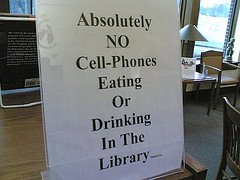
Bad library marketing.


Snapped in a Chicago library by Aaron over at Walking Paper.

Google Launches "Page Creator"

This summary is not available. Please click here to view the post.

LexisNexis Teams with Compliance 360

From: PR Web

Compliance 360, provider of governance, risk and compliance management software for companies in regulated industries announced today that it has partnered with LexisNexis to form the industry’s first offering of superior legal, regulatory, company and news content integrated with a compliance management solution. Utilizing Compliance 360’s content acquisition engine, users have the ability to seamlessly link updated content from LexisNexis with other corporate compliance data for more effective change management.

Compliance 360 customers are able to access the latest updates to rules and regulations, public records and other actionable content through LexisNexis and automatically workflow-enable that information into their legal departments or other compliance-related business areas. Utilizing the solution, managers can better respond to external regulatory events, stay abreast of newly proposed or enacted laws and regulations applicable to their businesses and more effectively manage the impact changing laws and regulations have on corporate compliance programs.

Wednesday, February 22, 2006

2006 Horizon Report

This is definitely worth reading.

2006 Horizon Report
Abstract:
The annual Horizon Report is a collaborative effort between the New Media Consortium (NMC) and the EDUCAUSE Learning Initiative (ELI). Each year, the report identifies and describes six areas of emerging technology likely to have a significant impact on teaching, learning, or creative expression in higher education within three adoption horizons: a year or less, two to three years, and four to five years.
The areas of emerging technology cited for 2006 are:
• Social computing
• Personal broadcasting
• Cell-phone-accessible educational content and services
• Educational gaming
• Augmented reality and enhanced visualization
• Context-aware environments and devices
Each section of the report provides live Web links to example applications and additional readings.

Tuesday, February 21, 2006

The 21st Century Library...

From Free Range Librarian
K.G. Schneider: Techno-Librarian. Writer. Gadfly. Commentator-at-Large.


The 21st Century Library is an interesting commentary with reference to the ALA keynote address by Andrei Codrescu and in preparation for a NPR Talk of the Nation topic on libraries.


Talk of the Nation is supposed to discuss the "Bookless Library." The blurb states: "Information technology changes as soon we think we understand it. We look at how libraries keep up and redefine their role. How would you design a library for the 21st century?"


I was unable to locate the program or blurb on their site. It may have been postponed or something but should be worth listening to or reading over the transcript if or when it becomes available.


Update:"This program has been postponed
due to the unavailability of a key guest."

Monday, February 20, 2006

Google Scholar searches go to local libraries

From The Google Blog
Posted by Christian DiCarlo, Content Partnerships Team, Google Scholar


Recently I’ve been working with libraries on something we’re excited to announce for Google Scholar users. Libraries are fantastic repositories of scholarship, and we want to make them as visible and accessible as possible. We’ve just expanded our Library Search program in Google Scholar to help people around the world find works of their interest in local libraries. That program now includes links to libraries in Hungary, Iceland, Israel, Portugal, Sweden, and Switzerland.

If for example you're a student in Sweden searching Google Scholar for [chemistry], you can click the “Library Search (Sweden)” link underneath the book titled "Principles of polymer chemistry" to see the list of Swedish libraries that hold the book. Then just pay a visit to one of those libraries to reserve it. If you’re outside Sweden, you can activate the Swedish library catalog links from the "Library Links" box in the "Scholar preferences" by searching for Sweden.

If you are a library patron and can't find the books from your library, ask your local library to participate in this program. If you are a librarian and would like to work with us to help users find scholarly literature in your library, please contact us.

We'd like to thank our union catalog partners for helping to make this happen. Here's hoping researchers worldwide will use it to find and build on the amazing collections in the world's libraries.

Real World Learning Objects Library


The Real World Learning Objects (RWLO) Resource Library is an online repository of Internet-based unique and compelling learning objects designed so that community college faculty can easily access and adapt for use in their classes.

Developed for the PT3 Community College Pathways to Improved Teacher Preparation through Technology Project (Pathways) with funding from the U.S. Department of Education, these RWLOs promote “unique and compelling” uses of the Internet: access to real time data, telecollaboration, primary sources, or web publishing. These applications engage students in authentic activities and Internet-based instructional resources that are uniquely possible only through the use of the Internet and provide compelling real world learning experiences.

Wikibooks are coming!

From The Philadelphia Inquirer

Wikibooks are coming. They likely will confront the homogenization, the slow publication and adoption processes, and the need for political correctness in textbook publishing. Wikibooks also could ease the costs of buying, distributing, and replacing textbooks.

Wikis are editable, collaborative, freely licensed online projects.

Imagine your textbook in a new way. Imagine a book that grows as knowledge grows. Imagine teachers teaching the same content contributing their collective knowledge as well as their best strategies and resources to keep the book fresh. Imagine scholars outside the education field contributing their research. Imagine textbooks customized to meet the needs of different locations with different standards or, more important, the needs of different learners.

Wikitexts may provide an equitable solution for the millions of students around the world with some access to computers but limited access to print texts.


More at the link.

Friday, February 17, 2006

New receiver reads HDTV streams from the internet


AHT International introduced the P2POD HDTV media player, a device that uses peer-to-peer technology to download and stream HDTV programs from the Internet. This nicely-designed unit reportedly has a user-friendly interface intended to make it easy to manage the thousands of channels now available. It could get much better, too, because when more of these proprietary P2PODs are in use, all of the other P2PODs benefit. More peers, more speed.

In addition to video, the P2POD is also able to receive and transmit over 6000 Internet radio broadcasts directly to a home entertainment system. If you can't find what you want on the Internet, you can also transfer media files to it via USB 2.0.

Expected to be rolled out in the third quarter of this year, the most astonishing fact is its price, under $150. We're just wondering how we might hack this sucker so it can be used with BitTorrent. Yes, we know, BitTorrent transfers its files differently, but still....

Denver Library offers downloadable films/videos

From The Rocky Mountain News

Next month, the Denver Public Library system will become the first in the nation to allow people to download movies and concert videos from home with a click of their computer mouse.

And it'll be free to anyone with a Denver library card and a speedy Internet connection.

"It makes it convenient, because you don't have to come to the library," Michelle Jeske, the library's manager of Web Information Services, said Thursday. "As long as you have a library card, you can have the library come to you."


More at link.

Where have library systems vendors gone astray?

From Librarian in Black

The Family Man Librarian (AKA Steve Oberg) has a thoughtful and well-written post about librarians' growing dissatisfaction with our OPACs/WebPACs/Catalogs: Where have library systems vendors gone astray? So, where have they gone astray?

  • Faulty participation in standards development affecting libraries

  • By and large, lack of deep pockets and resources to research and quickly implement new products or features

  • Too much time spent on unimportant, widgety enhancements to existing software

  • Focus on meeting individual libraries’ or customers’ contractual needs instead of the bigger picture of what is happening in the broader information technology arena or how to best serve the broader customer base

  • More attention given to librarians’ needs than library users’ needs

  • A tendency to focus on the lowest common denominator customer at the cost of alienating customers who want to expand and enhance and push the envelope of the system


More at the link.

TV-B-Gone


You're sitting in a restaurant with your friends. The TV in the corner is blaring. You realize that none of you are actually talking to each other. Instead, you're all staring at a piece of furniture!

Now there's a solution: the TV-B-Gone. This small keychain wonder is designed to turn off virtually any television. Invented by Mitch Altman, a former Silicon Valley entrepreneur, the TV-B-Gone is a simple remote control device with a single button. When activated, the unit emits 209 different turn-off codes for nearly every TV. The unit takes a little more than a minute to cycle through all of the turn-off codes, but fortunately, codes for the most common TVs are emitted first. And because it's small, unassuming, and attaches to your key ring, you can always be discreet about offing that off-putting talking head.

Just think, more authentic and meaningful social interactions can be yours in seconds. Be prepared when the TV goes off, though; you may have to talk to those friends of yours at the table. Of course, if it's just simple silence you're after, the TV-B-Gone delivers that, too. So pick up that book and enjoy!

The Photography of Robert & Shana ParkeHarrison


Most interesting!

Thursday, February 16, 2006

digg News Added to TCL

"digg" news feeds have been added to The Centered Liibrarian. The feeds are automatically updated and will appear in the right-side info banner.

Amazon Plans Music Service and Player

From The Wall Street Journal

In recent years, Amazon.com Inc. Chief Executive Jeff Bezos has explained his company's deliberately paced approach to the digital-music business by saying he wants to avoid simply imitating the dominant player in the field, Apple Computer Inc.'s iTunes Music Store.

Now Amazon, the world's No. 1 online retailer, is in advanced talks with the four global music companies about a digital-music service with a range of features designed to set it apart. Among them: Amazon-branded portable music players, designed and built for the retailer, and a subscription service that would deeply discount and preload those devices with songs, not unlike mobile phones that are included with subscription plans as part of the deal.

Wednesday, February 15, 2006

Bruce Sterling on the Future of Money


This guy fascinates the heck out of me. Here is a thought provoking article by the futurist describing how "money" might evolve over the next decades.
Instead of a plastic card for a bank, we could have a plastic card with a bank. The stone-pillared edifices that used to house banks are full of nightclubs and gyms now; people bank electronically, they use ATMs. An ATM is merely a device to spit paper. Why not make every card an ATM? Tomorrow's microchips won't lack for capacity. A cell phone is like yesterday's switching station, a laptop is yesterday's supercomputer. Why settle for a bank account when you could buy a cheap bank-on-a-chip?

Instead of price tags, we could have radio frequency identification tags that calculate price as you touch the item. Once they're stamped with an inked price, objects have to settle for that value, but why don’t prices change instantaneously in response to demand?

Instead of credit ratings to acquire capital, credit records could become capital. If I'm superb at shopping, a super-user whose word is law for those who trust me for recommendations, how come I'm not paid to shop? Maybe Mr. A minds his p's and q's and never touches his capital--while Mr. B is a player who plunges into debt and escapes it repeatedly.

Instead of "socially responsible investment," we might be confronted with money that refuses to let itself be spent. Electronic funds might double check themselves against a blacklist before they move from one chip to another. Touch a terrorist bank account, and you might find yourself with not just a refusal of funds but also with instant taps on your phone and e-mail.

Libraries turning to iPods and iTunes

Playlist has an article outlining how some libraries are using iPods and iTunes as a solution for librarians who are seeking to provide access to their digital collections.
Just as the iPod transformed the way individuals connect with their personal media collections, so too is it changing the way libraries help the public connect with mass media collections. Both iPods and iTunes enable libraries to provide new distribution methods for digital collections of books, music, and now, video. Yet with these digital collections come issues of copyright and access that pose new challenges for modern librarians.

Monday, February 13, 2006

Google beta ditches gmail.com

The beta is open to businesses, organizations and schools, according to Google's blog site. The search giant points to San Jose City College as one school that is testing hosted Gmail, offering its students e-mail accounts with the domain of jaguars.sjcc.edu. Link to CNET article

Friday, February 10, 2006

FUN - a university with a focus!

FUN = Future University. This university was established in 2000 and added a graduate program in 2003. It is located in Hakodate, Japan. They have one school, the School of Information Science and two departments within that school: Complex Systems and Media Architecture. They say, "We at Future University - Hakodate recognize that information systems cannot be isolated from people and society. Our courses cover a wide area, from large complex interactive systems to human-oriented design. We invite you to experience FUN; to play your part in the design of life in the 21st century."

This is a link to their site: http://www.fun.ac.jp/en/. The curricula for the first two years includes a broader range of topics, but the focus remains on systems and technology. Their students will be ready for the future!

Thursday, February 09, 2006

Google Challenges for Academic Libraries

The 10th anniversary issue of Ariadne has a number of good articles, including, Google Challenges for Academic Libraries.

LIFT06 Presentation Videos Available


LIFT is an annual world conference about new technologies and technology leaders way beyond the Bill Gates/Steve Jobs/Scott McNeely crowd. I have been follow ing the proceedings via blogs and have been fascinated. This is probably something we should consider attending next year.

They are talking about such things as spimes, ubiquitous computing, datashadows, ifoclouds, everyware, the bluesphere, blogjects and a bunch of stuff I had never heard of before. Fascinating!

Video and audio captures of key presentations are now available. I highly recommend Bruce Sterling's. Here are a few excerpts:

I think there are 6 trends in technology which all have something to do with physical objects and they all end up to a new kind of cultural sensibility for objects:

  • Interactive Chips: We now have objects can be labeled with interactive chips, that can be labelled with unique identity - RFID, electronic barcoding, arphids (rf-i-d for french)

  • Geolocation: positioning systems for physical objects in the cartesian environment

  • Powerful Search Engines: we can actually find things digitally, it’s not a project for google, we will end up googling objects pretty soon

  • 3D modeling for objects, virtual design, computer-aided design, computer aided manufacturing

  • Rapid Prototyping of objects: fabricators, computer fabricators, moving making objects from virtual design in a single manufacturing step: fabjects, blogjects

  • Cradle-to-Cradle Recycling: Transparent production, watching objects move digitally from the moment to which the design to the moment when they’re torn apart and recycled.


These are 6 big trends, all put in one bag. The outcome is that people will interact with objects in an unprecedented way; essentially we will end up with manufactured objects those information support system will be so extensive that there will be regarded as material extension of immaterial systems (we see them as hard copies of data-support systems). This would take 30 years away. I tend to try to describe what it would be like to live in these circumstances.

Wednesday, February 08, 2006

ManyBooks.net adds audiobooks


An experimental audiobook blog has been added to ManyBooks.net - each day a new chapter of a selected book will be posted, and made avaiable as a podcast via talkr.com. Visitors are welcome to subscribe to the regular text RSS Feed or the audio podcast.

This month the podcast features John Buchan's Greenmantle, a WWI espionage thriller.

Tuesday, February 07, 2006

BMW given Google 'death penalty'

Investigations by Google found that BMW's German website influenced search results to ensure top ranking when users searched for "used car."

Google has now reduced BMW's page rank to zero, ensuring the company no longer appears at the top.

BMW admitted using so-called "doorway pages" to boost search rankings, but denied any attempt to mislead users.

Link to story.

BookLetters - Enhanced eLibrary Services


BookLetters is an exciting service that enables your staff to reach out to patrons with high-quality e-newsletters and enhanced web services. BookLetter's Content Library puts information on thousands of authors and millions of books at your librarians’ fingertips, saving time. Your librarian controls the look, feel, and message of the web pages and e-newsletters that are automatically created by BookLetters’ computers. Your staff doesn’t even have to know html to take the next step in e-library service.

Library staff creates their own newsletters, event calendars and more in minutes with BookLetter's easy-to-use Web Editor. All newsletters link back to your library's OPAC, so patrons can reserve the book with a click of the mouse.

University of Michigan President Defends Google Book Search

Link to PDF Download

Just as powerful as the preservation aspect of Google Book Search is the fact our venture will result in a magnitude of discovery that seems almost incomprehensible. I could not have imagined that in my lifetime so much diffuse information literally would be at my fingertips.

It is an educator’s dream, knowing that the vast body of information held in the libraries of Michigan, Stanford, Harvard, Oxford and the New York Public Library will be universally searchable and, in the case of public domain works, accessible.

My parents were both teachers. My mother would take me and my two sisters to the public library in Cedar Falls, Iowa, and I remember it was like opening the doors to a different world with each trip we made. I was forever discovering entire new veins of titles, books that were simply enchanting to impressionable young girls.

Later on, as an undergraduate in college, I all but lived in the library. If I wasn’t holed up and reading in a carrel, I was simply roaming the stacks and uncovering new subjects and ideas.

I cannot tell you how exhilarating – and how humbling – it is to know that this digital enterprise, with our university’s books, will provide that same joy of discovery for people everywhere, from Iowa to Indonesia.
Monday, February 06, 2006

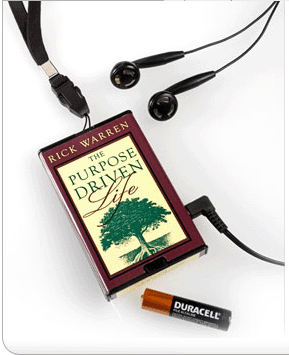
PlayAway - Audio books that don't need a player


Enjoy digital sound from a lightweight player with eight simple buttons. Wear it around your neck or stick it in your pocket. From novels to biographies, languages to business best sellers, Playaway comes already loaded with your favorite content.
Link

Automatic Title Generator for Fantasy Novels

Fun! This website generates entirely plausible titles for entirely unlikable fat extruded fantasy novels. Some examples:

Childrenِ Childِ and Crown
Crown and Illusion
Crystal and Fate
Dark's Light
El-Anash's Citadel
God of the War Queen
Heart and Power
Herald of Fate
Lonian's Children
Maidenِ Fireِ and Crown
Scourge and Glory
Secret and Illusion

Friday, February 03, 2006

Libraries fear digital lockdown

Libraries have warned that the rise of digital publishing may make it harder or even impossible to access items in their collections in the future. Link to BBC article

Thursday, February 02, 2006

Flock -- a browser and more

Check out this cool new open source browser (and tagger, and favorites manager, and search results manager, and blog poster) called Flock. It's still in development, but you can download a beta version and play around with it. You can do a bunch of things with it (at least thirteen different things)...I uploaded this blog post using it, for example*.


* OK, actually it didn't work quite as I thought -- it gave me an error message and I had to come here to blogger to actually publish the post. Maybe that's a bug they'll get fixed in later versions???

100 Best First Lines from Novels

1. Call me Ishmael. —Herman Melville, Moby-Dick (1851)

2. It is a truth universally acknowledged, that a single man in possession of a good fortune, must be in want of a wife. —Jane Austen, Pride and Prejudice (1813)

3. A screaming comes across the sky. —Thomas Pynchon, Gravity's Rainbow (1973)

...and 97 more!

Wednesday, February 01, 2006

Congress caught making false entries in Wikipedia

From CNET News

We already know, of course, that politicians live primarily for re-election and typically view the truth as an impediment to the higher purpose of unfettered self-aggrandizement.

Still, we can be excused for feeling mildly nauseated when fresh confirmation of this distasteful aspect of modern politicking surfaces.

The latest episode appeared last week in the form of a report that aides to Rep. Marty Meehan, a Massachusetts Democrat, deleted references to his broken term-limits pledge and massive campaign war chest on Wikipedia.

Then the trusty editors at Wikipedia got together and compiled a list of over 1,000 edits made by Internet addresses allocated to the U.S. Senate and House of Representatives. The IP address subsequently was blocked and unblocked.

An extensive analysis reveals how juvenile official Washington secretly is, behind the mind-numbingly serious talk of public policy.

Free Online Library Reminder Service with RSS Goodness

The inpiration for Elf came about because my friend started to receive a lot of overdue fines -- he and his wife were having a hard time keeping track of their library books and videos at their local library. They have three kids and the library is a big part of their lives (everyone has a library card). At first they tried a manual system where each kid took out exactly five items. That helped a bit but it forced a fixed reading diet on the kids and the kids weren't particularly keen on being limited this way. So he asked if some software I was working on at time could be adapted to help him and his family keep track of their library borrowings."

Leon County is not available, but TCC and many Florida counties are!

Debbiesidea.com - What to read first

Debbiesidea.com, grew out of a friendship between Debbie Sankey, a lifelong lover of music and books, and Ellen Pall, a writer.

Long before the Internet was commonly available - and certainly before the concept of a "Wikki" - Debbie had the idea that it would be useful to have a reference work suggesting which book of an unfamiliar author would be best to read first. Start reading an author with a poor or atypical example of his work, she observed, and you would likely never read that writer again—perhaps losing in the process a world of pleasure and knowledge. On the other hand, since there would seldom be one right book to read first, the resource would have to be a compendium of opinions.

Recommendations are based on the collective intelligence (meaning: anyone can add anything to any author page). It needs a lot of care and, obviously, more users, but it could be a useful tool.

Debbie died in 2004, at the age of ninety. The website has been created in loving memory of her and her very good idea.

Google misses earnings estimate

Google made news Tuesday, but not in a good way. The company missed analysts' expectation for fourth-quarter earnings--the first time it's done so since going public in 2004.

The search company still reported a profit of $372.2 million for the quarter, nearly double the year-ago period. But thanks in part to higher-than-expected tax rates, that number fell far short of what analysts were looking for.

While the company's share price plunged (down $34 at this post), bloggers weren't ready to throw in the towel just yet. However there were concerns that the company may be coming off the "do no wrong" era and settling down for more modest gains, at least financially.

Amazon plans to wed downloads, DVD

According to Variety Amazon.com is preparing to enter the digital download space this spring with a service that will likely marry downloads to DVD sales.

In one scenario, Amazon customers could stream a digital copy of a film for a fee and apply that charge as a credit toward the eventual purchase of the DVD.

Another plan is for a customer to buy a DVD; while waiting for it to arrive, he could stream the content over his computer.

Monday, January 30, 2006

Free eMail to SMS service


TeleFlip makes sending e-mail to cellphones very easy. Most cellular services allow you to send e-mail to text-enabled cellphones by using its telephone number, but you need to know the domain name, which isn't always intuitive. For example, to email a Verizon user, you send to phonenumber @ vtext.com. Teleflip has now made it possible to send to most any text-enabled cell phone merely by using phonenumber @ teleflip.com.

There might be a useful library tool here. SMS notification of an ILL arrival, overdue book, reserved book availability, special events - maybe a lot of stuff!

Try it. It's free! (yourcellphonenumber)@teleflip.com.

Friday, January 27, 2006

The Life Expectancy of Books

From: Boing Boing

Most books - even popular ones - quickly fall into obscurity and out of print. Here is fascinating insight into the phenomena.

The literature taught in schools is that which has survived: a collection of gross statistical anomalies. This is misleading. Falling out of print is a book's natural fate. We can belatedly train ourselves to believe that this will happen to other people's books. What's hard is for writers to believe it will happen to their own.

It'll happen just the same. It happens faster in mainstream fiction than it does in Our Beloved Genre, more slowly for nonfiction history books, very fast indeed for computer manuals; but in the end, all but a very few titles will be forgotten. Just look at the authors in that collection of bestseller lists. You're a literate bunch, but have you ever heard of Harold Bell Wright? How about Mazo de la Roche? Mary Roberts Rinehart, Lloyd Douglas, Irving Bacheller, Frank Yerby, Coningsby Dawson, Warwick Deeping? These were all notable authors in their day. Some of their books were no better than they should be, while others were genuinely praiseworthy; but all of them spent some time perched on top of the commercial heap.

All gone, now. We shall none of us escape obscurity.

Thursday, January 26, 2006

ScienceDirect and Scopus Now Enabled for MetaLib

From Elsevier.com:
ScienceDirect and Scopus have announced that both systems are enabled for MetaLib®, the Ex Libris portal product. ScienceDirect and Scopus are Elsevier’s primary science, technology, medicine and social science research information services. The new feature is the result of the MetaLib KnowledgeBase update released by Ex Libris, which extends MetaLib’s MetaSearch™ functionality, allowing end users to search and retrieve results from ScienceDirect and Scopus.

New Pew Report: Strength of Internet Ties

The Strength of Internet Ties: The internet and email aid users in maintaining their social networks and provide pathways to help when people face big decisions. Link

Some other websites that link to TCL

More and more sights are referencing our content and even linking to TCL. Here are just a few:

The Handheld Librarian

Library Associates

Distant Librarian

Google Librarian

Central Medical Library (Netherlands)

Blog in Space

College of the Mainland Library

The Redhaired Librarian

TCL in Space!


Last July I signed The Centered Librarian up with "Blog in Space". To date, we have been "beamed up" 5 times. Aliens can now partake of our collective wisdom!
Some 60 years ago humans first began transmitting television signals powerful enough to reach beyond our earth's atmosphere. Since then the media has continued to broadcast messages from I Love Lucy to the five o'clock news into space, potentially reaching intelligent alien life forms beyond our solar system. Blogs In Space is the first entity to allow everyday bloggers to transmit the news and thoughts of an everyday person into space. Simply put we take your feed and transmit it out on a powerful deep space transmission dish.

Dumbfind.com- New Search Engine Aims For More Targeted Results

Stupid name, interesting idea. Here is an article from Yahoo News:
Dumbfind.com entered onto the scene with a two-box search engine approach. Their idea is to combine traditional keywords with topics or categories. Before query results are served up to users, the search engine sorts its findings into related tag clusters to closely match the searcher's intent. When the search query is returned a list of tag clusters also appears.

Thumbthing!


Thumbthing,a brilliant new invention for
reading books – it makes
reading more comfortable.

Also use it as a bookmark.

Ideal for reading in bed, or in
the bath or on the beach.
Great for commuters.

Imagining the Google Future

Business 2.0 Magazine has an interesting article this month examining Google's many possible futures. Included in the speculation are Google is media. Google is the Internet. Google is dead. Google is God.
What kind of company will Google become in the coming decades? Will it succumb to hubris and flame out like so many of its predecessors? Or will it grow into an omnipresent, omnipotent force -- not just on Wall Street or the Web, but in society? We put the question to scientists, consultants, former Google employees, and tech visionaries like Ray Kurzweil and Stephen Wolfram. They responded with well-argued, richly detailed, and sometimes scary visions of a Google future. On the following pages, we've compiled four very different scenarios for the company. Each details an extreme, but plausible, outcome. In three of them, Google attains monopolistic power, lording over the media, the Internet, and scientific development itself. In the fourth, Google withers and dies. That may seem unthinkable now, but nobody is immune to arrogant missteps. Not even the smartest business minds of 2005.

Searching For a Better Image

Ask Jeeves has launched a brand-new image search service, using some innovative techniques to identify high-quality pictures on the web. How does it stack up against the competition?

Read more about it here

Wednesday, January 25, 2006

Libraries as Cultural Icon?

Changing a Cultural Icon:
The Academic Library as a Virtual Destination by Jerry D. Campbell, Chief Information Officer and Dean of University Libraries at the University of Southern California, Los Angeles.

This makes a compelling case that the model for academic libraries has changed and the library as we know it has less and less relevancy to today's users.
http://www.educause.edu/apps/er/erm06/erm0610.asp

Tuesday, January 24, 2006

LivePlasma Movie, Music Discovery Engine


Liveplasma.com, an online site for music and, more recently, movies, graphically "maps" shoppers' potential interests. A search for music by Coldplay, for example, brings up a graphical representation of what previous customers of Coldplay music have purchased, presented in clusters of circles of various sizes.

The bigger the circle, the greater the popularity of that band. The circles are clustered into orbits representing groups of customers with similar preferences.

"This is a way of showing recommendations that are vastly more useful than textual links," said Whit Andrews, a research vice president at Gartner Inc., a market research company in Stamford, Conn.

Apple has expanded its iTunes U program, which allows colleges and universities to post audio and video educational content online using a content management system based on iTunes.

Google Imagery Improves

From the GoogleBlog...

We're always trying to improve the imagery in Google Earth and Google Local, but our latest update is bigger than usual. Not only have we added extensive 6-inch imagery for many parts of the U.K., but we've updated the Google Local database to match the coverage we have in Google Earth, and (drum roll, please) ... we've added two more zoom levels in Google Local's Satellite mode! Now for many areas around the world you can see a lot more detail than you could before.

Take a look at people standing at the gates of Buckingham Palace in London, or jump over the pond and see the Statue of Liberty in New York, and then maybe drop down to the southern hemisphere and check out the boats sailing past the Sydney Opera House.

NCSU Debuts New Catalog

During ALA Midwinter there was quite a bit of chatter about North Carolina State University Libraries new catalog. High points, in my opinion, are relevance ranking, spelling help, and clean user friendly design. Here is an announcement from LJ Academic Newswire, 19-Jan-2006:

North Carolina State University Libraries (NCSU) has taken an important step in making catalogs more robust and user-friendly, deploying the Endeca ProFind™ platform to add capabilities patrons expect from web browsing. Patrons can now search results ranked by relevance, and refine navigation by topic, author, genre, language, material type, format, and availability. Sorting options include publication date, title, author, call number, and popularity. Also, the application displays a “breadcrumb” of the refinements selected to allow backtracking and broadening of search results. Users can also browse by subject without searching at all. Endeca’s technology is used in TLC’s CARL•X library system that has been installed in a few public libraries, but NCSU worked directly with the company, which mainly sells its software to retailers. “Endeca was very interested in talking to libraries,” Andrew Pace, NCSU’s head of systems, told the LJ Academic Newswire. “They knew a lot about searching. We knew a lot about metadata. We did it in six months.” He said the technology “costs less than an ILS, but what you’d expect to buy a high end web search technology.”

Pace known by many of his peers for his colorful denunciations of OPACs, said he began examining Endeca and similar products offered by AquaBrowser and RLG last year. “We don’t have any relevance in Sirsi,” he noted. The last thing cataloged is at the top of the list, which is not great when you add 5000 government documents in a batch load. We’re hoping to expose those titles that users wouldn’t be able to find.” While other libraries may be using Endeca technology, “the thing that’s really first for [our library] is the [Library of Congress] classification browsing. We took LC subject headings and broke them up into their four component parts.” Previously, he noted, the system had to be down for three days to reindex the library’s keyword index of 1.5 million bibliographic records. “Endeca does that in about four hours.” How will users respond to the system? “I almost hope it’s met with deafening silence from the users,” Pace said. “It’s about time it made more sense. Nobody calls up Barnes & Noble and Wal-Mart and asks them how to do a search.”


More links:
NCSU Libraries Unveils Revolutionary, Endeca-Powered Online Catalog

Friday, January 20, 2006

The Library Gives Me a Headache

Dr. Betsy Barefoot, Co-Director for the Policy Center on the First Year of College, and Associate Professor of Educational Leadership at Brevard College in Brevard, North Carolina, has an article in the online Chronicle Review, titled "Bridging the Chasm: First Year Students and Library. It is password protect, but us this link and scroll down for the article.

The campus library may historically be the centerpiece of institutional life on college and university campuses, but many first-year students think it is largely irrelevant to their lives. The reasons include the students' characteristics, attitudes, and prior experiences; the nature of first-year college courses; the lack of instruction on information literacy; and, perhaps most important, the availability of information 24/7 from online sources. Why walk to the library when all the information you could ever need is available at your fingertips in the comfort of your residence-hall room? Or so goes first-year student logic.

Library offers e-Books to reverse declining circulation

Morton Grove Library in Illinois eying e-books as way to reverse declining adult-circulation.
“(Library Director) Schapiro said the e-books will give the library a way to respond to a decline in adult circulation. While the drop has not been drastic, it has been noticeable, he said.

“Over the last couple of months we’ve been noticing a steady decline in our adult circulation. It doesn’t mean there are fewer people coming in,” he said.

Thursday, January 19, 2006

Google, Yahoo Still Favorites in North America

From Search Engine Watch - Survey: Google, Yahoo Still Favorites in North America, For the second year running, a Keynote Systems study says Google provides the most satisfying search...Link

Wednesday, January 18, 2006

Take the Test: "Are you a Librarian?"

From "It's All Good"

Over on PUBLIB, there has been a discussion of a quiz called, "Are You a Librarian?" After more than three decades in the profession, I scored a 72%, good enough for their ranking of "Assistant Librarian." I quote from my results:

"You seem to be a librarian, but you are not as knowledgeable as your more devoted colleagues in some of the library lore, trivia, technical details and social knowledge that can give depth and perspective to ones professional identity; but your practical knowledge of your job may be quite excellent."

On the other hand, I outscored 99% of the other quiz takers of my age and gender.

One drawback is that you don't find out which questions you answered wrong. Otherwise, this is a fun way to waste fifteen minutes or so. Twenty, if you blog about it afterwards!

Score your book's title! Will it sell?!

Want to know if you've got a killer title for your novel? Now, for the first time in literary history, you can put your title to the scientific test and find out whether it has what it takes for bestseller success.

Title Scorer.

Tuesday, January 17, 2006

Bizarre attempt at internet censorship

Web Censorship for Dummies. Annalee Newitz, AlterNet. Posted January 3, 2006. Here's an interesting story about CP80, a lobbying group pushing the "Internet Channel Initiative," a "technology solution" designed to limit pornography. Their idea is to put all pornography on one "channel" (i.e., port) and so be able to limit access to that port. However, this television metaphor doesn't fly because ports are used to differentiate types of communication protocols (http, smtp, etc.), not kinds of content. But beyond the technological problems with their initiative, check out the corporate sponsors -- amazon, iTunes, Best Buy, Sony Musci Store, Hickory Farms(?!) etc. This is even more troubling because these companies have alot of power and pull and they obviously aren't even thinking about the free speech implications of this "initiative", only the bottom line. This is the epitome of corporate irresponsibility. I think these companies should be at the top of the "do not shop at" list!...

Firefox Garners 20% of Euro Market

The Mozilla Firefox browser has achieved a market share of more than 20 percent in Europe, according to the latest figures released by French Web metrics firm XiTi.

XiTi, which based its figures on a sample of 32.5 million Web site visits that took place on Jan. 8, said that Finland has the highest proportion of Firefox users, followed by Slovenia and Germany. It found that the open-source browser is used by 38, 36 and 30 percent of users in these countries, respectively.

From CNET News

Using building tops to advertise on Google Maps


Advertisers are slowly discovering the potential of Google Maps. Expect to see more of this in the future.

Friday, January 13, 2006

Learn who is linking to The Centered Librarian

I have added a button in the right panel that shows who has placed a link to us on their site. Yahoo indicates 93 links, though some are redundant. At least we have some audience!