Amazon.com says "...Statistically Improbable Phrases, or "SIPs", show you the interesting, distinctive, or unlikely phrases that occur in the text of books in Search Inside the Book. Our computers scan the text of all books in the Search Inside program. If they find a phrase that occurs a large number of times in a particular book relative to how many times it occurs across all Search Inside books, that phrase is a SIP in that book.
Once we identify a phrase that is statistically improbable:
For books where the phrase is a SIP, we provide an exact count of and link to the occurrences in those books.
For books where the phrase merely appears in the book, we provide a link to those occurrences
We also display a link to search A9.com for the phrase"
A search on Seeing What's Next: Using Theories of Innovation to Predict Industry Change and many others will result in SIPs appearing at the top of the page. They work rather like subject headings for which there was no metadata. Interesting.
Wednesday, March 30, 2005


Tuesday, March 29, 2005
Google is dying; death by a billion cuts
I recently heard a comparison of the way Yahoo can add information when it wants the information in its database -consume an XML file and affect the search rankings vs. the way Google tries to add the same information -consume webpage after webpage and rely on their algorithm to create relevant rankings. It may be that the model Google uses has limits and it may have reached them. Google-watch says just that. An interesting view: Google is dying
Monday, March 28, 2005
Libraries try 'gentle nudge' to spur returns
Lake County this month became the third Central Florida county to seek help from a company that specializes in collecting library fines and overdue items.
Lake turned to a collection agency that uses friendly phone calls and letters to give patrons with overdue materials an encouraging prod rather than a sharp elbow to the ribs that comes with a tougher approach. The soft approach has paid off in Brevard, which has collected more than $400,000 in fines and overdue materials since contracting with Unique Management Services in 1997.
Article Here
Lake turned to a collection agency that uses friendly phone calls and letters to give patrons with overdue materials an encouraging prod rather than a sharp elbow to the ribs that comes with a tougher approach. The soft approach has paid off in Brevard, which has collected more than $400,000 in fines and overdue materials since contracting with Unique Management Services in 1997.
Article Here
Friday, March 25, 2005
In 2014...
In 2014 we'll get ALL information in a new way. Here's a look at the possible the future of search -and more. (8 min flash movie.)
LINK
LINK
Google Print has started returning hits
If you type "book" and then a title or subject you will get results. Here is a shot of the results I got by entering "book library management" 
Google Trendmapper
From Seth's Blog
This is a cool service that let's you watch the google hits of a phrase or site over time. That's interesting. What's really interesting, though, is the list of phrases that people are watching. Some are not surprising (Joi Ito) and some are just sort of puzzling (ninja--did they not understand what this is for?)
Most interesting of all, though, is the way a small community of bloggers and webheads are always doing the next great thing. If you have a brand or a site or a cause, you should do this. But how does the word about it disseminate? Watch the link below to see who else is tracking...
Main List of Searches (most interresting)
Home Page
This is a cool service that let's you watch the google hits of a phrase or site over time. That's interesting. What's really interesting, though, is the list of phrases that people are watching. Some are not surprising (Joi Ito) and some are just sort of puzzling (ninja--did they not understand what this is for?)
Most interesting of all, though, is the way a small community of bloggers and webheads are always doing the next great thing. If you have a brand or a site or a cause, you should do this. But how does the word about it disseminate? Watch the link below to see who else is tracking...
Main List of Searches (most interresting)
Home Page
Consumerpedia
From Information Today
Take a look at Consumerpedia
Who uses our catalogs? Our patrons. So, why are they built for and by librarians? By having the community involved in how our catalogs are structured, they might actually make sense to the people who use it. Each library catalog will be unique to the community that helps to build it, with their own (un)structured taxonomies. Sure, there can be some underlying structure (I'm not a totally crazed lunatic), but why not contributions from our patrons in the form of open tagging structures to add to the existing catalog. It could work...
Take a look at Consumerpedia
Who uses our catalogs? Our patrons. So, why are they built for and by librarians? By having the community involved in how our catalogs are structured, they might actually make sense to the people who use it. Each library catalog will be unique to the community that helps to build it, with their own (un)structured taxonomies. Sure, there can be some underlying structure (I'm not a totally crazed lunatic), but why not contributions from our patrons in the form of open tagging structures to add to the existing catalog. It could work...
"Consumerpedia has no built in category hierarchy, but rather uses a unique user-driven hierarchical tagging system. This lets users create and define the relationships between different topics, helping others easily discover and browse related information...the Consumerpedia system is designed so that it evolves based upon how actual users wish to use it, with the sole organizing principle being how helpful it is to others. "
The Handheld Librarian
I just stumbled across a blog that may be valuable to us:
The Handheld Librarian
The Handheld Librarian
Librarians sharing news, applications, and ideas of interest with others working with handheld computer technology.
Wednesday, March 23, 2005
Skype (VOIP) at the Library
"Most libraries now have access to the Internet but not all are able to afford a toll free line to help patrons living outside their area code. The free or low fee long distance services could be a pretty attractive option for libraries looking to provide this type of service or to expand existing services."
If Skype takes off and becomes as popular as IM, it could help with virtual reference services even for those near the library.
Link Here
Second-generation RFID tags on the way
RFID specialist Impinj will come out with tags and readers based on the so-called "Gen 2" spec for RFID in the second quarter, which will make it the first company to release products for this standard, William Colleran, Impinj's CEO, said at PC Forum, an event taking place this week in Scottsdale, Ariz.
The new spec essentially expands and enhances the current RFID specifications, Colleran added. The company's Speedway Reader, coming out in the second quarter, can read 1,500 tags a second, he said. The Gen 2 spec also gives the person controlling the tags the ability to kill them, thereby helping with privacy concerns. The tags can also be read at a distance of 30 feet, which is further away than current RFID tags can be read.
Colleran, like many RFID proponents, promises the market will be huge. In 2004, tens of millions of RFID tags shipped. By 2008, 80 million will be shipped annually, and each tag will cost between 5 cents and 8 cents to make.
(By comparison, tags today cost between 15 cents and $100 each, according to In-Stat/MDR.)
"There is no reason 5 cent tags aren't possible," Colleran said. "This is the first market ever for consumable silicon."
Seattle-based Impinj grew out of research conducted at CalTech in the '90s under the auspices of tech luminary Carver Mead. The company has raised $50 million in venture capital, and in 2004 it garnered revenue of $2 million.
The new spec essentially expands and enhances the current RFID specifications, Colleran added. The company's Speedway Reader, coming out in the second quarter, can read 1,500 tags a second, he said. The Gen 2 spec also gives the person controlling the tags the ability to kill them, thereby helping with privacy concerns. The tags can also be read at a distance of 30 feet, which is further away than current RFID tags can be read.
Colleran, like many RFID proponents, promises the market will be huge. In 2004, tens of millions of RFID tags shipped. By 2008, 80 million will be shipped annually, and each tag will cost between 5 cents and 8 cents to make.
(By comparison, tags today cost between 15 cents and $100 each, according to In-Stat/MDR.)
"There is no reason 5 cent tags aren't possible," Colleran said. "This is the first market ever for consumable silicon."
Seattle-based Impinj grew out of research conducted at CalTech in the '90s under the auspices of tech luminary Carver Mead. The company has raised $50 million in venture capital, and in 2004 it garnered revenue of $2 million.
EDUCAUSE | Resources | Net Generation Students and Libraries
An interesting ebook titled Educating the Net Generation is available for free from Educause. Check out chapter 13, Net Generation Students and Libraries, by Joan Lippincott of the Coalition for Networked Information. Here is a quote:
What are some of the major disconnects between many of today's academic libraries and Net Gen students? The most common one is students' dependence on Google or similar search engines for discovery of information resources rather than consultation of library Web pages, catalogs, and databases as the main source of access. Since students often find library-sponsored resources difficult to figure out on their own, and they are seldom exposed to or interested in formal instruction in information literacy, they prefer to use the simplistic but responsive Google. Another disconnect is that digital library resources often reside outside the environment that is frequently the digital home of students' coursework, namely, the course management system, or CMS. Library services are often presented in the library organization context rather than in a user-centered mode. Libraries emphasize access to information but generally do not have facilities, software, or support for student creation of new information products. All of these disconnects can be remedied if appropriate attention is paid to the style of Net Gen students.
Tuesday, March 22, 2005
Ebooks and OCR come to the mobile phone
In the latest versions, cell-phone novels are downloaded in short installments and run on handsets as Java-based applications. You're free to browse as though you're in a bookstore, whether you're at home, in your office or on a commuter train. A whole library can be tucked away in your cell phone - a gadget you carry around anyway. "You can read whenever you have a spare moment, and you don't even need to use both hands," says Taro Matsumura, a 24-year-old graduate student who sometimes reads essays and serial novels on his phone...
Link Here
Friday, March 18, 2005
It's all good: "Getting Thousands of Hits" - Ban ThisMeme
It's all good: "Getting Thousands of Hits" - Ban This Meme
Our colleague Lorcan Dempsey's post to his blog yesterday was about library strategic plans and searching from library web sites. One commenter to Lorcan's posting worries about (my words, not his) dumbing down the library's search interface to the simplicity offered by Google, fearing the result would be "thousands of hits."
Thursday, March 17, 2005
Project Management - Don't Do These Things
Don’t believe everything you are told about a potential project’s benefits. Investigate for yourself and plan accordingly.
Don’t take on a project that doesn’t have a strong sponsor that is committed to seeing the project succeed.
Don't forget that most project assumptions should also be risks.
Don't set project expectations that are higher than reality can deliver.
Don't try to define reality too early in the project planning phase.
Don’t define solutions that do not address needs.
Don’t forget to manage customer expectations.
Don’t forget to thank your team members for the good job they are doing.
Don’t be a whiner. A leader never whines and a whiner never leads.
Don’t forget that leaders need to have credibility.
Don’t forget that credibility requires honesty, dedication, commitment, and capability.
Don’t forget that people are the number one reason for project failure.
Don’t forget that empowering teams is a management function.
Don’t allow others to influence your attitude. Be positive in the face of adversity.
Don’t forget to have fun while working on your projects.
Don’t forget that Project Management is mostly art and some science.
Don’t take on a project that doesn’t have a strong sponsor that is committed to seeing the project succeed.
Don't forget that most project assumptions should also be risks.
Don't set project expectations that are higher than reality can deliver.
Don't try to define reality too early in the project planning phase.
Don’t define solutions that do not address needs.
Don’t forget to manage customer expectations.
Don’t forget to thank your team members for the good job they are doing.
Don’t be a whiner. A leader never whines and a whiner never leads.
Don’t forget that leaders need to have credibility.
Don’t forget that credibility requires honesty, dedication, commitment, and capability.
Don’t forget that people are the number one reason for project failure.
Don’t forget that empowering teams is a management function.
Don’t allow others to influence your attitude. Be positive in the face of adversity.
Don’t forget to have fun while working on your projects.
Don’t forget that Project Management is mostly art and some science.
Wearable hub for communications in the home
Siemens has developed a communications device which recognizes voice commands and allows its user to control home communications and automation systems. The device can be worn like a badge or pin on clothes and transmits commands via Bluetooth to a central home communications server where a software converts the words into commands for the hooked-up systems.
The wearer can, for example, control the intercom system of a house, communicate with a visitor standing at the front door and instruct the master locking system to open the door. S/he can also accept phone calls and conduct phone conversations over a loudspeaker. A connection with an e-mail inbox on a PC is also envisioned. The voice recognition software reads incoming e-mails and recites the text.
The program doesnÃt have to be "trained" to recognize the userÃs voice. It can recognize 30,000 words, and predefined commands can be spoken. Beisdes, the software recognizes semantically linked words from longer sentences.
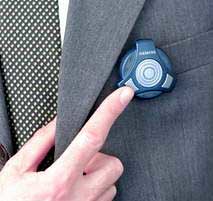
The wearer can, for example, control the intercom system of a house, communicate with a visitor standing at the front door and instruct the master locking system to open the door. S/he can also accept phone calls and conduct phone conversations over a loudspeaker. A connection with an e-mail inbox on a PC is also envisioned. The voice recognition software reads incoming e-mails and recites the text.
The program doesnÃt have to be "trained" to recognize the userÃs voice. It can recognize 30,000 words, and predefined commands can be spoken. Beisdes, the software recognizes semantically linked words from longer sentences.
Computers in Libraries Summary-Day One
Here are some notes on the 1st afternoons sessions:
Things to watch for in the next few years:
- secure broadband wireless will be huge
- low-power batteries on many things
- real-time infrastructure... emerging
- service-oriented architecture - perfect compliment for how libraries actually run
Hardware innovations in the next decade:
- "Living in a video game" - life might seem like this
- A bridge for physical and electronic worlds
- Smart pills, nanotechnology, etc.
- RFID - interesting challenge
- Trusted computing
Mobile and wireless in the next decade:
- continued integration between phones and PDAs
- mesh network - your wireless thing will know where you are
- mobile commerce - being able to buy articles online
computer human interactionin the next decade:
- biometrics, speech, handwriting, eye position
- head-mounted displays
- natural language, taxonomies, etc - search logic
- GIS - so your device can tell you where something is
Data Analytics in the next decade:
- advanced functionality
- comment - librarians are text based learners. That's why only 20% of the population uses libraries. It's a design thing...
- libraries need to figure out streaming media (CDs and DVDs will go away soon)
- sending a picture of someone to Google to find information about them... wow!
System development in the next decade:
- XML will get big
- Integration with other systems will become more commonplace
Other things mentioned:
* People will spend more time interacting with people in the electronic world
* 93% of kids 19 or younger currently have at least two IM addresses...
* Connected society - wearable tech. smart phones - outsell laptops, phones, PDA, etc.
* Location-based services - like wireless grabs your screen and puts you on a hotel's webpage - libraries should be able to do that, too.
* Handsets will get huge - focus on applications
* e-learning and distance education will get huge... some usiversities already have 60% of students as distance students
* every university will have federated search and open url technology within 2 years, public libs within 4 years - they'll need to have them to survive.
* shared ideas (intranets) shared creation - workflow content management, web conferencing shared presence - IM, video conferencing
Linky
Things to watch for in the next few years:
- secure broadband wireless will be huge
- low-power batteries on many things
- real-time infrastructure... emerging
- service-oriented architecture - perfect compliment for how libraries actually run
Hardware innovations in the next decade:
- "Living in a video game" - life might seem like this
- A bridge for physical and electronic worlds
- Smart pills, nanotechnology, etc.
- RFID - interesting challenge
- Trusted computing
Mobile and wireless in the next decade:
- continued integration between phones and PDAs
- mesh network - your wireless thing will know where you are
- mobile commerce - being able to buy articles online
computer human interactionin the next decade:
- biometrics, speech, handwriting, eye position
- head-mounted displays
- natural language, taxonomies, etc - search logic
- GIS - so your device can tell you where something is
Data Analytics in the next decade:
- advanced functionality
- comment - librarians are text based learners. That's why only 20% of the population uses libraries. It's a design thing...
- libraries need to figure out streaming media (CDs and DVDs will go away soon)
- sending a picture of someone to Google to find information about them... wow!
System development in the next decade:
- XML will get big
- Integration with other systems will become more commonplace
Other things mentioned:
* People will spend more time interacting with people in the electronic world
* 93% of kids 19 or younger currently have at least two IM addresses...
* Connected society - wearable tech. smart phones - outsell laptops, phones, PDA, etc.
* Location-based services - like wireless grabs your screen and puts you on a hotel's webpage - libraries should be able to do that, too.
* Handsets will get huge - focus on applications
* e-learning and distance education will get huge... some usiversities already have 60% of students as distance students
* every university will have federated search and open url technology within 2 years, public libs within 4 years - they'll need to have them to survive.
* shared ideas (intranets) shared creation - workflow content management, web conferencing shared presence - IM, video conferencing
Linky
Tuesday, March 15, 2005
Primary Research Group has Released a New Study: Best Practices of Public Library Information Technology Directors
This special report from Primary Research Group is based on exhaustive interviews with information technology directors and other critical staff involved in IT decision-making from the Princeton Public Library, Minneapolis Public Library, Evansville Public Library, Santa Monica Public Library, Boston Public Library, Columbus Metropolitan Public Library, San Francisco Public Library, Seattle Public Library, and the Denver Public Library.
Some of the report’s findings:
Public libraries feel their mission has in many ways been transformed by new technologies, particularly internet access, and that the key to winning greater support for public libraries is educating the public in the use of these technologies. Virtually all of the librarians in this report offer advice and insights for their peers, but all seem to agree on one thing: the public’s appetite for internet and database access is growing and virtually insatiable.
The public library’s peculiar combination of free internet access and knowledgeable tutors and guides has made it an indisputable draw. Many libraries have had success in technology-related bond issues for new libraries or for refurbishing old libraries, even as operating budgets are forced down by uncertain public finances.
Libraries that are using RFID automated book check out technology appear to be divided into two camps: those which hesitate in implementing the technology, and those which essentially limit or eliminate non-automated check out, literally compelling patrons to adjust to the new technology. All of those that had taken the latter approach were glad that they had.
In database licensing, many public libraries appear to believe that they can negotiate individually as well or nearly as well as they can in consortium. We feel that this is a ripe are for library scientists and public library associations to do some serious research to actually quantify the truth or falsity of these perceptions. Whatever the case, apart from some regional and state-level consortiums, public libraries, even larger ones, appear to seriously lag their counterparts in academic libraries in their enthusiasm for consortium arrangements.
While public libraries may lag in the use of consortiums, they are surprisingly advanced in their efforts to digitize their special collections. Many public libraries are further along in the digitization process than their counterparts in small and medium sized academic libraries.
After a slow start, electronic books are making a significant impact, led by organizations such as NetLibrary and Overdrive, whose innovative technology and approach to ebook management appear to be winning many converts.
The libraries in the small sample seemed quite interested in expanding in-house telecommunications capacities, enabling librarians to communicate with one another, and with patrons, while they walked around the library. Vocera, a voice over IP application for libraries, was a coveted product.
Increasingly, public libraries are viewing themselves as places to introduce new technologies to the public. Centers that introduce new software and hardware have increasingly become part of the public library mission and are major selling points in raising new funds for libraries.
Some of the report’s findings:
Public libraries feel their mission has in many ways been transformed by new technologies, particularly internet access, and that the key to winning greater support for public libraries is educating the public in the use of these technologies. Virtually all of the librarians in this report offer advice and insights for their peers, but all seem to agree on one thing: the public’s appetite for internet and database access is growing and virtually insatiable.
The public library’s peculiar combination of free internet access and knowledgeable tutors and guides has made it an indisputable draw. Many libraries have had success in technology-related bond issues for new libraries or for refurbishing old libraries, even as operating budgets are forced down by uncertain public finances.
Libraries that are using RFID automated book check out technology appear to be divided into two camps: those which hesitate in implementing the technology, and those which essentially limit or eliminate non-automated check out, literally compelling patrons to adjust to the new technology. All of those that had taken the latter approach were glad that they had.
In database licensing, many public libraries appear to believe that they can negotiate individually as well or nearly as well as they can in consortium. We feel that this is a ripe are for library scientists and public library associations to do some serious research to actually quantify the truth or falsity of these perceptions. Whatever the case, apart from some regional and state-level consortiums, public libraries, even larger ones, appear to seriously lag their counterparts in academic libraries in their enthusiasm for consortium arrangements.
While public libraries may lag in the use of consortiums, they are surprisingly advanced in their efforts to digitize their special collections. Many public libraries are further along in the digitization process than their counterparts in small and medium sized academic libraries.
After a slow start, electronic books are making a significant impact, led by organizations such as NetLibrary and Overdrive, whose innovative technology and approach to ebook management appear to be winning many converts.
The libraries in the small sample seemed quite interested in expanding in-house telecommunications capacities, enabling librarians to communicate with one another, and with patrons, while they walked around the library. Vocera, a voice over IP application for libraries, was a coveted product.
Increasingly, public libraries are viewing themselves as places to introduce new technologies to the public. Centers that introduce new software and hardware have increasingly become part of the public library mission and are major selling points in raising new funds for libraries.
RFID Zapper
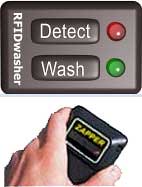
For the incredibly privacy-conscious (or those with something to hide), the TagZapper by West End Laboratories is a handheld device to wipe RFID transmitting devices.
Article
Article
Friday, March 11, 2005
Hand Bookbindings - Beautiful!
The craft and art of binding books by hand was vividly chronicled in an exhibition at Princeton University’s Firestone Library. Entitled "Hand Bookbindings: Plain and Simple to Grand and Glorious," the exhibition ran from November 10, 2002 through April 20, 2003 in the Library’s main gallery. While conventional wisdom holds that books cannot be judged by their covers, visitors had a chance to do just that from the most humble of volumes to the most luxurious; from the monastic manuscripts of the twelfth century to the special editions of the twentieth.
Now that the exhibition has run its course, it has been turned into an online display of over two hundred bindings.
Now that the exhibition has run its course, it has been turned into an online display of over two hundred bindings.
Portals in Libraries: Library Technology and Planning for Change
Library websites are typically organized around library functions (interlibrary loan, circulation, reference) or existing information stores (the card catalog, print indexes). Web-savvy users who are not familiar with traditional library organization methods do not view our websites as transparent or able to meet their information-seeking requirements.
Great article Here
Great article Here
Subscribe to:
Comments (Atom)