Wednesday, March 23, 2011

50 beautiful photos of Saturday's super moon


See the rest here.

Visual evidence that the NYT's pricing structure is wrong

Click to enlarge

Found at The Understatement via Daring Fireball

The Book Cover Archive

Over 1300 to browse

and more great sites on book cover design
Found via Coudal Partners

Map: Where Americans Are Moving

More than 10 million Americans moved from one county to another during 2008. Forbes magazine has a very interesting interactive map that visualizes those moves. Click on any county to see comings and goings: black lines indicate net inward movement, red lines net outward movement.


Found at TYWKIWDBI

Yet another book list: 50 most influential from the past 50 years


From the site:
In compiling the books on this list, the editors at SuperScholar have tried to provide a window into the culture of the last 50 years. Ideally, if you read every book on this list, you will know how we got to where we are today. Not all the books on this list are “great.” The criterion for inclusion was not greatness but INFLUENCE. All the books on this list have been enormously influential.

The books we chose required some hard choices. Because influence tends to be measured in years rather than months, it’s much easier to put older books (published in the 60s and 70s) on such a list than more recent books (published in the last decade). Older books have had more time to prove themselves. Selecting the more recent books required more guesswork, betting on which would prove influential in the long run.

We also tried to keep a balance between books that everyone buys and hardly anyone reads versus books that, though not widely bought and read, are deeply transformative. The Grateful Dead and Frank Zappa never sold as many records as some of the “one-hit wonders,” but their music has transformed the industry. Influence and popularity sometimes don’t go together. We’ve tried to reflect this in our list.

Radiation dose chart

Apropos of the crisis in Japan and concern over radiation leakage, a friend sent me a link to this chart.

Click to enlarge

Monday, March 21, 2011

10 things you didn't know about the moon


1) There's actually four kinds of lunar months

2) We see slightly more than half of the moon from Earth

3) It would take hundreds of thousands of moons to equal the brightness of the sun
The rest and narrative here.

A century of meat

Click to enlarge

Found at TYWKIWDBI

Sunday, March 20, 2011

Book Saver

Looks like there's a new gadget that could 'turn the page' on the future of eBook access. The new Book Saver acts as a quick digital scanner for print books. Ion, the company that makes this gadget, claims one can scan a 200 page book in 15 minutes time, which is believable after seeing the YouTube video. At least one reviewer has already noted the similarities with this device and music ripping.

Friday, March 18, 2011

London in the round

A visualization of the city in silhouettes...
Click to enlarge

Found at Coudal Partners

Thursday, March 17, 2011

Digital textbooks will soon be the norm

Sales of digital textbooks currently account for only a fraction of the U.S. college textbook market. According to the latest report by the social learning platform Xplana, the tipping point for e-textbooks has been reached, and they predict in the next five years digital textbook sales will surpass 25% of sales for the higher education and career education markets.

Last year Xplana predicted that one in five college textbooks would be digital by the year 2014, but due to the rate at which colleges are embracing digital textbooks, Xplana now projects that sales will grow by 80 to 100% over the next four years.

Full report here.

Tuesday, March 15, 2011

Earthquake damage to libraries in Japan


There is a rather extensive collection of images apparently uploaded by Japanese librarians over at togetter

A brief history of title design

Ian Albinson and his staff over at The Art of the Title have put together a most excellent short film for SXSW.

A Brief History of Title Design from Ian Albinson

Monday, March 14, 2011

The Time for Libraries is Now

Amazingly realistic "Geminoid" is eerily human

It's not a fake. This is the latest iteration of Geminoid series of ultra-realistic androids, from Kokoro and Hiroshi Ishiguro. Specifically, this is Geminoid DK, which was constructed to look exactly like Associate Professor Henrik Scharfe of Aalborg University in Denmark


21 reasons learning English is hard...

1. The bandage was wound around the wound.

2. The farm was used to produce produce.

3. The dump was so full it had to refuse more refuse.

4. We must polish the Polish furniture.

5. He could lead if he would get the lead out.

6. The soldier decided to desert his dessert in the desert.

7. Since there was no time like the present, he thought it was time to present the present.

8. A bass was painted on the head of the bass drum.

9. When shot at, the dove dove into the bushes.

10. I did not object to the object.

11. The insurance was invalid for the invalid.

12. There was a row among the oarsmen on how to row.

13. They were too close to the door to close it.

14. The buck does funny things when does are present.

15. A seamstress and a sewer fell down into a sewer line.

16. To help with planting, the farmer taught his sow to sow.

17. The wind was too strong to wind the sail.

18. After a number of injections my jaw got number.

19. Upon seeing the tear in the painting I shed a tear.

20. I had to subject the subject to a series of tests.

21. How can I intimate this to my most intimate friend?

Designers respond to help Japan

In response to the earthquake and tsunami tragedy in Japan, designers have responded in the best way that they know. Creating pieces like this one below with the sale proceeds going to support the people of Japan in their time of need.

View more incredible designs and participate here.

Found via: Coudal Partners

Thought provoking drawings by Paweł Kuczyński


Many more here.

The Power of Pull: Your personal data locker.

Pull by David Siegel predicts the next disruptive wave to be the semantic web – a more standardized, accessible Web where our personal data will be so precisely parsed as to make logical conclusions possible. He predicts a fundamental transition from pushing information to pulling, using a new way of thinking and collaborating online. Siegel envisions the future of smart computing where your data follows you around and is accessible from anywhere through the Web, predicting that hardware and operating systems will become obsolete as the Web itself becomes the computer. The "cloud" will at last arrive with all its potential realized.

David Siegel, is an entrepreneur and public speaker who has been writing and lecturing about the Internet and the semantic web since 1995. He started blogging in 1994, before the term was invented, and built some of the Internet's first sites. He is an active angel investor and advisor to startups and large corporations. He is the author of the bestselling Creating Killer Websites and Futurize Your Enterprise. He lives in New York City. Below is a descriptive and fascinating video demonstrating his concepts. His blog and more detailed information is here.

Saturday, March 12, 2011

The Homesteader's Free Library


homestead.org is a great resource for anyone headed back to the land. There are wonderful resources on such topics as cooking, construction, beekeeping, gardening, machinery, poultry and so much more.

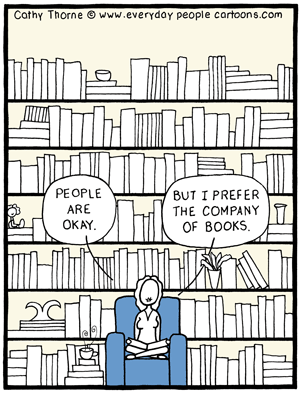
I prefer books

Fonts in popular logos


Colleection and commentary over at hongkiat.com

Thursday, March 10, 2011

Replacing the "N-word" with "Robot" in Huck Finn

Because it makes about as much literary sense as replacing it with "slave".

TinEye reverse image lookup

TinEye is a reverse image search engine. You can submit an image to TinEye to find out where it came from, how it is being used, if modified versions of the image exist, or to find higher resolution versions.

TinEye is the first image search engine on the web to use image identification technology rather than keywords, metadata or watermarks. It is free to use for non-commercial searching.

TinEye regularly crawls the web for new images, and also accepts contributions of complete online image collections. To date, TinEye has indexed 1,894,458,529 images from the web to help you find what you're looking for. Below is an introductory video.

Wednesday, March 09, 2011

The American Library Association takes on self-destructing eBooks

The American Library Association has commissioned two new task forces to investigate the future of ebooks in libraries: the Equitable Access to Electronic Content Task Force and the E-book Task Force. The objective is to come up with a nationwide, coherent strategy to address the fact that some publishers will not make their books available as lendable ebooks, while others require ebooks to be packaged in formats that self-destruct after a certain number of checkouts. Among other things, the ALA states the task forces will:

  • Work to establish meetings between ALA leadership and publisher and author associations to discuss model lending and purchase options for libraries.

  • Establish mechanisms for interactive and ongoing communication for ALA members to voice concerns and pose questions to ALA leadership.

  • Establish communication and solicit input with other ALA member divisions and units, including the Office for Intellectual Freedom.
Full text of the press release.

Podcast on an eBook Reader's Bill of Rights

This brief podcast on an eBook Reader's Bill of Rights from The Pod Delusion provides a good explanation of this latest proposal from the blogosphere.

Smithsonian Wild


Welcome to Smithsonian WILD! This site is designed to showcase some of the exciting research conducted by the Smithsonian Institution and its collaborators around the world, and to highlight the incredible diversity of wildlife that exists in a range of habitats across the globe.

The use of motion-triggered 'camera traps' has become an incredibly useful tool for scientists to answer an enormous range of conservation and ecological questions. Researchers attach these unique cameras to posts or trees, often along forest trails, and when a camera's sensor registers an animal's body heat and movement, a photograph is taken. The studies highlighted here demonstrate the range of applications of this method, and how these cameras give us a glimpse into an animal world that is rarely seen by anyone. You can search the site by following the trail of interesting animals or the lure of diverse sites around the world.

A wonderful new site and well worth a visit.

Schrödinger's cat. Just because...

The typography and art of Robert Rebotti


Muvh more at Living Design

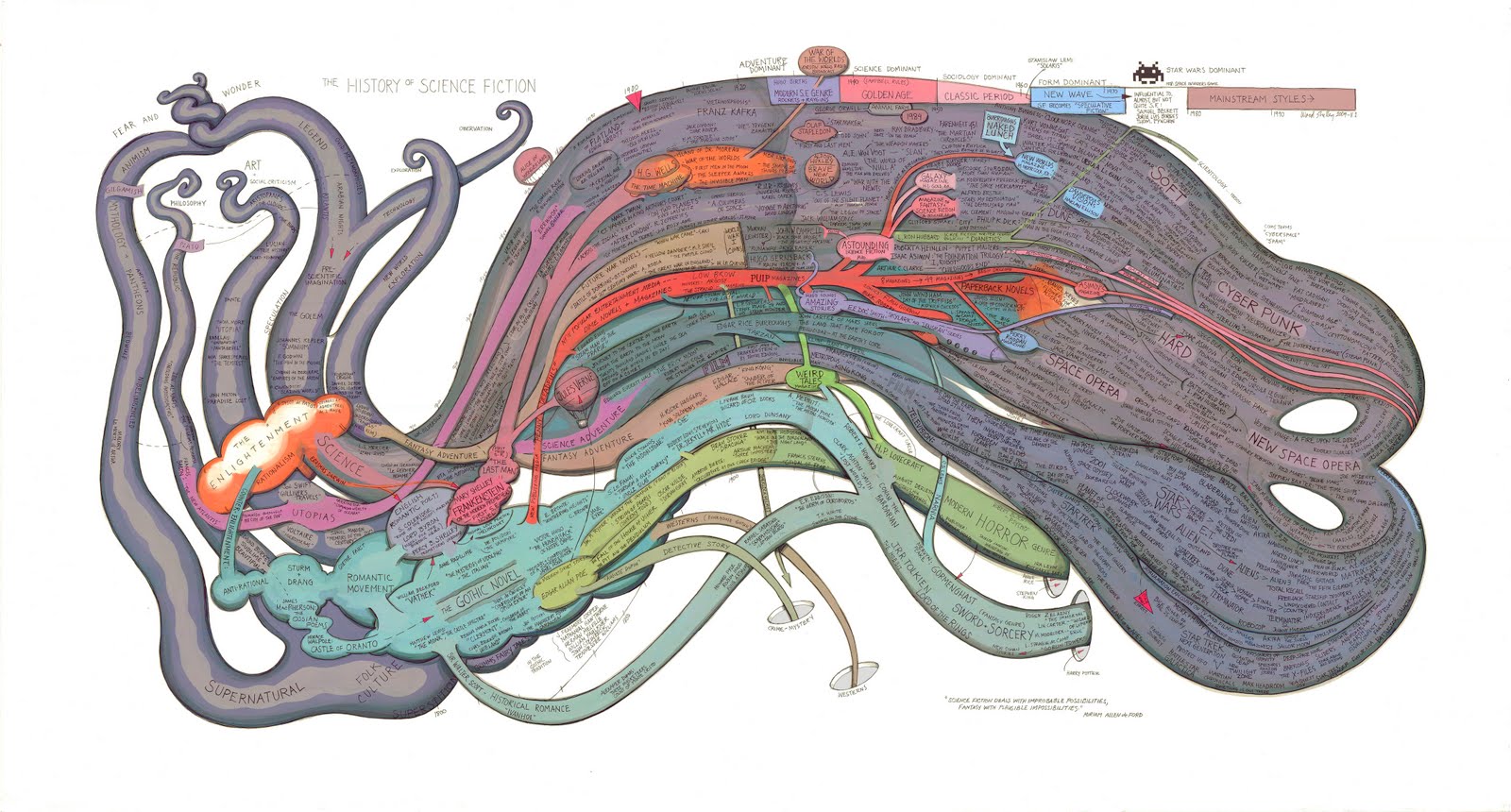
Infographic: A hand-drawn history of science fiction

Click to enlarge

Found at Places and Spaces. Click the link for a much larger version.

Tuesday, March 08, 2011

Another beautiful library

Click to enlarge

Study Center of the Anna Amalia Library in Weimar.

Found at fotocommunity

Infographic: Mardi Gras Madness

Click to enlarge


1.2 MILLION people attended Mardi Gras festivities last year--3.5 times the population of New Orleans.

The City of New Orleans Spends $3.33 MILLION on Mardi Gras each year. It sees a return of $4.48 for every public dollar spent.

Hotels take in $56 million over the 12 days. Prices for a double room on Bourbon Street increase 151% over any other time during the year.

The 12-days party includes 87 parades put on by 54 different krewes.

Mardi Gras always kicks off 59 days before Easter.

The Endymion and Bacchus superparades feature 75 floats and 60 marching bands.

2,300 members toss 1.5 million plastic cups, 2.5 million doubloons, and 200,000 beads to parade bystanders.

The Mardi Gras Indians craft the most elaborate parade costumes.

Each sequined and ostrich-plume-covered costume has 100,000-plus beads and weighs 150 lbs.

There are 3,000 bars in New Orleans, THE HURRICANE is considered the cocktail of Mardi Gras: 4 oz. LIGHT AND DARK RUM, 2 oz. PASSION-FRUIT JUICE, 1 OZ. ORANGE JUICE, 1/2 OZ. LIME JUICE, AND 1/2 OZ. GRENADINE.

Haydel's Bakery Sells 57,000 yellow, green, and purple king cakes--baked with plastic doll inside--during Mardia Gras. That's enough to give 2 million people, or all of Slovenia, a slice.

In 2010, Haydel's baked the world's LARGEST king cake: IT wrapped around the Louisiana Superdome twice and fed 6,000 folks. That's roughly 92,890 bonus bottles of Southern Comfort. Alcohol sales spiked $2.6 MILLION during the festivities.

In 154 years, Mardi Gras celebrations have been canceled 13 times--for, among other reasons, a YELLOW-FEVER epidemic and riots during the Reconstruction--but not after Hurricane Katrina.

700,000 people partied at the post-Katrina Mardi Gras, the only year corporate sponsorship was allowed.

Glad donated 2,100 boxes of trash bags.

For every 1 woman who participates in the FLASHING ritual for beads, there are 10 men with video cameras ready to record it. Girls Gone Wild has 6 films dedicated to Mardi Gras.

7 out of 10 Americans polled in 2009 said they support making Mardi Gras A NATIONAL HOLIDAY

Found at Fast Company

IE6 is finally dying

Click to enlarge

Found at Living Design

Minimalist Photography


Prakash Ghodke has a gorgeous collection of "minimalist" photographs over at Noupe.com.

eBooks: durability is a feature, not a bug


Cory Doctorow has posted a pointed reply to HarperCollins' recent decision to establish a 26-loan limit on their eBooks. This means after 26 checkouts, the library must pay for a new license if they want to continue lending the book electronically. The rationale offered by the publisher is since paper books wear out and need to be replaced if they are to remain in a library's collection, the same should be true of their electronic formats. The publisher argues that it should not be denied revenues that come from reselling replacement books and resources. Because the publisher assumes digital resources never deteriorate, they have set an arbitrary limit to the number of times an electronic resource can be accessed. Libraries are not pleased with this policy.

In his article in the Guardian, Doctorow says
"Now, in point of fact, many ordinary trade books circulate far more than 26 times before they're ready for the discard pile. If a group of untrained school kids working as part-time pages can keep a copy of the Toronto Star in readable shape for 30 days' worth of several-times-per-day usage, then it's certainly the case that the skilled gluepot ninjas working behind the counter at your local library can easily keep a book patched up and running around the course for a lot more than 26 circuits. Indeed, the HarperCollins editions of my own books are superb and robust examples of the bookbinder's art (take note!), and judging from the comments of outraged librarians, it's common for HarperCollins printed volumes to stay in circulation for a very long time indeed.

But this is the wrong thing to argue about. Whether a HarperCollins book has the circulatory vigour to cope with 26 checkouts or 200, it's bizarre to argue that this finite durability is a feature that we should carefully import into new media. It would be like assuming the contractual obligation to attack the microfilm with nail-scissors every time someone looked up an old article, to simulate the damage that might have been done by our careless patrons to the newsprint that had once borne it."

In protest of HaperCollins' policy, librarians over at The Virtual Library made this video:

Monday, March 07, 2011

Welcome to Pinepoint


Imagine your hometown never changed. That no one ever grew old or moved on. Part book, part film, part family photo album, Welcome to Pine Point unearths a place frozen in time and discovers what happens when an entire community is erased from the map.

Waiting for Superman


From Time:
“Our future depends on good teachers — and that the coddling of bad teachers by their powerful unions virtually ensures mediocrity, at best, in both teachers and the students in their care.”

How to care for your books

1. The spine of a new hardcover book can be stiff and might crack if it is forced open. To condition the spine, remove the dust cover and stand the book vertically on a hard surface with the spine down. Holding the pages upright, let the covers fall open. Then release the pages in 1/4-inch batches on alternating sides, pressing the pages gently as they fall. Continue until you get to the center of the book. Never force a book to open — if it doesn't open all the way, cradle the spine at an angle.

2. Always store books upright or flat, keeping similarly sized books together. Never lean them at an angle or vertically on their spine or pages. Don't pack books too tightly on the shelves or they may crack or become scratched if they are pulled out too roughly. To properly remove a book from the shelf, push in the two books next to it and grasp the book by either edge of the spine. Don't pull it from the top of the spine.

3. Don't store books too close to a heater, in direct sunlight or in damp places where they could become mildewed. If your books do mildew, try rubbing the mildew with a very dry cloth and leaving the book open in the sunlight for about 45 minutes (but not for too long or the book may start to fade). If the book is very valuable, take it to a specialist in book conservation before trying to clean it yourself.

4. When you dust your books, make sure to dust from the spine outward so that the dirt doesn't settle in the pocket behind the spine.

5. Handle books with clean, dry hands. Oils, perspiration, dirt and food residue can cause a lot of damage.

Found at Apartment Therapy

Time lapse photos of the ALMA antenna array in the Chilean Andes


High on the Chajnantor plateau in the Chilean Andes, the European Southern Observatory (ESO), together with its international partners, is building ALMA — a state-of-the-art telescope to study light from some of the coldest objects in the Universe. More info and movies at the link.

Found at Coudal Partners

The Codex Sinaiticus Project


Codex Sinaiticus, a manuscript of the Christian Bible written in the middle of the fourth century, contains the earliest complete copy of the Christian New Testament. The hand-written text is in Greek. The New Testament appears in the original vernacular language (koine) and the Old Testament in the version, known as the Septuagint, that was adopted by early Greek-speaking Christians. In the Codex, the text of both the Septuagint and the New Testament has been heavily annotated by a series of early correctors.

The significance of Codex Sinaiticus for the reconstruction of the Christian Bible's original text, the history of the Bible and the history of Western book-making is immense.

The Codex Sinaiticus Project was made possible by the collaboration between The British Library, Leipzig University Library, St. Catherine's Monastery in Syria and The National Library of Russia.

Book-inspired bathroom tiles


From Katy Galbraith via TYWKIWDBI

Margaret Atwood on books...


From The Telegraph

Friday, March 04, 2011

Ever wonder what those weird camera settings do?

Is publisher greed endangering the e-book market?

Is publisher greed endangering the e-book market? We're already seeing publishers like Harper Collins restricting e-book use by libraries, and Amazon not allowing library loaned e-books to display on Kindle. Now Random House is the last of the big 6 publishers to switch to agency pricing. This latest move is a big blow to any hopes that e-books with older published dates will ever reach a remainders market. It's the Wild West right now in e-book land and the robber barons are looking to scoop up as much gold as possible. Read here at Literary Sluts Blog.

Thursday, March 03, 2011

Harper Collins fires a shot at libraries

Harper Collins announced the other day that they were reversing policy on rights sold with their e-books. They set a "26 times used" policy on all their e-books sold to libraries. In other words, a Harper Collins e-book will stop working after being checked-out for 26 times.

OverDrive, one of the main vendors to libraries for downloadable e-books, came out with their own statement that implies more than one publisher has the same thinking as Harper Collins. This, of course, does not bode well for libraries.

From what I can gather, Harper Collins' implied argument is that its not fair that a single copy of an e-book will never wear out, unlike print, which wears with use. The wear and tear of print will sometimes cause a library to purchase fresh print copies.

Librarians counter that they do not receive the same discount for e-books that they receive for print books. In addition, we can resell or give away, i.e. truly own, purchased print material.

There are librarians calling for a boycott of Harper Collins, but, of course, most of us will probably not do so. In addition ALA has made no real statement concerning this latest issue. This is all adding up more and more like libraries will not have a place in the future of e-books, or, at least, an extremely limited role.

Infographic: The geologic time spiral.

Click to enlarge

From The US Department of the Interior

What if Google was as incompetent as the rest of us?

Google Sloppy

The world's most confusing bookshelf

This insanely clever creation from the clever chaps of Clarke Hopkins Clarke is called Bias of Thought and it's based on the well-known illusion the devil's fork.

Infographic: A visual guide to airline travel


Click to enlarge

Tuesday, March 01, 2011

First Book: Access to new books for children


From the site:
"At First Book, our innovative approaches tackle the single biggest barrier to the development of literacy – access to books.

To date, First Book has provided more than 80 million books to children in need, increasing access to needed materials for educators and administrators, and helping to elevate educational opportunities for our nation’s most disadvantaged youth.

But that’s just the beginning – our successes, while impressive, have only reached a small fraction of the population in need in the United States. We have more work to do, more audiences to reach, more educators and administrators to empower, and ultimately more children who need books and quality educational opportunities – and we cannot do it alone.

We don’t want to fight illiteracy – we want to end it. By working together, we can and will create a generation of lifelong readers and achievers."

The Book Surgeon


Using knives, tweezers and surgical tools, Brian Dettmer carves one page at a time. Nothing inside the out-of-date encyclopedias, medical journals, illustration books, or dictionaries is relocated or implanted, only removed.

15 more here.

Read More Books

How to tell which loaf of bread is freshest...

Who Knew? Grocery stores use a very simple color-coding method to tell which day a given loaf of bread was baked.

Found at Wise Bread.

Creative Truths


A few more by Shirley-Ann Dick.

Banksy - Exit Through the Gift Shop

Banksy is the pseudonym of a British graffiti artist, political activist and painter. His satirical street art and subversive epigrams display an irreverent dark humor and searing political comment on streets, walls and bridges in cities around the world.

This year Banksy, along with producer Jaimie D'Cruz, received an Oscar nomination in the documentary feature category for Exit Through the Gift Shop, a documentary chronicling the artist's art and career. Speculation is rampant that "Exit Through the Gift Shop" may in fact be a hoax -- that is to say, a faux-documentary in which all is not as it appears. But apparently, this has not bothered the nominating voters of the academy's documentary branch. The movie is also nominated for a BAFTA award in the category of outstanding debut by a British writer, director or producer.

Below are a few examples of his work and the trailer for the documentary.