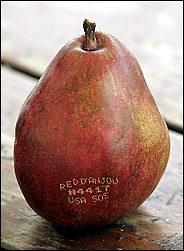
 | Produce industry service company Durand-Wayland, Inc. developed a system for identifying produce with laser-etched codes. These "fruit tattoos" would replace those little stickers that always get stuck in your teeth when you bite into a nice, crisp apple while distracted. The technology's beginning to catch on, according to a NYT story. |
Wednesday, July 20, 2005
Finally! Rid of those pesky fruit labels.


Broadband eyes a quantum leap
Internet access 50 times faster than current speeds could arrive via TV cables as early as '06.
HELSINKI (Reuters) - Broadband Internet access via TV cables will be able to hit 100 megabits per second as early as next year, 50 times faster than the average broadband speeds now offered to cable TV homes, a Finnish firm said Wednesday.
Similar data transmission speeds are possible over fiber networks, but these cost much more for the operators to build.
"This is a cost-efficient technology as we use the cable TV networks which are already in place," Jukka Rinnevaara, chief executive of small-cap Finnish broadband equipment manufacturer Teleste, told Reuters.
HELSINKI (Reuters) - Broadband Internet access via TV cables will be able to hit 100 megabits per second as early as next year, 50 times faster than the average broadband speeds now offered to cable TV homes, a Finnish firm said Wednesday.
Similar data transmission speeds are possible over fiber networks, but these cost much more for the operators to build.
"This is a cost-efficient technology as we use the cable TV networks which are already in place," Jukka Rinnevaara, chief executive of small-cap Finnish broadband equipment manufacturer Teleste, told Reuters.
Tuesday, July 19, 2005
Become.com Offers Comparison Shopping
Become.com, a shopping research site, has added integrated comparison shopping and several additional features designed to simplify and expedite your online shopping experience
Read more about it here
Read more about it here
Monday, July 18, 2005
New Image Search Site
Pixsy is a new engine that provides access to imagery posted on various social networking services, blogs, mobile blogs, and other web sites.
Results pages include thumbnails along with direct links to the image url and the page where the image is posted. I ran a couple of searches and spotted images posted to TextAmerica.com (a moblog service) and Buzznet. I also came across images from sites like the BBC, SF Gate, and Sportsline.com.
The right side of a results page includes keyword ads that often include images. The images appear to come from various web sites and then combined with ads from Yahoo Search Marketing.
Results pages include thumbnails along with direct links to the image url and the page where the image is posted. I ran a couple of searches and spotted images posted to TextAmerica.com (a moblog service) and Buzznet. I also came across images from sites like the BBC, SF Gate, and Sportsline.com.
The right side of a results page includes keyword ads that often include images. The images appear to come from various web sites and then combined with ads from Yahoo Search Marketing.
Wednesday, July 13, 2005
Stop your presentation before it kills again!
Sometimes the best presentation is... no presentation. Ditch the slides completely. Put the projector in the closet, roll the screen back up, and turn the damn lights back on!
A most excellent blog with an excellent article on the dangers of PowerPoint and some tips if you must use it.

A most excellent blog with an excellent article on the dangers of PowerPoint and some tips if you must use it.
Compare Book Prices in 34 Stores
Booksprice.com compares the price of selected books in your shopping cart in 34 different stores.
Downloadable MP3 Walking Tours
AudioTreks™ tours are digital audio walking tours of fun, popular neighborhoods. Instead of following a person or a book, you can download audio walking tours to your own MP3 player or iPod.
Leave heavy guide books at home. We'll tell you just as much, and more!
Go sightseeing at your own speed, and on your time. Stop for lunch or shopping, then turn it back on.
They're easy to follow. Like the audio tours in museums, they're recorded in "segments" that are easy to locate on your MP3 player. Each tour also comes with a map to download and print.
An AudioTreks™ Tour is like having a friend who lives in the neighborhood show you around!
Leave heavy guide books at home. We'll tell you just as much, and more!
Go sightseeing at your own speed, and on your time. Stop for lunch or shopping, then turn it back on.
They're easy to follow. Like the audio tours in museums, they're recorded in "segments" that are easy to locate on your MP3 player. Each tour also comes with a map to download and print.
An AudioTreks™ Tour is like having a friend who lives in the neighborhood show you around!
Parents Against Bad Books in Schools: If not so sad, this would be funny
From: "boingboing.net"
I think PABBIS (Parents Against Bad Books in School) is a little too interested in in "bad" books. This link takes you to its "SAMPLE BOOK REVIEW DOCUMENTATION FORM." Mild warning for some language.
I think PABBIS (Parents Against Bad Books in School) is a little too interested in in "bad" books. This link takes you to its "SAMPLE BOOK REVIEW DOCUMENTATION FORM." Mild warning for some language.
Finally - ePaper
Fujitsu has announced the launch of bendy electronic paper that can store and display images wirelessly.
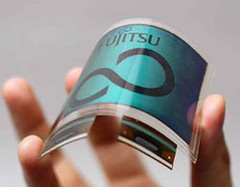 Bendable colour screens have been in the pipeline for some time (see related links), but Fujitsu is the first company to announce a wireless version that it hopes will hit shops sometime between April 2006 and March 2007.
According to Fujitsu its newly developed e-paper features an image memory function that enables “continuous display of the same image without the need for electricity”, although it does require a smidge of power to switch images. Plus, the images don’t warp or lose quality when the e-paper is bent or rolled up.
Fujitsu has even outlined some applications for its smarty-pants paper, including wireless transfer of photos and text messages from mobiles onto the ultra-portable e-paper. Here are just a few other uses it envisages for launch:
Bendable colour screens have been in the pipeline for some time (see related links), but Fujitsu is the first company to announce a wireless version that it hopes will hit shops sometime between April 2006 and March 2007.According to Fujitsu its newly developed e-paper features an image memory function that enables “continuous display of the same image without the need for electricity”, although it does require a smidge of power to switch images. Plus, the images don’t warp or lose quality when the e-paper is bent or rolled up.
Fujitsu has even outlined some applications for its smarty-pants paper, including wireless transfer of photos and text messages from mobiles onto the ultra-portable e-paper. Here are just a few other uses it envisages for launch:
- It can offer more convenient digital-media devices that can be carried from room to room in the home.
- Operating manuals and other short-term information displays, facilitating the trend toward paperless offices or factories.
- Electronic shelf display tags, restaurant menus, and other in-store uses. Can also be used for pricing displays or product information displays that stand out in full color and can be readily updated.
Tuesday, July 12, 2005
"Stink-In" planned for Houston Library
The Reverend G. Todd Williams of the New Covenant Church in Houston is looking for a few good men. And women. And by "good," he means men and women with enough stanky body odor to choke a rhino.
Williams says he'll be holding a "Stink-In" July 9 at the Montrose Public Library to protest a new city ordinance that says library patrons can be forced to leave if they have "offensive bodily hygiene."
The law clearly discriminates against the homeless, he says. And so, as an announcement of the protest puts it, "We are encouraging folks to mow their lawns, play tennis, play hard and get all sweaty…don't SHOWER, then plan to head to the public library."
At 3 p.m., all the fragrant revolutionaries -- including the many homeless members of Williams's congregation, who probably won't need to play tennis beforehand -- will descend on the library. Hilarity will ensue, no doubt, along with a heartwarming message that the stench-ridden need love, too.
"This is an ordinance about hate," Williams says. "And it's got the seal of approval by the city on it."
In honor of the protest, the Storytime Book that day will be the children's classic The Stinky Cheese Man. Or it should be.
Williams says he'll be holding a "Stink-In" July 9 at the Montrose Public Library to protest a new city ordinance that says library patrons can be forced to leave if they have "offensive bodily hygiene."
The law clearly discriminates against the homeless, he says. And so, as an announcement of the protest puts it, "We are encouraging folks to mow their lawns, play tennis, play hard and get all sweaty…don't SHOWER, then plan to head to the public library."
At 3 p.m., all the fragrant revolutionaries -- including the many homeless members of Williams's congregation, who probably won't need to play tennis beforehand -- will descend on the library. Hilarity will ensue, no doubt, along with a heartwarming message that the stench-ridden need love, too.
"This is an ordinance about hate," Williams says. "And it's got the seal of approval by the city on it."
In honor of the protest, the Storytime Book that day will be the children's classic The Stinky Cheese Man. Or it should be.
Wednesday, July 06, 2005
Comparison Shop for Books and Music on Any Phone
You are in a bookshop or a record shop. You found something that interests you. You can't decide whether to buy it now or later online. What you need is a price check and a quick review, perhaps some ideas of something similar that others might recommend. Amabuddy can help! Amabuddy will quote Amazon.com's price, a typical used price and a 1-5 reader rating. Grab a book or CD off your shelf and try it!
To use amabuddy first make sure you locate the ISBN number on the back of the book or inside the book on first few pages. To enter X in an ISBN number use the # key.
Dial toll-free 1-888-WESIGNAL (1-888-937-4462) and enter the data. Cool.
To use amabuddy first make sure you locate the ISBN number on the back of the book or inside the book on first few pages. To enter X in an ISBN number use the # key.
Dial toll-free 1-888-WESIGNAL (1-888-937-4462) and enter the data. Cool.
Tuesday, July 05, 2005
Studies using eye-tracking technology
A new report offers fascinating, in-depth insights on how users interact with Google search results, based on studies using eye-tracking technology. Keeping an eye on Google
What's Cooking in Search Engine Labs
U of Michigan agreement with Google available
The U of Michigan has posted their confidential agreement with
Google in response to a freedom of information request. The request comes from Daniel Brandt who runs the aggressively anti-Google site, Googlewatch. His Freedom of Information Act request resulted in this posting. I'm linking here to the page with comments from other readers, scroll down for article, other links and comments.
Google in response to a freedom of information request. The request comes from Daniel Brandt who runs the aggressively anti-Google site, Googlewatch. His Freedom of Information Act request resulted in this posting. I'm linking here to the page with comments from other readers, scroll down for article, other links and comments.
Friday, July 01, 2005
User Taxonomies at Yahoo
First introduced in April and significantly updated this week, Yahoo's MyWeb allows users to designate sites as share-worthy and to search what others in their Yahoo-based communities or the larger Yahoo user base find relevant. When a user logs into MyWeb, she can search through what others in her communities have saved, through what the MyWeb community at large has saved, or search the Web without the MyWeb interface. If the user finds a site she likes, she can select "Save," which calls up a separate window. A user then titles the page, adds some keywords (to aid others in their own searching), and then designates if she wants to save the site for herself alone or to share with others in her community or the rest of Yahoo's visitors.
Read more here.
Read more here.
Thursday, June 30, 2005
Tuesday, June 28, 2005
Estimating Realistic Project Deadlines
from: The Economist
A Project Duration Formula
Combine the awareness of obstacles and their need to have buffer time built into the project time line with a good project duration estimation formula and you'll begin to be more accurate in your ability to meet those project deadlines. Snead and Wycoff provide a simple way to calculate a realistic duration for the project or for the individual next actions within it:
Te=(To+4Tm+Tp)/6
Key:
• Te = Realistic time estimate
• To = Most optimistic time estimate (the Sunny Side estimate with no setbacks)
• Tp = Most pessimistic time estimate (with every obstacle happening)
• Tm = Most probable time estimate (this makes you think realistically; some setbacks happen, others don't)
Let's say we have a project of developing a departmental newsletter. The variables break down as follows:
• Tm = 14 days
• To = 10 days
• Tp = 30 days
The calculation would be:
Te = (10+(4X14)+30)/6
The best estimated duration for the project would be 16 days.
By applying both strategies of building in buffer time for obstacles and using a good project duration formula, consistency in estimating deadlines will develop. Being known as someone whose projects come in on time and under budget is always a career helper and improves one's perceived competence. Besides, it also makes us more confident in our abilities and that confidence helps to improve our performance, which boosts our confidence, which, again, elevates our performance. As one can see, there is such a thing as an upward spiral.
A Project Duration Formula
Combine the awareness of obstacles and their need to have buffer time built into the project time line with a good project duration estimation formula and you'll begin to be more accurate in your ability to meet those project deadlines. Snead and Wycoff provide a simple way to calculate a realistic duration for the project or for the individual next actions within it:
Te=(To+4Tm+Tp)/6
Key:
• Te = Realistic time estimate
• To = Most optimistic time estimate (the Sunny Side estimate with no setbacks)
• Tp = Most pessimistic time estimate (with every obstacle happening)
• Tm = Most probable time estimate (this makes you think realistically; some setbacks happen, others don't)
Let's say we have a project of developing a departmental newsletter. The variables break down as follows:
• Tm = 14 days
• To = 10 days
• Tp = 30 days
The calculation would be:
Te = (10+(4X14)+30)/6
The best estimated duration for the project would be 16 days.
By applying both strategies of building in buffer time for obstacles and using a good project duration formula, consistency in estimating deadlines will develop. Being known as someone whose projects come in on time and under budget is always a career helper and improves one's perceived competence. Besides, it also makes us more confident in our abilities and that confidence helps to improve our performance, which boosts our confidence, which, again, elevates our performance. As one can see, there is such a thing as an upward spiral.
iTunes 4.9 Incorporates Podcasts
You can use iTunes to create your own personal digital music library and easily organize and listen to your collection of digital music files. You can also create your own custom audio CDs and transfer your music to an Apple iPod. If you are installing iTunes for use with an iPod, after installing iTunes, use the cable that came with your iPod to connect your iPod to your computer.
In addition, with iTunes 4.9, you can now browse and subscribe to podcasts from within the iTunes Music Store. Podcasts are frequently updated radio-style shows downloadable over the Internet. You can also transfer podcasts to iPod, for listening on the go. Pretty cool.
Free Download
In addition, with iTunes 4.9, you can now browse and subscribe to podcasts from within the iTunes Music Store. Podcasts are frequently updated radio-style shows downloadable over the Internet. You can also transfer podcasts to iPod, for listening on the go. Pretty cool.
Free Download
Friday, June 24, 2005
Thursday, June 23, 2005
Blogs as Instructional Tools in Libraries - A Survey
From www.librarystuff.net
Help out librarians Lani Draper & Priscilla Coulter by taking part in their blog survey:
"The purpose of this survey is to find out how librarians are using weblogs (blogs) to interact with and teach library users. The results will be presented at the Off-Campus Library Services Conference in Savannah, GA in April 2006. Your participation is greatly appreciated."
Help out librarians Lani Draper & Priscilla Coulter by taking part in their blog survey:
"The purpose of this survey is to find out how librarians are using weblogs (blogs) to interact with and teach library users. The results will be presented at the Off-Campus Library Services Conference in Savannah, GA in April 2006. Your participation is greatly appreciated."
Tuesday, June 21, 2005
OCLC's e-serials pilot project
From OCLC's web site:
"The pilot will make eSerials as visible as print materials in WorldCat, the world’s largest database of items held in libraries, and will expose those records to searchers on the open Web through the Open WorldCat program."
From OCLC's web site:
"The pilot will make eSerials as visible as print materials in WorldCat, the world’s largest database of items held in libraries, and will expose those records to searchers on the open Web through the Open WorldCat program."
Will be interesting to see how this interacts with Google Search and libraries' use of Serials Solutions and SFX/MetaLib A'-Z list" (that LINCC Libraies will have in August).
Read more here.
Publishers' Group Asks Google to Stop Scanning Copyrighted Works for 6 Months
From "The Chronicle of Higher Education"
The Association of American Publishers has asked Google to stop scanning copyrighted books published by the association's members for at least six months while the company answers questions about whether its plan to scan millions of volumes in five major research libraries complies with copyright law.
LINK
The Association of American Publishers has asked Google to stop scanning copyrighted books published by the association's members for at least six months while the company answers questions about whether its plan to scan millions of volumes in five major research libraries complies with copyright law.
LINK
Dina Merrill to appear in librarian documentary
 MADISON, WI – The producers of the “The Hollywood Librarian: Librarians in Cinema and Society” announced today that Dina Merrill has agreed to be interviewed for the documentary about librarians.
The actress, now vice chairman of RKO Pictures, starred as “Sylvia Blair” in one of Hollywood’s more positive portrayals of librarians, together with Katharine Hepburn, Joan Blondell and Sue Randall. “Desk Set,” released in 1957, was Ms. Merrill’s film debut vehicle after nearly 10 years on Broadway. In the movie, all four women are seen as competent and professional research librarians as they navigate the reference department in the wake of a newly-installed, 1950’s computer.
Since her film debut, Ms. Merrill has acted in dozens of motion pictures, television shows and miniseries, as well as establishing her position as a leading philanthropist.
Ann Seidl, the writer and director of the documentary, says she was thrilled to talk with Ms. Merrill and delighted with her participation in the film. “‘Desk Set’ contains some of the most recognizable librarians in American cinema,” said Seidl. “And the issue of technology in libraries is one of the major themes of the movie and of the time period. Being able to talk with one of its stars on camera will add greatly to the documentary.”
Seidl plans to interview Ms. Merrill about the film set, her co-stars and the movie’s adaptation from the stage sometime in late summer or early fall in New York, where Ms. Merrill resides. Financing is being sought from documentary grantmakers and library corporations to fund this and other scheduled interviews with librarians and location shoots.
Monday, June 20, 2005
2/3 of Top Chefs Stream Restaurant Music via iPod
From tuaw.com
As part of a "best of" article in this month's "Food & Wine" magazine, the editors surveyed 70 of America's top chefs about a variety of topics, from ranges, to knives, to restaurant sound systems. It turns out 2/3 of the chefs use iPods to program the ambient music in their dining rooms. They didn't ask how many use iPods to blast the requisite punk rock and techno mixes that keep restuarant kitchens moving, but I think we can assume the percentage there is even higher. Some restaurants, like New York's Little Giant even offer "open cradle" nights where regulars can bring pods and take over the speakers for the evening, something to keep in mind the next time you want to create the perfect evening with that special someone at the little bistro around the corner.
As part of a "best of" article in this month's "Food & Wine" magazine, the editors surveyed 70 of America's top chefs about a variety of topics, from ranges, to knives, to restaurant sound systems. It turns out 2/3 of the chefs use iPods to program the ambient music in their dining rooms. They didn't ask how many use iPods to blast the requisite punk rock and techno mixes that keep restuarant kitchens moving, but I think we can assume the percentage there is even higher. Some restaurants, like New York's Little Giant even offer "open cradle" nights where regulars can bring pods and take over the speakers for the evening, something to keep in mind the next time you want to create the perfect evening with that special someone at the little bistro around the corner.
Friday, June 17, 2005
Search Google via SMS
With the new Google SMS service, you can do basic Google queries from any SMS-capable phone (which is darn near all of them) by sending text messages to 46645 (GOOGL). Results usually come within a minute, and are text-based only - no links or other craziness that could screw up an SMS.
TechConnections conference
From Gary Houk (Vice President, Cataloging and Metadata Services Division, OCLC) at the Ohio Regional Library System's TechConnections6 on the topic of “Connecting Users to Library Services in an Amazoogle World: Trends in Information Discovery and Delivery.”
Need to factor in the habits of these “digital natives” when you’re planning your services and the delivery of them. If you’re spending a lot of money on your portal, is that the best use of your money? Most likely your users aren’t starting at your portal.
Need to factor in the habits of these “digital natives” when you’re planning your services and the delivery of them. If you’re spending a lot of money on your portal, is that the best use of your money? Most likely your users aren’t starting at your portal.
Thursday, June 16, 2005
A few months old, but still very interesting
A short movie about the evolution of Google through 2014 and its impact on society as it becomes the sole repository for information (and acquires Amazon.com). LINK
"GoogleExpand" -- well, actually, I made that up, I just mean what Google has purchased and what they may purchase in the future. Interesting speculations from Kuro5hin.
Wednesday, June 15, 2005
Sirsi and Google Scholar
"Sirsi Corporation announced today a new service that permits a library to link its holdings to Google Scholar via Sirsi Resolver, Sirsi's OpenURL reference linking tool. Using this service, library users can search Google Scholar, rely on a link between Sirsi Resolver and Google Scholar to indicate whether or not the library has access to the particular e-resources, and then have one-click access to full-text articles from those licensed e-resources. This linking service will be available at no charge to Sirsi libraries that are already using Sirsi Resolver, including those using Sirsi Resolver through Sirsi Hosted Services. Sirsi has completed the development of this service and is currently working with several academic libraries on its installation, including Bucknell University, the University of Virginia, and Veracruzana University."
Press release
Press release
OverDrive Announces Video on Demand for Public Libraries
"OverDrive, the leader in download audiobooks and eBooks for libraries, announced today the addition of Video on Demand (VoD) services and materials to its Digital Library Reserve network. The new Video on Demand service will be demonstrated to the over 20,000 librarians attending the 2005 American Library Association Annual Conference at Booth #1244 McCormick Place, Chicago, June 24-28. The service is scheduled to go live for patron use later this year."
PRESS RELEASE
PRESS RELEASE
Monday, June 13, 2005
Old-time radio shows via PodCast
Dozens of old radio shows - variety, mystery, music, sci-fi - available for download here.
Wednesday, June 08, 2005
Free - download all 9 Beethoven symphonies
The BBC is releasing all nine of Beethoven's symphonies (five are up now) as unencumbered MP3s.
LINK
LINK
Tuesday, June 07, 2005
Internet Marketing Opportunities Through RSS
posted by Rok Hrastnik in RSS Marketing
When it comes to new internet marketing opportunities for your business, RSS just might be the answer you were looking for. Here are just some of the new opportunities it can provide you with …
1. Podcasting and Videocasting
Podcasting (delivering internet audio content) and Videocasting (delivering internet video content) allow you to communicate via rich media messages, not only making your content more attractive and powerful, but also enabling a more personal »conversation« with your audiences.
Up until know, the internet was predominantly a textual channel. Adding audio and video to the mix, delivering both via RSS, goes beyond the basic capabilities provided by »traditional« internet content delivery channels.
Rich media personalizes the internet experience and gives your company a distinguishable face, while at the same time providing you with a media platform to convey your message so that it is easier to understand, see and feel.
Think about ...
• Delivering press releases in audio or video
• Sending your customers a personal video message from the CEO
• Doing audio interviews to expand your reach and provide more content to your visitors
• Delivering video demonstrations of your products
• Using video and audio to demonstrate how your customers and readers can easily resolve various issues that you are helping them with
• Delivering important messages to your readers, customers and business partners via a more personal audio experience, instead of using impersonal e-mail communications
• And so on ...
In addition, Podcasting and Videocasting form the basis of new business models, giving you the opportunity to expand your product base to include these formats with higher perceived value.
Customer education & support are improved as well, since you can now demonstrate key product usage points via online video providing customer support content in a format, which can easily demonstrate everything you need to convey to your customers.
2. High Frequency Content Updates
High frequency content updates, even on a daily or hourly basis, are now finally possible with RSS. No more need to hold on your important messages, news and other content for a week or even a month to include it in your e-zine --- with RSS you can update your content as often as you want/need, and your subscribers won't mind.
3. Appcasting
Appcasting goes one step further, giving you the ability to deliver critical software updates and patches to your existing clients, without them having to visit your web site every week to see if the much needed update is already available or not.
4. Product News, Releases And Updates
Product news, releases and updates are now finally possible in an easy-to-consume way. Using RSS, you can provide your customers or prospects with simple tools to create their own »product feeds«, through which they'll be immediately notified when new products that precisely match their interests are available.
As soon as your product portfolio changes, so does the content in the RSS feeds that your customers are subscribed to.
Just think of the following possibilities ...
--> The search tool is one of the most often used in larger web stores, giving your visitors an easy way to find the products they are interested. But the same search results can be delivered via RSS as well. Imagine your customer doing a search for one of your product categories, and then also receiving a link to the RSS feed for those very same search results, to find out immediately when a new product matching his terms is released or available for order.
--> This works for complex searches as well. If your customers are in the habit of searching for specific product categories, but only in a specific price range, you can deliver those very same results to them via RSS, but with a small twist ---> as soon as a new product matching their terms, including the desired price, is launched, they are notified about it via RSS instantly. No need to visit your site again to do the time-consuming search; the release comes directly to them.
--> Of course, the same approach that many are already using for e-mail alerts can be used for RSS. Give your visitors a simple form using which they enter their criteria, and then give them access to an RSS feed bringing them product updates based exactly on their criteria. Why not just use e-mail? Because no one really wants more e-mail messages in their inboxes and no one wants to give away their personal information, while RSS is anonymous, doesn't require an e-mail address and is read when the customer decides he has the time.
5. Personalized Content Services
Personalized/customized database listings are quite similar to product updates, but relate to any kind of complex information you provide to your visitors, such as …
• Job listings
• Dating
• Real estate
• Etc.
Using RSS, your visitors can decide exactly what kind of »content« (in this case, an individual content item could be a new job listing) they are looking for and then have that content delivered directly to them, via their own personalized RSS feed.
And yet, all of these are just some examples of what you can do with RSS. The possibilities for new content delivery & business development models are quite endless.
For example, some companies are already giving their visitors the opportunity to track their FedEx, UPS and other packages via RSS feeds. Yet others are creating new services that allow you to receive critical information from an RSS feed to your mobile phone via SMS (such as getting an SMS notifying you that a new job matching your criteria is available). Yet again other sites enable you to keep track of when you need to return your library material, and even when your holds are ready and when they are about to expire, all this using RSS.
All of these are new business opportunities made possible with RSS, and each of them in a way improves lives of end-users, without placing a larger burden (more e-mail messages) on them.
When it comes to new internet marketing opportunities for your business, RSS just might be the answer you were looking for. Here are just some of the new opportunities it can provide you with …
1. Podcasting and Videocasting
Podcasting (delivering internet audio content) and Videocasting (delivering internet video content) allow you to communicate via rich media messages, not only making your content more attractive and powerful, but also enabling a more personal »conversation« with your audiences.
Up until know, the internet was predominantly a textual channel. Adding audio and video to the mix, delivering both via RSS, goes beyond the basic capabilities provided by »traditional« internet content delivery channels.
Rich media personalizes the internet experience and gives your company a distinguishable face, while at the same time providing you with a media platform to convey your message so that it is easier to understand, see and feel.
Think about ...
• Delivering press releases in audio or video
• Sending your customers a personal video message from the CEO
• Doing audio interviews to expand your reach and provide more content to your visitors
• Delivering video demonstrations of your products
• Using video and audio to demonstrate how your customers and readers can easily resolve various issues that you are helping them with
• Delivering important messages to your readers, customers and business partners via a more personal audio experience, instead of using impersonal e-mail communications
• And so on ...
In addition, Podcasting and Videocasting form the basis of new business models, giving you the opportunity to expand your product base to include these formats with higher perceived value.
Customer education & support are improved as well, since you can now demonstrate key product usage points via online video providing customer support content in a format, which can easily demonstrate everything you need to convey to your customers.
2. High Frequency Content Updates
High frequency content updates, even on a daily or hourly basis, are now finally possible with RSS. No more need to hold on your important messages, news and other content for a week or even a month to include it in your e-zine --- with RSS you can update your content as often as you want/need, and your subscribers won't mind.
3. Appcasting
Appcasting goes one step further, giving you the ability to deliver critical software updates and patches to your existing clients, without them having to visit your web site every week to see if the much needed update is already available or not.
4. Product News, Releases And Updates
Product news, releases and updates are now finally possible in an easy-to-consume way. Using RSS, you can provide your customers or prospects with simple tools to create their own »product feeds«, through which they'll be immediately notified when new products that precisely match their interests are available.
As soon as your product portfolio changes, so does the content in the RSS feeds that your customers are subscribed to.
Just think of the following possibilities ...
--> The search tool is one of the most often used in larger web stores, giving your visitors an easy way to find the products they are interested. But the same search results can be delivered via RSS as well. Imagine your customer doing a search for one of your product categories, and then also receiving a link to the RSS feed for those very same search results, to find out immediately when a new product matching his terms is released or available for order.
--> This works for complex searches as well. If your customers are in the habit of searching for specific product categories, but only in a specific price range, you can deliver those very same results to them via RSS, but with a small twist ---> as soon as a new product matching their terms, including the desired price, is launched, they are notified about it via RSS instantly. No need to visit your site again to do the time-consuming search; the release comes directly to them.
--> Of course, the same approach that many are already using for e-mail alerts can be used for RSS. Give your visitors a simple form using which they enter their criteria, and then give them access to an RSS feed bringing them product updates based exactly on their criteria. Why not just use e-mail? Because no one really wants more e-mail messages in their inboxes and no one wants to give away their personal information, while RSS is anonymous, doesn't require an e-mail address and is read when the customer decides he has the time.
5. Personalized Content Services
Personalized/customized database listings are quite similar to product updates, but relate to any kind of complex information you provide to your visitors, such as …
• Job listings
• Dating
• Real estate
• Etc.
Using RSS, your visitors can decide exactly what kind of »content« (in this case, an individual content item could be a new job listing) they are looking for and then have that content delivered directly to them, via their own personalized RSS feed.
And yet, all of these are just some examples of what you can do with RSS. The possibilities for new content delivery & business development models are quite endless.
For example, some companies are already giving their visitors the opportunity to track their FedEx, UPS and other packages via RSS feeds. Yet others are creating new services that allow you to receive critical information from an RSS feed to your mobile phone via SMS (such as getting an SMS notifying you that a new job matching your criteria is available). Yet again other sites enable you to keep track of when you need to return your library material, and even when your holds are ready and when they are about to expire, all this using RSS.
All of these are new business opportunities made possible with RSS, and each of them in a way improves lives of end-users, without placing a larger burden (more e-mail messages) on them.
Monday, June 06, 2005
Google's "Summer of Code"
The Summer of Code is Google's program designed to introduce students to the world of open source software development.
This summer, don't let your programming skills lie fallow. Use them for the greater good of open source software and computer science. Google will provide a $4500 award to each student who successfully completes a project by the end of the summer. LINK
This summer, don't let your programming skills lie fallow. Use them for the greater good of open source software and computer science. Google will provide a $4500 award to each student who successfully completes a project by the end of the summer. LINK
Brazil adopts open-source software
In Brazil's Ministry for Cities, staff are busily at work.
The scene is much like any other modern office: an open-plan work space crammed with desks, telephones and computers.
But there's one big difference. The word 'Microsoft' is nowhere in sight.
Instead, computers here now use the Linux operating system. It has many similar functions to Microsoft's Windows - but unlike Windows, it is available for free. LINK
The scene is much like any other modern office: an open-plan work space crammed with desks, telephones and computers.
But there's one big difference. The word 'Microsoft' is nowhere in sight.
Instead, computers here now use the Linux operating system. It has many similar functions to Microsoft's Windows - but unlike Windows, it is available for free. LINK
Wednesday, June 01, 2005
Yahoo Launches Sorting Tool For Search Results
"Yahoo Inc. has released in beta a tool that sorts search results according to whether they are commercial or more informational, such as from academic or research-oriented sources.
Called Mindset, the tool is available through the Yahoo Research Labs site Yahoo Next."
Yahoo News story here.
Called Mindset, the tool is available through the Yahoo Research Labs site Yahoo Next."
Yahoo News story here.
Tuesday, May 31, 2005
WorldCat Wiki
This is from Thomas Hickey's blog. He is chief scientest at OCLC.
"The idea is to have a Wiki that complements WorldCat. People could add reviews, cover art, comments, etc. and relate these to bibliographic records (maybe at the FRBR work-level too). We hope the system is flexible enough so that people do (good) things we're not expecting. We'd like the Wiki to be available anywhere WorldCat records are"
Read the full entry here
"The idea is to have a Wiki that complements WorldCat. People could add reviews, cover art, comments, etc. and relate these to bibliographic records (maybe at the FRBR work-level too). We hope the system is flexible enough so that people do (good) things we're not expecting. We'd like the Wiki to be available anywhere WorldCat records are"
Read the full entry here
Sunday, May 29, 2005
Email a phone ...
Teleflip allows you to send an email text message to any cell phone. Free -- and simple!
Try this. Send an email to (yourcellphonenumber)@teleflip.com (North America only).
Teleflip allows you to send an email text message to any cell phone. Free -- and simple!
Try this. Send an email to (yourcellphonenumber)@teleflip.com (North America only).
Saturday, May 28, 2005
Check out The 2005 Horizon Report produced by EDUCAUSE Learning Initiative.
The report highlights six technologies that the underlying research suggests will become very important to higher education over the next one to five years.
Extended Learning
Ubiquitous Wireless
Intelligent Searching
Educational Gaming
Social Networks and Knowledge Webs
Context-aware, computer augmented reality
The report highlights six technologies that the underlying research suggests will become very important to higher education over the next one to five years.
Extended Learning
Ubiquitous Wireless
Intelligent Searching
Educational Gaming
Social Networks and Knowledge Webs
Context-aware, computer augmented reality
Want to know the number of Starbucks per capita?
Want to get a quick look at demographics of your community or see historic postcards?
Visit ePodunk
From ePodunk site: "We believe in the power of place. ePodunk provides in-depth information about more than 25,000 communities around the country, from Manhattan to Los Angeles, Pottstown to Podunk. Our listings also include geocoded information about thousands of parks, museums, historic sites, colleges, schools and other places across America. "
Want to get a quick look at demographics of your community or see historic postcards?
Visit ePodunk
From ePodunk site: "We believe in the power of place. ePodunk provides in-depth information about more than 25,000 communities around the country, from Manhattan to Los Angeles, Pottstown to Podunk. Our listings also include geocoded information about thousands of parks, museums, historic sites, colleges, schools and other places across America. "
Friday, May 27, 2005
Check out the unnofficial wiki for the June ALA conference.
From the site..."Anyone who wants to add to or edit topics on the wiki can do it. You don't need to ask before making a change -- this wiki belongs to all of us. If you know something about Chicago or have some ALA Conference tips, please contribute to the wiki. I went to my first ALA Annual Conference in 2004, and I know it would have been great to have had advice and suggestions on what to do in Orlando and at the Conference."
First Podcast novel still going strong.
The typical print run for a first-time novelist ranges from 3,000 to 5,000 copies.
EarthCore, one of the world's first podcast-only novels, already has over 5,500 readers after just four weeks and five episodes. From the author's blog you can download several chapters with each posting.
Read more about podiobooks here.
The typical print run for a first-time novelist ranges from 3,000 to 5,000 copies.
EarthCore, one of the world's first podcast-only novels, already has over 5,500 readers after just four weeks and five episodes. From the author's blog you can download several chapters with each posting.
Read more about podiobooks here.
Book Covers Made into Mosaics
Bonjour! Hey, it is in French, but you can click on the Flag to get English for what you need, then scroll down. Free tool MozoDojo turns photos into mosaics. Some are suggesting it as interesting tool for library book covers.
uhhhhh -- copyright implications?
Bonjour! Hey, it is in French, but you can click on the Flag to get English for what you need, then scroll down. Free tool MozoDojo turns photos into mosaics. Some are suggesting it as interesting tool for library book covers.
uhhhhh -- copyright implications?
Ten Steps to Effective Web Presence for Libraries
1. Design for Your Users
2. IM with Users and Ponder JYBE
3. Blog your Stuff
4. Podcast Rich Content
5. Utilize RSS
6. Ponder a wiki
7. Utilize Image Sites
8. Offer a Toolbar
9. Local Flavor Rules
10. Be Discoverable
Link to good PDF with more detail and illustrations.
2. IM with Users and Ponder JYBE
3. Blog your Stuff
4. Podcast Rich Content
5. Utilize RSS
6. Ponder a wiki
7. Utilize Image Sites
8. Offer a Toolbar
9. Local Flavor Rules
10. Be Discoverable
Link to good PDF with more detail and illustrations.
Companies Tap Into RSS
From "Business2.0"
Real simple syndication, better known as RSS, is moving from weblogs to the Fortune 500. The technology, designed to let users subscribe to blog newsfeeds, is being co-opted by corporations to keep employees and customers informed -- alerting systems administrators when a server goes down, for instance, or sending lists of recent credit card purchases to a customer's Treo.
The simplicity appeals to companies because monitoring data takes too much time and e-mail updates clog inboxes. RSS, on the other hand, can issue customizable alerts more quickly than e-mail. "RSS will be adapted by corporations really fast," predicts Ray Valdez, an analyst at the Gartner Group. Startups are already eyeing the nascent market. Ottawa-based Serence has clients ranging from FindSavings.com, which alerts shoppers about new coupons, to a law firm that's using RSS to monitor patents. Big companies, too, are getting into the game. Computer Associates's (CA) Security Advisor RSS service provides updates on the latest viruses and worms to corporate IT departments. Real simple, indeed.
Real simple syndication, better known as RSS, is moving from weblogs to the Fortune 500. The technology, designed to let users subscribe to blog newsfeeds, is being co-opted by corporations to keep employees and customers informed -- alerting systems administrators when a server goes down, for instance, or sending lists of recent credit card purchases to a customer's Treo.
The simplicity appeals to companies because monitoring data takes too much time and e-mail updates clog inboxes. RSS, on the other hand, can issue customizable alerts more quickly than e-mail. "RSS will be adapted by corporations really fast," predicts Ray Valdez, an analyst at the Gartner Group. Startups are already eyeing the nascent market. Ottawa-based Serence has clients ranging from FindSavings.com, which alerts shoppers about new coupons, to a law firm that's using RSS to monitor patents. Big companies, too, are getting into the game. Computer Associates's (CA) Security Advisor RSS service provides updates on the latest viruses and worms to corporate IT departments. Real simple, indeed.
Library samples interest in MP3 books
NORWALK -- To gauge interest in listening to books on MP3 players, Norwalk Public Library will give one away.
The library may offer a service to patrons that would enable them to download books from its Web site to personal MP3 players, the portable devices that play digital music.
But, because the service would be expensive -- about $8,000 a year -- library officials want to ensure it would be used. To do that, they're conducting a survey.
LINK
The library may offer a service to patrons that would enable them to download books from its Web site to personal MP3 players, the portable devices that play digital music.
But, because the service would be expensive -- about $8,000 a year -- library officials want to ensure it would be used. To do that, they're conducting a survey.
LINK
Tuesday, May 24, 2005
Publishing Companies Grow Concerned Over E-Reserves on Campuses
May 25, 2005 — There's been a change in Ellen Lichtenstein's study patterns.
For half her classes this past year, she no longer had to visit a library to get the reading materials professors had placed on reserve. Instead, she only needed Internet access and a password.
"It's as simple as logging into my e-mail account, clicking on a few links and printing it," said Lichtenstein, 21, a New York University communications senior from Birmingham, Ala. "There's no going to the library, waiting on line, waiting to Xerox it, there's none of that."
And publishing companies are worried precisely because of that ease and convenience — it's another way for publishers to lose sales.
LINK
For half her classes this past year, she no longer had to visit a library to get the reading materials professors had placed on reserve. Instead, she only needed Internet access and a password.
"It's as simple as logging into my e-mail account, clicking on a few links and printing it," said Lichtenstein, 21, a New York University communications senior from Birmingham, Ala. "There's no going to the library, waiting on line, waiting to Xerox it, there's none of that."
And publishing companies are worried precisely because of that ease and convenience — it's another way for publishers to lose sales.
LINK
Monday, May 23, 2005
Illinois Library Getting Fingerprint Scanners
Library officials in this suburb west of Chicago have come up with a high-tech solution for keeping unauthorized visitors from using their computers: fingerprint scans.
The scanners to be installed on 130 library computers this summer will verify the identity of computer users.
Library officials said they wanted to tighten computer access because many people borrow library cards and pass codes from friends or family to log on. The technology also will help the library implement a new policy that allows parents to put filters on their children's' accounts, officials said.
But privacy advocates have criticized the plan. More here
The scanners to be installed on 130 library computers this summer will verify the identity of computer users.
Library officials said they wanted to tighten computer access because many people borrow library cards and pass codes from friends or family to log on. The technology also will help the library implement a new policy that allows parents to put filters on their children's' accounts, officials said.
But privacy advocates have criticized the plan. More here
Friday, May 20, 2005
Wave and Pay With a Wireless Credit Card
A new payment system unveiled by Chase Bank allows users to pay for goods and services with just a blink of their plastic credit card. Embedded with an RFID chip, users simply just wave their card at the cash register and the terminal reads the data to process the payment. In effect, Chase says this will consumers happier because the checkout process will go much faster at a rate between 30 and 40 percent.
Google Scholar and SFX: new opportunities for libraries and researchers
May 19, Press Release from Ex Libris:
Ex Libris announced today the immediate availability of a new set of tools to enable Google Scholar to display OpenURL links to SFX. With these tools, institutions with the award-winning SFX link server can register with Google Scholar to have their SFX links displayed in Google Scholar search results. Once registered, the institutions' electronic library holdings are made available to Google Scholar so that the Google Scholar search results will clearly indicate when electronic full text is available.
Wednesday, May 18, 2005
15 things you can do with RSS
Basically, you can perform any task with RSS that requires search or information retrieval from a server. Automatically and repeatedly. Here are my favourites (please let me know if there are better services and I'll update). I use this list to convince people to start using an RSS feed reader. There's more to RSS than just weblog syndication and news aggregation.
LINK
LINK
Library Collections Linked on Google Scholar for Free
Library Collections Linked on Google Scholar for Free
by Barbara Quint
May 16, 2005
by Barbara Quint
May 16, 2005
The Google Scholar project (http://scholar.google.com), which launched in November 2004 (http://www.infotoday.com/newsbreaks/nb041122-1.shtml), has responded to the complaints of many academic and research librarians by expanding its usefulness for campus-based users. Its new institutional access feature links Google Scholar users to electronic versions—and even print versions—of journals accessible through library collections. Any library using OpenURLs and meeting Google Scholar’s conditions can join the program. Authorization of “appropriate copy” to individual library patrons, “on-campus or off,” remains the library’s electronic responsibility. Unlike many commercial information services, Google offers the institutional link resolving at its usual attractive rate—free. Within days of the announcement, a reported 150 libraries had joined.
Approximately 30 libraries and several major library software vendors offering link resolvers (e.g., SFX from Ex Libris, Article Linker from Serials Solutions, and 1Cate from Openly Informatics) have worked since the beginning of this year on a pilot project to develop and test this important new feature. Though its scholarly focus clearly targets academic and research libraries, any and all libraries can participate. “We’d like to see them all,” welcomed Anurag Achaya, Google Scholar’s project manager. Some public libraries have joined already. Although U.S. libraries dominate, participants stretch from Iceland to Japan, Beirut to Tel-Aviv.
Ex Libris expands marketing division
Library Technology Guides: Ex libris Press Release:
Today, Ex Libris announced that Heidi Trockman and Ted Koppel have joined Ex Libris as the newest members to its growing marketing team. In her newly-created role as Marketing Manager, Ms. Trockman will manage all marketing communication initiatives for Ex Libris' rapidly expanding North American market. Mr. Koppel joins Ex Libris as Product Manager for Verde, Ex Libris' electronic resource management system. Both join a global Product Management and Marketing team at Ex Libris and will be based in the Boston office.
Monday, May 16, 2005
Podiobooks
A podiobook is a serialized audio book which is made available in podcast format. While still a relatively new phenomenon, this new audiobook delivery method seems to be gaining popularity. For more information and a podiobook directory, visit this thread in the ipodlounge and podiobooks.com.
Thursday, May 12, 2005
Polishing the turd: the dangers of redesigning the OPAC
So as Art and I continue to try to export the data from our respective Voyager catalogs to create an alternative web opac, I have been trying to formulate what such a beast should look like. We have the opportunity to make the web interface look and behave in any way we want, so there are a lot of things to think about. The goal is to make the opac behave in the way non-information professionals would expect a searching interface to work, so we're not just talking about a cosmetic makeover to the current design.LINK
We just had a professional usability study done on our web site and services. The results were rather sobering. While not every aspect of our web presence is bad, a great deal of it is, and, worse, the bad parts are generally the most important. Making the situation even more complicated is the fact that a lot of these awkward interfaces are not under our control (the databases, ejournals and opac). Well, not currently under our control.
I'll skip over the part about our website (we're able to fix that pretty easily) and write about what they recommended for the catalog. The first screen they gave us was a redesigned search form. An interesting dialogue came out of that:
Usability Expert: Ok, so this is the search form...
Librarian(s): So... is this the simple search form or the advanced search?
Usability Expert: This is the search form.
And it really is as simple as that. It is a text input field that, by default, would do a keyword natural language query on the catalog, or you could add limits and filters (title, author, subject, etc.) or make a more sophisticated boolean search using the exact same form.
Monday, May 09, 2005
Mashups for RSS
...as if I know all about "Mashups" or "Mashing up" :-)
I gather it is big in music (mixing a hodgepodge of existing tunes and lyrics together into one song etc.) and now... RSS.
http://www.researchbuzz.org/more_mashing_up_rss_mix_.shtml
I gather it is big in music (mixing a hodgepodge of existing tunes and lyrics together into one song etc.) and now... RSS.
"Mashing up is turning into a meme -- first it was music, then it was Web services.. now it's RSS feeds.
RSSMix (available at http://www.rssmix.com/ ) Allows you to specify any number of RSS feeds to be blended together into one uberfeed. Once you have an uberfeed there are other things you can do with it, but one thing at a time."
Also mentions "Excel blogs" yikes!!
http://www.researchbuzz.org/more_mashing_up_rss_mix_.shtml
Friday, May 06, 2005
Google Accelerator Can Wreck Web Apps/Stats
The accelerator scours a page and prefetches the content behind each link. This gives the illusion of pages loading faster (since they’ve already been pre-loaded behind the scenes). Here’s the problem: Google is essentially clicking every link on the page — including links like “delete this” or “cancel that.” And to make matters worse, Google ignores the Javascript confirmations. So, if you have a “Are you sure you want to delete this?” Javascript confirmation behind that “delete” link, Google ignores it and performs the action anyway.
I’ve also been investigating whether its effect on web analytics software. Will a prefetch be counted as a page view even if the user never visits that page?
LINK
I’ve also been investigating whether its effect on web analytics software. Will a prefetch be counted as a page view even if the user never visits that page?
LINK
Thursday, May 05, 2005
Google Web Accelerator Launched
Google Web Accelerator is an application that uses the power of Google's global computer network to make web pages load faster.  Google Web Accelerator is easy to use; all you have to do is download and install it, and from then on many web pages will automatically load faster than before.
Google does this by:
LINK
Google Web Accelerator is easy to use; all you have to do is download and install it, and from then on many web pages will automatically load faster than before.Google does this by:
- Sending your page requests through Google machines dedicated to handling Google Web Accelerator traffic.
- Storing copies of frequently looked at pages to make them quickly accessible.
- Downloading only the updates if a web page has changed slightly since you last viewed it.
- Prefetching certain pages onto your computer in advance.
- Managing your Internet connection to reduce delays.
- Compressing data before sending it to your computer.
LINK
Wednesday, May 04, 2005
A Model for Customer Support Using Blogs and Wikis
From Common Craft- Social Design for the Web:
"Blogs and message boards both suffer from the same problem- they are great for presenting emerging information, but poor at organizing it for future reference. The “good stuff” that people often need and companies often want to capture quickly gets buried among all the comments and messages.
You could say that blogs and message boards are good at managing flows, but poor at managing stocks.
With this post, I’m outlining a potential way organizations can use blogs and message boards as a way to generate useful information and a wiki as a way to filter, archive and organize it for future reference."
Read more here.
"Blogs and message boards both suffer from the same problem- they are great for presenting emerging information, but poor at organizing it for future reference. The “good stuff” that people often need and companies often want to capture quickly gets buried among all the comments and messages.
You could say that blogs and message boards are good at managing flows, but poor at managing stocks.
With this post, I’m outlining a potential way organizations can use blogs and message boards as a way to generate useful information and a wiki as a way to filter, archive and organize it for future reference."
Read more here.
Tuesday, May 03, 2005
RSS Trafic Alerts Hack for Yahoo traffic
Use this URL and modify as described:
http://maps.yahoo.com/traffic.rss?csz=32310&mag=4&minsev=2
http://maps.yahoo.com/traffic.rss?csz=32310&mag=4&minsev=2
- czs is your zip code
- mag is the level of magnification (3 = 4 miles, 4 = 10 miles, 5 = 40 miles)
- minserv is the minimum severity of the traffic condition (1 = minor, 2 = moderate, 4 = major, 5 = critical.)"
EarthLink to offer cellphone with built-in WiFi for unlimited VoIP calling
CNET managed to pry a few details out of EarthLink about SK-Earthlink, that new joint venture with South Korean carrier SK Telecom they announced back in January to team up on cellphone service here in the US. Nothing about a possible launch date or pricing, but apparently the plan is to offer at least one cellphone with built-in WiFi that would let subscribers make unlimited local and long distance VoIP calls (as part of their monthly plan) when they’re in range of a wireless hotspot and then roam on the wider cellular networks every else.
Man Pays $2,190 Library Fine
ORCHARD PARK, N.Y. (AP) A man who borrowed a book in 1981 from his hometown library in suburban Buffalo has returned it, along with $2,190.
Joel Schlesinger would have owed 10 cents a day up to $10, the maximum penalty for an overdue book that year. Even now, the fine is only 25 cents a day up to $15.
But in 2005, the library system and Erie County have financial troubles. He returned "The Joy of Camping" to the Orchard Park Public Library last Friday with something extra in the check.
"We certainly had no intention of charging (that) amount," said library director Ann Laubacker. But they accepted the donation.
Schlesinger, who sells and services Dairy Queen franchises, said he found the book a few months ago in the attic of his northern New Jersey home. Meanwhile, he was planning a reunion with his brothers in western New York to play some golf. He checked the library Web site, read about the financial troubles and phoned Laubacker before his visit.
A member of the Orchard Park High School Class of 1976, Schlesinger said he spent a lot of time in that library, "doing projects and stuff. We didn't have the Internet back then."
The book was due Feb. 27, 1981. He calculated $2,190 for the 24 years since.
"It's tough times they're going through," he said. "I hope they can do some good things ... maybe buy some books. That would be terrific."
Joel Schlesinger would have owed 10 cents a day up to $10, the maximum penalty for an overdue book that year. Even now, the fine is only 25 cents a day up to $15.
But in 2005, the library system and Erie County have financial troubles. He returned "The Joy of Camping" to the Orchard Park Public Library last Friday with something extra in the check.
"We certainly had no intention of charging (that) amount," said library director Ann Laubacker. But they accepted the donation.
Schlesinger, who sells and services Dairy Queen franchises, said he found the book a few months ago in the attic of his northern New Jersey home. Meanwhile, he was planning a reunion with his brothers in western New York to play some golf. He checked the library Web site, read about the financial troubles and phoned Laubacker before his visit.
A member of the Orchard Park High School Class of 1976, Schlesinger said he spent a lot of time in that library, "doing projects and stuff. We didn't have the Internet back then."
The book was due Feb. 27, 1981. He calculated $2,190 for the 24 years since.
"It's tough times they're going through," he said. "I hope they can do some good things ... maybe buy some books. That would be terrific."
Friday, April 29, 2005
California Libraries Flooded with "Lame" CDs
As part of a 3-year-old antitrust settlement with music companies, nearly 700,000 CDs are being shipped out to California schools and libraries; the shipments will continue until June.  Some Golden State librarians, however, are scratching their heads over the packages, which are heavy on overhyped but undersold CDs that apparently were gathering dust in the record companies' storage rooms.
LINK
Some Golden State librarians, however, are scratching their heads over the packages, which are heavy on overhyped but undersold CDs that apparently were gathering dust in the record companies' storage rooms."We already have three copies of the Ricky Martin album. Do we really need to have 19 now?" — librarian Steve Sloan
LINK
Thursday, April 28, 2005
Nottingham Trent University chooses ALEPH 500 and Verde to complement its MetaLib and SFX solutions
Library Technology Guides Article:
"Ex Libris (UK) Ltd. announced at the Library + information Show 2005 that Nottingham Trent University selected the ALEPH 500 Integrated Library System to replace the university's existing Geac ADVANCE system. Nottingham Trent University has chosen to enhance its ALEPH 500 system with the ADAM (ALEPH Digital Asset Management) Module and ARC (ALEPH Reporting Center). The university has also selected the Verde e-Resource Management system to complement their existing SFX and MetaLib solution....
About Nottingham Trent
Nottingham Trent University is one of the largest in the UK. It attracts students from across the world and has a total student population of approximately 26,000 - made up of around 21,000 undergraduates and 5,000 postgraduates. Its entry standards are consistently high and it remains one of the most popular universities in the country in terms of applications received. It has become one of the UK's top universities for graduate employment - with around 97 per cent of full-time students graduating from the university gaining jobs or going on to further study within six months of completing their courses.
Nottingham Trent has a multi-site library operation with a collection of over a third of a million items. Forward looking, it was the first academic library in the UK to implement a full self-service operation using RFID technology."
"Ex Libris (UK) Ltd. announced at the Library + information Show 2005 that Nottingham Trent University selected the ALEPH 500 Integrated Library System to replace the university's existing Geac ADVANCE system. Nottingham Trent University has chosen to enhance its ALEPH 500 system with the ADAM (ALEPH Digital Asset Management) Module and ARC (ALEPH Reporting Center). The university has also selected the Verde e-Resource Management system to complement their existing SFX and MetaLib solution....
About Nottingham Trent
Nottingham Trent University is one of the largest in the UK. It attracts students from across the world and has a total student population of approximately 26,000 - made up of around 21,000 undergraduates and 5,000 postgraduates. Its entry standards are consistently high and it remains one of the most popular universities in the country in terms of applications received. It has become one of the UK's top universities for graduate employment - with around 97 per cent of full-time students graduating from the university gaining jobs or going on to further study within six months of completing their courses.
Nottingham Trent has a multi-site library operation with a collection of over a third of a million items. Forward looking, it was the first academic library in the UK to implement a full self-service operation using RFID technology."
European Libraries Fight Google-ization
European Libraries Fight Google-ization | Europe | Deutsche Welle |:
"In a stand against a deal struck by five of the world's top libraries and Google to digitize millions of books, 19 European libraries have agreed to back a similar European project to safeguard literature.
Nineteen European national libraries have joined forces against a planned communications revolution by Internet search giant Google to create a global virtual library, organizers said Wednesday. The 19 libraries are backing instead a multi-million euro counter-offensive by European nations to put European literature online."
"In a stand against a deal struck by five of the world's top libraries and Google to digitize millions of books, 19 European libraries have agreed to back a similar European project to safeguard literature.
Nineteen European national libraries have joined forces against a planned communications revolution by Internet search giant Google to create a global virtual library, organizers said Wednesday. The 19 libraries are backing instead a multi-million euro counter-offensive by European nations to put European literature online."
Cool OPAC Tricks
The Bedford Public Library System has added some neat features to their OPAC. First click on "Search" and then check out some of the "New at the Library" links at the bottom. According to librarian Donna Pletcher:
"This is done by putting a 695 field in the MARC record with a specially created subject heading. We've worked out a macro such that there is virtually no data entry involved for the cataloger. It's very simple on their end."
"The rest is done using the Pac Config module in HTML. You can look at the source on the search page and see where I've copied in the search URL for each new item link."
"I worked on this in February, brought it out in March and the staff love it. Patrons discovered it quickly and place holds on anything available, especially in fiction. I'd like to also create a link for award winners and maybe staff picks. People tell me they check it regularly looking for what's new and available."
Friday, April 22, 2005
BusinessWeek Says "Blogs Will Change Your Business"
Go ahead and bellyache about blogs. But you cannot afford to close your eyes to them, because they're simply the most explosive outbreak in the information world since the Internet itself. And they're going to shake up just about every business -- including yours. It doesn't matter whether you're shipping paper clips, pork bellies, or videos of Britney in a bikini, blogs are a phenomenon that you cannot ignore, postpone, or delegate. Given the changes barreling down upon us, blogs are not a business elective. They're a prerequisite.
LINK
Thursday, April 21, 2005
The iPod Experiments - in Libraries
Michael Stephens has written an interesting article for Library Journal on how libraries across the U.S. are using iPods.
LINK
No other consumer electronic device has created such an impact on popular culture in recent years as the Apple iPod. Since iPod's release in November 2001, music fans have been able to carry upwards of 15,000 song files on those sleek devices with their trendy white headphones. Over ten million iPods have been sold—nearly half of them in the last three months of 2004. A nationwide survey conducted by the Pew Internet and American Life Project found more than 22 million U.S. adults—approximately 11 percent of the population over age 18—have an iPod or another version of anMP3 player. iPods are hot, so we must look to them if we want to meet users at their technological edge.
Is there potential for a mass storage device in libraries? Are librarians using iPods? Yes, and in some surprising ways.
LINK
Wednesday, April 20, 2005
First Podcast Novel - Free Download
 EarthCore is the world's first podcast-only novel: you can't find it in stores, you can't download the full audio, and the only way to find out what happens is to subscribe to the podcast. This novel is a cross between episodic modern-action fare like "24" and classic sci-fi movies like Predator and Starship Troopers. Subscribe via RSS, or click on the episode links to download the MP3s.
Tuesday, April 19, 2005
Blackboard and Amazon team up - Profit!
The Concord Masterfile Amazon Course Item feature for Blackboard 6 allows course builders to add recommended books as course items.
Using Amazon's published webservices interface, this building block links to the amazon.com database, then dynamically renders a thumbnail and the item description, including pricing and availability.
The student can then click on the link and order the item using Amazon's shopping cart and transaction engine.
The institution can include its Amazon associate account number as part of the Building Block setup. This number is automatically passed to Amazon with each student order and the institution receives a referral fee for each item purchased - a great way to generate new revenue!
LINK
Using Amazon's published webservices interface, this building block links to the amazon.com database, then dynamically renders a thumbnail and the item description, including pricing and availability.
The student can then click on the link and order the item using Amazon's shopping cart and transaction engine.
The institution can include its Amazon associate account number as part of the Building Block setup. This number is automatically passed to Amazon with each student order and the institution receives a referral fee for each item purchased - a great way to generate new revenue!
LINK
NY Times pageviews up 342% since RSS Added
According to the latest New York Times press release, the NY Times RSS feeds generated 5.9 million pageviews of their site in March, which represents a 342% increase year over year and a 39% increase from February.
Friday, April 15, 2005
Search Engine for Podcasts
TVEyes: "TVEyes, the real-time broadcast search provider, today announced Podscope®, the first engine to search within a Podcast. TVEyes’ Podscope, which makes every word searchable within a podcast, enables the audio indexing of podcast content, which is equally applicable to video blogs and personal videos. Podcasts are essentially downloadable radio programs distributed through RSS that can be put onto a digital media music player or iPod. Podscope will be generally available later this month."
More information is available here and here.
More information is available here and here.
MIT students pull prank on conference
In a victory for pranksters at the Massachusetts Institute of Technology, a bunch of computer-generated gibberish masquerading as an academic paper has been accepted at a scientific conference.
Jeremy Stribling said Thursday that he and two fellow MIT graduate students questioned the standards of some academic conferences, so they wrote a computer program to generate research papers complete with "context-free grammar," charts and diagrams.
LINK
Jeremy Stribling said Thursday that he and two fellow MIT graduate students questioned the standards of some academic conferences, so they wrote a computer program to generate research papers complete with "context-free grammar," charts and diagrams.
LINK
Thursday, April 14, 2005
The Infinite Library
Interesting aricle from MIT's "Technology Review"
The Infinite Library: "The digitization of the world’s enormous store of library books—an effort dating to the early 1990s in the United Kingdom, the United States, and elsewhere—has been a slow, expensive, and underfunded process. But last December librarians received a pleasant shock. Search-engine giant Google announced ambitious plans to expand its “Google Print” service by converting the full text of millions of library books into searchable Web pages. At the time of the announcement, Google had already signed up five partners, including the libraries at Oxford, Harvard, Stanford, and the University of Michigan, along with the New York Public Library. More are sure to follow.
Most librarians and archivists are ecstatic about the announcement, saying it will likely be remembered as the moment in history when society finally got serious about making knowledge ubiquitous. Brewster Kahle, founder of a nonprofit digital library known as the Internet Archive, calls Google’s move “huge....It legitimizes the whole idea of doing large-volume digitization.”
But some of the same people, including Kahle, believe Google’s efforts and others like it will force libraries and librarians to reëxamine their core principles—including their commitment to spreading knowledge freely. Letting a for-profit organization like Google mediate access to library books, after all, could either open up long-hidden reserves of human wisdom or constitute the first step toward the privatization of the world’s literary heritage. “You’d think that if libraries are serious about providing access to high-quality material, the idea of somebody digitizing that stuff very quickly—well, what’s not to like?” says Abby Smith, director of programs for the Council on Library and Information Resources, a Washington, DC, nonprofit that helps libraries manage digital transformation. “But some librarians are very concerned about the terms of access and are very concerned that a commercial entity will have control over materials that libraries have collected.”
The Infinite Library: "The digitization of the world’s enormous store of library books—an effort dating to the early 1990s in the United Kingdom, the United States, and elsewhere—has been a slow, expensive, and underfunded process. But last December librarians received a pleasant shock. Search-engine giant Google announced ambitious plans to expand its “Google Print” service by converting the full text of millions of library books into searchable Web pages. At the time of the announcement, Google had already signed up five partners, including the libraries at Oxford, Harvard, Stanford, and the University of Michigan, along with the New York Public Library. More are sure to follow.
Most librarians and archivists are ecstatic about the announcement, saying it will likely be remembered as the moment in history when society finally got serious about making knowledge ubiquitous. Brewster Kahle, founder of a nonprofit digital library known as the Internet Archive, calls Google’s move “huge....It legitimizes the whole idea of doing large-volume digitization.”
But some of the same people, including Kahle, believe Google’s efforts and others like it will force libraries and librarians to reëxamine their core principles—including their commitment to spreading knowledge freely. Letting a for-profit organization like Google mediate access to library books, after all, could either open up long-hidden reserves of human wisdom or constitute the first step toward the privatization of the world’s literary heritage. “You’d think that if libraries are serious about providing access to high-quality material, the idea of somebody digitizing that stuff very quickly—well, what’s not to like?” says Abby Smith, director of programs for the Council on Library and Information Resources, a Washington, DC, nonprofit that helps libraries manage digital transformation. “But some librarians are very concerned about the terms of access and are very concerned that a commercial entity will have control over materials that libraries have collected.”
The Freesound Project
The Freesound Project aims to create a huge collaborative database of audio snippets, samples, recordings, bleeps, ... released under the Creative Commons Sampling Plus License. The Freesound Project provides new and interesting ways of accessing these samples, allowing users to
- browse the sounds in new ways using keywords, a "sounds-like" type of browsing and more
- up and download sounds to and from the database, under the same creative commons license
- interact with fellow sound-artists!
We also aim to create an open database of sounds that can also be used for scientific research. Many audio research institutions have trouble finding correctly licensed audio to test their algorithms. Many have voiced this problem, but so far there hasn't been a solution.
Google Video (Beta) Upload Program launches
Ggoogle Video has added an upload feature that will allow users to upload and store personal videos.
Your work deserves to be seen.
You've made a great video. Now who will watch it?
Whether you produce hundreds of titles a year or just a few, you can give your videos the recognition and visibility they deserve by promoting them on Google - for free. Signing up for the Google Video Upload Program will connect your work with users who are most likely to want to view them.
Sign up and upload...
We're accepting digital video files of any length and size. Simply sign up for an account and upload your videos using our Video Uploader (please be sure you own the rights to the works you upload), and, pending our approval process and the launch of this new service, we'll include your video in Google Video, where users will be able to search, preview, purchase and play it
Tuesday, April 12, 2005
Talking Post-it Notes
VoiSec is a tiny button for recording, storing and playing short spoken messages with a good quality of sound.
VoiSec runs on batteries, requires no other devices and can be re-used time after time. It is designed for robustness and optimum ergonomics. Just press the lid to play the message, press again to abort. The flat surface of the lid can be used for marking by adhesive stickers or marker pens.
The button can easily be attached to other objects, e.g. to tell the contents of a package.The included attachment tray uses e.g. a double-sided adhesive patch, velcro patch or magnet to attach VoiSec to other objects.
When the button is removed from the tray and compressed, a new message may be recorded using the built-in microphone underneath.
VoiSec runs on batteries, requires no other devices and can be re-used time after time. It is designed for robustness and optimum ergonomics. Just press the lid to play the message, press again to abort. The flat surface of the lid can be used for marking by adhesive stickers or marker pens.
The button can easily be attached to other objects, e.g. to tell the contents of a package.The included attachment tray uses e.g. a double-sided adhesive patch, velcro patch or magnet to attach VoiSec to other objects.
When the button is removed from the tray and compressed, a new message may be recorded using the built-in microphone underneath.
Plazoo - a new RSS search engine
Plazoo is a beta RSS search engine. PLAZOO constantly spiders the news and information of thousands of RSS feeds. myPLAZOO is a free and easy-to-use tool selecting from these sources the news you are really interested in. According to your specifications myPLAZOO delivers the news in virtually real time. Plazoo
Many Books.net
For those into reading books on your PDA, take a look at Manybooks.net : "10,524 eBooks formatted for reading on your Palm, PocketPC, Zaurus, Rocketbook, or Symbian cellphone. (Librie format in beta)." For you RSS addicts, they have a feed for recent
Google Launches Cell-Phone Search Engine
Google just unveiled its latest service for cellphones.
If your phone has a Web browser (that works with XHTML — about 70 percent of current phones do), direct it to mobile.google.com/local. (Bookmark it so you won't have to type all that the next time.)
In the What box, type in what you're looking for, like "Italian restaurant." In the Where box, put your Zip code (or city and state). Click search, and boom — Google shows you the Yellow Pages and Web results, in a list and even on a map (which you can scroll or zoom).
By highlighting a result, you can click to place a phone call to that place, or get driving directions from your current location.
It's all free, and there are no ads. You go, Google.
If your phone has a Web browser (that works with XHTML — about 70 percent of current phones do), direct it to mobile.google.com/local. (Bookmark it so you won't have to type all that the next time.)
In the What box, type in what you're looking for, like "Italian restaurant." In the Where box, put your Zip code (or city and state). Click search, and boom — Google shows you the Yellow Pages and Web results, in a list and even on a map (which you can scroll or zoom).
By highlighting a result, you can click to place a phone call to that place, or get driving directions from your current location.
It's all free, and there are no ads. You go, Google.
Monday, April 11, 2005
New York Public Library to Sell Major Artworks to Raise Funds
The New York Public Library has decided to sell 19 works of art from its collection - including "Kindred Spirits," a widely admired landscape by the Hudson River School painter Asher B. Durand, and two seminal portraits of George Washington by Gilbert Stuart - so that it can better compete in acquisitions of important books and collections.
LINK
LINK
Friday, April 08, 2005
Integrating Library Reserves and Course Management Systems: Aleph, RSS, and Sakai
EDUCAUSE | Resources | Resource Center Abstract: "The University of Michigan Library provides course reserves information to the Sakai-driven campus course management system through RSS. We will discuss the system's framework, describe technical challenges, and suggest collaborative strategies for implementing a similar service. Usage statistics, user responses, and strategies for overcoming technical challenges will also be discussed."
Link to presentation here.
Link to presentation here.
The Next Disruptive Technology
Smartmoney.com: Techsmart: The Next Disruptive Technology: "So, what is it? WiMax is the catchy name for a new wireless standard. Similar to how 802.11 was marketed as WiFi, WiMax is the consumer-friendly branding of 802.16, or high-speed wireless broadband, capable of spanning greater distances than WiFi. Whereas WiFi typically provides wireless broadband service up to 150 feet in so-called hot spots, WiMax is capable of covering a radius of three to 10 kilometers (about two to six miles)."
Thursday, April 07, 2005
libraries or bookstores?
Here's a way to find out how frequently a term appears in Google and how it compares to another term. This Googlefight will give you a comparison for the terms "libraries" and "bookstores," but you can enter other terms.
BLINKX
Here's another search engine that's worth a look. They'll search the Web, TV and your desktop simultaneously. The TV search takes your terms and searches the audio files of television programs. The results list features clips from the show. Pretty amazing. LINK to BLINKX
Tuesday, April 05, 2005
Amazon.com Movers & Shakers
Did anyone know that Amazon has a movers and shakers listing for the biggest gainers in sales? Could this be useful for collection development? RSS Feed me please....
Wednesday, March 30, 2005
Statistically Improbable Phrases
Amazon.com says "...Statistically Improbable Phrases, or "SIPs", show you the interesting, distinctive, or unlikely phrases that occur in the text of books in Search Inside the Book. Our computers scan the text of all books in the Search Inside program. If they find a phrase that occurs a large number of times in a particular book relative to how many times it occurs across all Search Inside books, that phrase is a SIP in that book.
Once we identify a phrase that is statistically improbable:
For books where the phrase is a SIP, we provide an exact count of and link to the occurrences in those books.
For books where the phrase merely appears in the book, we provide a link to those occurrences
We also display a link to search A9.com for the phrase"
A search on Seeing What's Next: Using Theories of Innovation to Predict Industry Change and many others will result in SIPs appearing at the top of the page. They work rather like subject headings for which there was no metadata. Interesting.
Once we identify a phrase that is statistically improbable:
For books where the phrase is a SIP, we provide an exact count of and link to the occurrences in those books.
For books where the phrase merely appears in the book, we provide a link to those occurrences
We also display a link to search A9.com for the phrase"
A search on Seeing What's Next: Using Theories of Innovation to Predict Industry Change and many others will result in SIPs appearing at the top of the page. They work rather like subject headings for which there was no metadata. Interesting.
Tuesday, March 29, 2005
Google is dying; death by a billion cuts
I recently heard a comparison of the way Yahoo can add information when it wants the information in its database -consume an XML file and affect the search rankings vs. the way Google tries to add the same information -consume webpage after webpage and rely on their algorithm to create relevant rankings. It may be that the model Google uses has limits and it may have reached them. Google-watch says just that. An interesting view: Google is dying
Monday, March 28, 2005
Libraries try 'gentle nudge' to spur returns
Lake County this month became the third Central Florida county to seek help from a company that specializes in collecting library fines and overdue items.
Lake turned to a collection agency that uses friendly phone calls and letters to give patrons with overdue materials an encouraging prod rather than a sharp elbow to the ribs that comes with a tougher approach. The soft approach has paid off in Brevard, which has collected more than $400,000 in fines and overdue materials since contracting with Unique Management Services in 1997.
Article Here
Lake turned to a collection agency that uses friendly phone calls and letters to give patrons with overdue materials an encouraging prod rather than a sharp elbow to the ribs that comes with a tougher approach. The soft approach has paid off in Brevard, which has collected more than $400,000 in fines and overdue materials since contracting with Unique Management Services in 1997.
Article Here
Friday, March 25, 2005
In 2014...
In 2014 we'll get ALL information in a new way. Here's a look at the possible the future of search -and more. (8 min flash movie.)
LINK
LINK
Google Print has started returning hits
If you type "book" and then a title or subject you will get results. Here is a shot of the results I got by entering "book library management" 
Google Trendmapper
From Seth's Blog
This is a cool service that let's you watch the google hits of a phrase or site over time. That's interesting. What's really interesting, though, is the list of phrases that people are watching. Some are not surprising (Joi Ito) and some are just sort of puzzling (ninja--did they not understand what this is for?)
Most interesting of all, though, is the way a small community of bloggers and webheads are always doing the next great thing. If you have a brand or a site or a cause, you should do this. But how does the word about it disseminate? Watch the link below to see who else is tracking...
Main List of Searches (most interresting)
Home Page
This is a cool service that let's you watch the google hits of a phrase or site over time. That's interesting. What's really interesting, though, is the list of phrases that people are watching. Some are not surprising (Joi Ito) and some are just sort of puzzling (ninja--did they not understand what this is for?)
Most interesting of all, though, is the way a small community of bloggers and webheads are always doing the next great thing. If you have a brand or a site or a cause, you should do this. But how does the word about it disseminate? Watch the link below to see who else is tracking...
Main List of Searches (most interresting)
Home Page
Consumerpedia
From Information Today
Take a look at Consumerpedia
Who uses our catalogs? Our patrons. So, why are they built for and by librarians? By having the community involved in how our catalogs are structured, they might actually make sense to the people who use it. Each library catalog will be unique to the community that helps to build it, with their own (un)structured taxonomies. Sure, there can be some underlying structure (I'm not a totally crazed lunatic), but why not contributions from our patrons in the form of open tagging structures to add to the existing catalog. It could work...
Take a look at Consumerpedia
Who uses our catalogs? Our patrons. So, why are they built for and by librarians? By having the community involved in how our catalogs are structured, they might actually make sense to the people who use it. Each library catalog will be unique to the community that helps to build it, with their own (un)structured taxonomies. Sure, there can be some underlying structure (I'm not a totally crazed lunatic), but why not contributions from our patrons in the form of open tagging structures to add to the existing catalog. It could work...
"Consumerpedia has no built in category hierarchy, but rather uses a unique user-driven hierarchical tagging system. This lets users create and define the relationships between different topics, helping others easily discover and browse related information...the Consumerpedia system is designed so that it evolves based upon how actual users wish to use it, with the sole organizing principle being how helpful it is to others. "
The Handheld Librarian
I just stumbled across a blog that may be valuable to us:
The Handheld Librarian
The Handheld Librarian
Librarians sharing news, applications, and ideas of interest with others working with handheld computer technology.
Wednesday, March 23, 2005
Skype (VOIP) at the Library
"Most libraries now have access to the Internet but not all are able to afford a toll free line to help patrons living outside their area code. The free or low fee long distance services could be a pretty attractive option for libraries looking to provide this type of service or to expand existing services."
If Skype takes off and becomes as popular as IM, it could help with virtual reference services even for those near the library.
Link Here
Second-generation RFID tags on the way
RFID specialist Impinj will come out with tags and readers based on the so-called "Gen 2" spec for RFID in the second quarter, which will make it the first company to release products for this standard, William Colleran, Impinj's CEO, said at PC Forum, an event taking place this week in Scottsdale, Ariz.
The new spec essentially expands and enhances the current RFID specifications, Colleran added. The company's Speedway Reader, coming out in the second quarter, can read 1,500 tags a second, he said. The Gen 2 spec also gives the person controlling the tags the ability to kill them, thereby helping with privacy concerns. The tags can also be read at a distance of 30 feet, which is further away than current RFID tags can be read.
Colleran, like many RFID proponents, promises the market will be huge. In 2004, tens of millions of RFID tags shipped. By 2008, 80 million will be shipped annually, and each tag will cost between 5 cents and 8 cents to make.
(By comparison, tags today cost between 15 cents and $100 each, according to In-Stat/MDR.)
"There is no reason 5 cent tags aren't possible," Colleran said. "This is the first market ever for consumable silicon."
Seattle-based Impinj grew out of research conducted at CalTech in the '90s under the auspices of tech luminary Carver Mead. The company has raised $50 million in venture capital, and in 2004 it garnered revenue of $2 million.
The new spec essentially expands and enhances the current RFID specifications, Colleran added. The company's Speedway Reader, coming out in the second quarter, can read 1,500 tags a second, he said. The Gen 2 spec also gives the person controlling the tags the ability to kill them, thereby helping with privacy concerns. The tags can also be read at a distance of 30 feet, which is further away than current RFID tags can be read.
Colleran, like many RFID proponents, promises the market will be huge. In 2004, tens of millions of RFID tags shipped. By 2008, 80 million will be shipped annually, and each tag will cost between 5 cents and 8 cents to make.
(By comparison, tags today cost between 15 cents and $100 each, according to In-Stat/MDR.)
"There is no reason 5 cent tags aren't possible," Colleran said. "This is the first market ever for consumable silicon."
Seattle-based Impinj grew out of research conducted at CalTech in the '90s under the auspices of tech luminary Carver Mead. The company has raised $50 million in venture capital, and in 2004 it garnered revenue of $2 million.
Subscribe to:
Posts (Atom)