


 Aldous Huxley may be best known for his iconic 1932 novel Brave New World, one of the most important meditations on futurism and how technology is changing society ever published, but he was also deeply fascinated by children’s fiction. In 1967, three years after Huxley’s death, Random House released a posthumous volume of the only children’s book he ever wrote, some 23 years earlier. The Crows of Pearblossom tells the story of Mr. and Mrs. Crow, whose eggs never hatch because the Rattlesnake living at the base of their tree keeps eating them. After the 297th eaten egg, the hopeful parents set out to kill the snake and enlist the help of their friend, Mr. Owl, who bakes mud into two stone eggs and paints them to resemble the Crows’ eggs. Upon eating them, the Rattlesnake is in so much pain that he beings to thrash about, tying himself in knots around the branches. Mrs. Crow goes merrily on to hatch “four families of 17 children each,” using the snake “as a clothesline on which to hang the little crows’ diapers.”
 Writer, poet and art collector Gertrude Stein is one of the most beloved — and quoted — luminaries of the early 20th century. In 1938, author Margaret Wise Brown of the freshly founded Young Scott Books became obsessed with convincing leading adult authors to try their hands at a children’s book. She sent letters to Ernest Hemingway, John Steinbeck, and Gertrude Stein. Hemingway and Steinbeck expressed no interest, but Stein surprised Brown by saying she already had a near-complete children’s manuscript titled The World Is Round, and would be happy to have Young Scott bring it to life. Which they did, though not without drama. Stein demanded that the pages be pink, the ink blue, and the artwork by illustrator Francis Rose. Young Scott were able to meet the first two demands despite the technical difficulties, but they Scott didn’t want Rose to illustrate the book and asked Stein to instead choose from several Young Scott illustrators. Reluctantly, she settle don Clement Hurd, whose first illustrated book had appeared just that year. The World Is Round was eventually published, featuring a mix of unpunctuated prose and poetry, with a single illustration for each chapter. The original release included a special edition of 350 slipcase copies autographed by Stein and Hurd.
 In the 1940s and 1950s, celebrated American author and cartoonist James Thurber, best-known for his contributions to The New Yorker, penned a number of book-length fairy tales, some illustrated by acclaimed French-American artist and political cartoonist Marc Simont. The most famous of them was The 13 Clocks — a fantasy tale Thurber wrote in Bermuda in 1950, telling the story of a mysterious prince who must complete a seemingly impossible challenge to free a maiden, Princess Saralinda, from the grip of the evil Duke of Coffin Castle. The eccentric book is riddled with Thurber’s famous wordplay and written in a unique cadenced style, making it a fascinating object of linguistic appreciation and a structural treat for language-lovers of all ages.
 In 1922, nearly two decades before the first of his three Pulitzer Prizes, poet Carl Sandburg wrote a children’s book titled Rootabaga Stories for his three daughters, Margaret, Janet and Helga, nicknamed “Spink”, “Skabootch” and “Swipes,” respectively. Their nicknames occur repeatedly in some of the volume’s whimsical interrelated short stories.
 Indian-British novelist Salman Rushdie has had his share of acclaim and controversy, but one thing that has remained constant over his prolific career is his penchant for the written word. In 1990, he turned his talents to children’s literature with the release of Haroun and the Sea of Stories — a phantasmagorical allegory for a handful of timely social and social justice problems, particularly in India, explored through the young protagonist, Haroun, and his father’s storytelling. The book received a Writer’s Guild Award for Best Children’s Book that year.
 Ian Fleming is best-known as the creator of one of the best-selling literary works of all time: the James Bond series. A few years after the birth of his son Caspar in 1952, Fleming decided to write a children’s book for him, but Chitty Chitty Bang Bang didn’t see light of day until 1964, the year Fleming died. It tells the story of the Potts family and the father figure, Caractacus, who uses money from the invention of a special candy to buy and repair a unique, magical former race car, which the family affectionately names Chitty Chitty Bang Bang. Fleming’s inspiration came from a series of aero engines built by racing driver and engineer Count Louis Zborowski in the early 1920s, whose first six-cylinder Maybach aero engine was called Chitty Bang Bang.
 Prolific poet, social activist, novelist, playwright, and columnist Langston Hughes is considered one of the fathers of jazz poetry, a literary art form that emerged in the 1920s and eventually became the foundation for modern hip-hop. In 1954, the 42-year-old Hughes decided to channel his love of jazz into a sort-of-children’s book that educated young readers about the culture he so loved. The First Book of Jazz was born, taking on the ambitious task of being the first-ever children’s book to review American music, and to this day arguably the best. Hughes covered every notable aspect of jazz, from the evolution of its eras to its most celebrated icons to its geography and sub-genres, and made a special point of highlighting the essential role of African-American musicians in the genre’s coming of age. Hughes even covers the technicalities of jazz — rhythm, percussion, improvisation, syncopation,blue notes, harmony — with remarkable eloquence that, rather than overwhelming the young reader, exudes the genuine joy of playing.
Let’s face it - English is a crazy language. There is no egg in eggplant nor ham in hamburger; neither apple nor pine in pineapple. English muffins weren’t invented in England or French fries in France. Sweetmeats are candies while sweetbreads, which aren’t sweet, are meat. We take English for granted. But if we explore its paradoxes, we find that quicksand can work slowly, boxing rings are square and a guinea pig is neither from Guinea nor is it a pig.
And why is it that writers write but fingers don’t fing, grocers don’t groce and hammers don’t ham? If the plural of tooth is teeth, why isn’t the plural of booth beeth? One goose, 2 geese. So one moose, 2 meese? One index, 2 indices? Doesn’t it seem crazy that you can make amends but not one amend? If you have a bunch of odds and ends and get rid of all but one of them, what do you call it?
If teachers taught, why didn’t preachers praught? If a vegetarian eats vegetables, what does a humanitarian eat? In what language do people recite at a play and play at a recital? Ship by truck and send cargo by ship? Have noses that run and feet that smell? How can a slim chance and a fat chance be the same, while a wise man and a wise guy are opposites?
You have to marvel at the unique lunacy of a language in which your house can burn up as it burns down, in which you fill in a form by filling it out and in which an alarm goes off by going on. English was invented by people, not computers, and it reflects the creativity of the human race (which, of course, isn’t a race at all). That is why, when the stars are out, they are visible, but when the lights are out, they are invisible.
via sorry and Libraryland.

J.K. Rowling has teamed up with Google to help you fall in love with the world of Hogwarts all over again -- e-book style. The voluminous tomes will be making their exclusive electronic debut through Google's eBooks platform as part of the Sony-backed Pottermore site launching this October. El Goog's open format plays nicely with "more than 80 ereaders" -- we're looking at you iRiver Story HD -- and can also be downloaded in app form for iOS and Android smartphones. But the integration doesn't end there -- under terms of the agreement, Google Checkout "will be the preferred third party payment platform" for all the site's Harry Potter knick knacks your credit limit will allow.
(Via Engadget.)
Milton Glaser is one of the greatest graphic designers alive today. From his iconic I ♥ NY logo to his prolific newspaper and magazine designs, logos, brand identities, posters and other celebrated visual ephemera, Glaser is as revered for his exceptional visual output as he is for his thoughtful reflections on the role of design at large. His work, equal parts playful and poignant, explores the intersection of form and light to inform and delight, these being the purpose of art as defined by Ancient Roman poet Horace.
That’s the inspiration behind the title of the fantastic 2008 documentary Milton Glaser: To Inform & Delight, a remarkable debut by first-time filmmaker Wendy Keys. The film, now out on DVD, iTunes and Amazon Instant Video (free for Amazon Prime members, bless), offers an unprecedented glimpse of the ordinary moments of Glaser’s personal life, his creative process and the cross-pollination between the two, revealing the genuine humility, warmth and extraordinary intelligence of a modern-day Renaissance man.
"I have made nothing on I [heart] New York, ever. There’ve been no cash rewards as a consequence of doing it. On the other hand, it really makes me feel very, very proud to have taken part in that shift in the city’s consciousness from being indifferent to itself to realizing, ‘We love this place.’” ~ Milton Glaser
(Via Brain Pickings.)
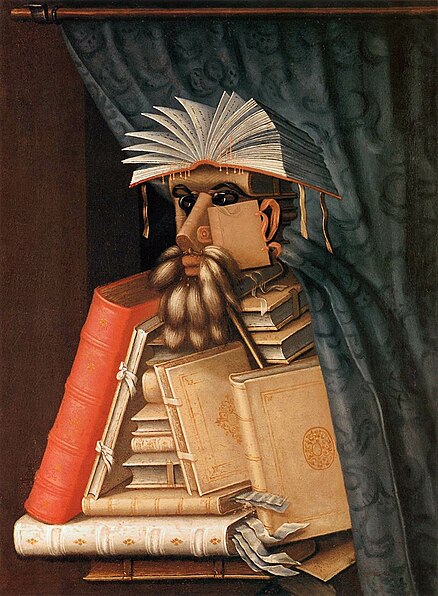
In the mid-16th century the Italian painter Giuseppe Arcimboldo gave us The Librarian, a portrait composed almost entirely of books. One of the most original painters of the Renaissance it is not hard to see how his work would influence the Surrealists and Cubists some 400 years later.

In his 1994 book The Three Golden Keys illustrator Peter Sís "recaptures the wonder of his own lost childhood in Prague and celebrates the city's cultural heritage, reborn after forty-five years of Communist rule." One of the places he finds a Golden Key is at the library.
The caption for the illustration gives an anonymous nod to Arcimboldo. It reads:
"The librarian magically emerges from the wall. I have seen him before in some old painting. He moves toward me, holding a scroll'
and it is the reading of that scroll that results in a Golden Key.
Also of note is this engraving, (after) Arcimboldo's 'The Librarian,' by Georg Philipp Harsdörffer. It was included in Harsdörffer's 8 volume work 'Frauenzimmer Gesprechspiele' that was published through the 1640s.
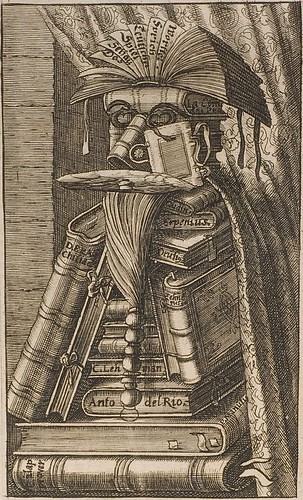
For more of Harsdörffer's work see this post from the BibliOdyssey archive, The Odd Baroque
This video was made for the New Zealand Book Council. It’s based on Going West by Maurice Gee.
(Via The Unbound Book.)

Cambridge Journals is celebrating recent achievements by making all its online journals content from 2009 and 2010 free for six weeks. Cambridge has enjoyed accelerating success in recent years with increasing numbers of journals published, improved impact factors and multiple enhancements made to Cambridge Journals Online. Usage has significantly increased with the digitisation of new and archive content, and more people are now able to access Cambridge Journals than ever before. Currently over 1.3 million articles are downloaded from CJO every month. To celebrate these successes, and to reach out to new customers, Cambridge Journals has announced that it is making all online content published during 2009 and 2010 free between 15 July and 30 August 2011
From Peter Scott's Library blog (Via Celia's.)
 James Joyce may be best known as a poet, playwright, short story writer and novelist. But in an August 10, 1936 letter his grandson, Stephen, Joyce planted the story seeds of what became The Cat and the Devil — a charming children’s picture-book, originally illustrated by French cartoonist Roger Blachon, about the cat of Beaugency and a moral dilemma, a classic fable narrative mixing Irish wit with French folklore, shaken and stirred with Joyce’s extraordinary storytelling.
 In 1865, legendary satirist Mark Twain did something unexpected — he penned a children’s story, titled Advice to Little Girls, in which he challenged children to digest the kind of intelligent humor and knowledge he was, and still is, known for among his adult audiences. The story was eventually published in The 30,000 Dollar Bequest and Other Stories.
You ought never to take your little brother’s ‘chewing-gum’ away from him by main force; it is better to rope him in with the promise of the first two dollars and a half you find floating down the river on a grindstone. In the artless simplicity natural to this time of life, he will regard it as a perfectly fair transaction. In all ages of the world this eminently plausible fiction has lured the obtuse infant to financial ruin and disaster.”Vladimir Radunsky has more over at the New York Review of Books.
 In 1923, with her greatest works still ahead of her, Virginia Woolf responded to a submissions call from a family newspaper called The Charleston Bulletin, published by her teenage nephews. The Widow and the Parrot is, roughly, a tongue-in-cheek moral story about kindness to animals and though Quentin, Woolf’s older nephew, bemoaned it as a disappointment and “a tease…based on the worst Victorian examples,” devoid of Woolf’s typical subversive humor he had hoped for, it remains a sweet reflection of character, her taking the time to contribute to a small family pet project in the heat of her literary career.
 T.S. Eliot is often regarded as the most important English-language poet of the 20th century. In the 1930s, Eliot, under his assumed name “Old Possum,” wrote a series of letters to his godchildren, in which he included a handful of whimsical poems about feline psychology and sociology. They were eventually published in 1939 as Old Possum’s Book of Practical Cats, originally illustrated by the author himself. But, given our affinity for mid-century illustrator Edward Gorey, the even bigger treat is the 1982 edition illustrated by Gorey in his signature style of black-and-white drawings at the intersection of the macabre and the whimsical.
 Between the time Mary Shelley published anonymous edition of her iconic Frankenstein in London in 1818 and the publication of the second edition in France in 1823, where her name appears for the first time, she penned Maurice, or The Fisher’s Cot — a children’s story Shelley wrote in 1820 for a daughter of friends. Shelley tried to have the story published by her father, William Godwin, but he refused, burying the text for nearly two centuries. In 1997, scholars discovered a manuscript copy was in Italy, considered one of modernity’s great feats of literary forensics.
 Iconic Russian novelist Leo Tolstoy may be best-known for his epics Anna Karenina and War and Peace, considered two of the greatest novels of all time, but he also had a keen and active interest in children and children’s literature. He founded a school for peasant children on his family’s estate, followed by a second, more experimental school with the motto, “Come when you like, leave when you like” — an early model for open education. Inspired by the simplicity and innocence with which the children of his schools told stories, he began writing about his own childhood, eventually publishing a series of alphabet books after War and Peace. Known as “The ABC Book” (Azbuka) and “The New ABC Book” (Novaia Azbuka), these easy readers were widely adopted in Russia’s education system and remained in use throughout the Soviet Era.
 In 1888, before his most iconic plays and essays made grand their debut, Oscar Wilde wrote The Happy Prince and other Tales — a poetic collection of five children’s stories about happiness, life and death. Though the most popular Western version, illustrated by Laura Stutzman, is certainly a treat, nothing compares to the astounding 1992 Chinese translation (which features an English version in the back of the book) illustrated by renowned Chinese artist Ed Young.

How could a private company make a profit running a free service that is funded by taxpayers?Read the article here.
The mandate of the private operator would be to reduce the level of public funding that now supports our libraries. At the same time, they need to make a profit. There is an inevitable conflict here which signals bad news for all library users, from children to seniors. First, local branches of the Toronto Public Library would almost certainly be closed. Library users would see higher user fees, fewer books and less access to the information and other vital services our public libraries offer for little or no cost as hours of operation are limited. The cuts to library staff that have been going on for years will be accelerated.
It's also bad news for our city. We would lose a powerful educational and cultural force that opens books and opens minds, taking from Toronto a public service that all other great cities jealously guard.

Entrance to Children’s Section, Cerritos Millenium Library, Cerritos, California (photo: Victor Rocha).
From Librarianista Via TYWKIWDBI


From the Middle Ages to the Digital Age, or what sheep skin has to do with content curation.

In this fascinating short documentary, part of The Getty Museum‘s excellent Making Art series on ArtBabble, we get to see the astounding patience and craftsmanship that went into the making of medieval illuminated manuscripts — remarkable books painstakingly written and decorated by hand, coveted as some of the most precious objects produced in the Middle Ages.
For more on these marvels of the written word, you won’t go wrong with Christopher De Hamel’s A History of Illuminated Manuscripts — though, regrettably, not an illuminated manuscript itself. And, in the meantime, perhaps we should consider what the new vehicles of patience and craftsmanship are for creating value in today’s greatest feats of publishing — journalistic integrity, curatorial sensibility, information discovery.
via MetaFilter and Brain Pickings.

 Since 1998, Esquire magazine has conducted more than 300 interviews with artists, athletes, celebrities, entrepreneurs, musicians, politicians, scientists and writers. The series — called “What I’ve Learned” — provides a fascinating cross-section of the lives of prominent people. From Buzz Aldrin to Batman, the interview list reads like a Who’s Who of our era.
Smoke like a chimney, work like a horse, eat without thinking, go for a walk only in really pleasant company.” ~ Albert Einstein
Get yourself in trouble. If you get yourself in trouble, you don’t have the answers. And if you don’t have the answers, your solution will more likely be personal because no one else’s solutions will seem appropriate. You’ll have to come up with your own.” ~ Chuck Close
You practice and you get better. It’s very simple.” ~ Philip Glass
A big part of life is realizing what you’re good at.” ~ Alyssa Milano
Children teach you that you can still be humbled by life, that you learn something new all the time. That’s the secret to life, really — never stop learning. It’s the secret to career. I’m still working because I learn something new all the time. It’s the secret to relationships. Never think you’ve got it all.” ~ Clint Eastwood
You can’t just live in a comfortable little suburban neighborhood and get your education from movies and television and have any perspective on life.” ~ J. Craig Venter
A friend is someone who will tell you when you’re bullshitting, when you’ve overstepped a mark, or when you’re being an idiot.” ~ Sting
I think we will make it. Because one quality people have — certainly Americans have it — is that they can adapt when they see necessity staring them in the face. What to avoid is what someone once called the definition of hell: truth realized too late.”~ E. O. Wilson
The measure of achievement is not winning awards. It’s doing something that you appreciate, something you believe is worthwhile. I think of my strawberry souffle. I did that at least twenty-eight times before I finally conquered it.” ~ Julia Child
In the end, winning is sleeping better.” ~ Jodie Foster

Smartphones Changed Literally Everything
Brian Chen, a writer at Wired, has a book out called “Always On.” He went on the previously-mentioned best radio show/podcast on Earth (NPR’s Fresh Air) to talk about the book, which chronicles how smartphones changed the world. One of the subjects discussed was education:
“Instead of lecturing students and saying ‘Hey, open your textbook and go to page 96,’ the teacher is acting as a guide and saying ‘OK, so here’s the topic we’re going to discuss today. Take out your iPhone and go search on the web or search Wikipedia and let’s have a conversation about where we want to take this discussion,” says Chen.
He explains that students at Abilene are being taught the importance of discerning good data from bad data — and not just to blindly accept the information that would have been presented in a textbook.

Out of Print celebrates the world’s great stories through fashion. Our shirts feature iconic and often out of print book covers. Some are classics, some are just curious enough to make great t-shirts, but all are striking works of art.
We work closely with artists, authors and publishers to license the content that ends up in our collections. Each shirt is treated to feel soft and worn like a well-read book.
In addition to spreading the joy of reading through our tees, we acknowledge that many parts of the world don't have access to books at all. We are working to change that. For each shirt we sell, one book is donated to a community in need through our partner Books For Africa.
How we read is changing as we move further into the digital age. It's unclear what the role of the book cover will be in this new era, but we feel it's more important than ever to reflect on our own individual experiences with great literary art before it's forever changed.


If you're like most people I work with in companies, the demands come at you from every angle, all day long, and you have to make difficult decisions without much time to think about them. What enduring principles can you rely on to make choices that reflect openness, integrity and authenticity?
Here are ten that work for me:
1. Always challenge certainty, especially your own. When you think you're undeniably right, ask yourself "What might I be missing here?" If we could truly figure it all out, what else would there be left to do?
2. Excellence is an unrelenting struggle, but it's also the surest route to enduring satisfaction. Amy Chua, the over-the-top "Tiger Mother," was right that there's no shortcut to excellence. Getting there requires practicing deliberately, delaying gratification, and forever challenging your current comfort zone.
3. Emotions are contagious, so it pays to know what you're feeling. Think of the best boss you ever had. How did he or she make you feel? That's the way you want to make others feel.
4. When in doubt, ask yourself, "How would I behave here at my best?" We know instinctively what it means to do the right thing, even when we're inclined to do the opposite. If you find it impossible, in a challenging moment, to envision how you'd behave at your best, try imagining how someone you admire would respond.
5. If you do what you love, the money may or may not follow, but you'll love what you do. It's magical thinking to assume you'll be rewarded with riches for following your heart. What it will give you is a richer life. If material riches don't follow, and you decide they're important, there's always time for Plan B.
6. You need less than you think you do. All your life, you've been led to believe that more is better, and that whatever you have isn't enough. It's a prescription for disappointment. Instead ask yourself this: How much of what you already have truly adds value in your life? What could you do without?
7. Accept yourself exactly as you are but never stop trying to learn and grow. One without the other just doesn't cut it. The first, by itself, leads to complacency, the second to self-flagellation. The paradoxical trick is to embrace these opposites, using self-acceptance as an antidote to fear and as a cushion in the face of setbacks.
8. Meaning isn't something you discover, it's something you create, one step at a time. Meaning is derived from finding a way to express your unique skills and passion in the service of something larger than yourself. Figuring out how best to contribute is a lifelong challenge, reborn every day.
9. You can't change what you don't notice and not noticing won't make it go away. Each of us has an infinite capacity for self-deception. To avoid pain, we rationalize, minimize, deny, and go numb. The antidote is the willingness to look at yourself with unsparing honesty, and to hold yourself accountable to the person you want to be.
10. When in doubt, take responsibility. It's called being a true adult.
Reprinted from Harvard Business Review
Tony Schwartz is President and CEO of The Energy Project, a company that helps individuals and organizations fuel energy, engagement, focus, and productivity by harnessing the science of high performance. Tony's most recent book, The Way We're Working Isn't Working: The Four Forgotten Needs that Energize Great Performance, was published in May 2010 and became an immediate The New York Times and Wall Street Journal bestseller. Follow him on Twitter @TonySchwartz.(Via Fast Company.)
Here's a great HOWTO for building a bedside lamp in a hollow book. The book's cover is the switch, and the book's designer says he wanted to prove that literature is illuminating.
How To: Not Your Ordinary Book Light.
(via Red Ferret and Boing Boing)
Greg In The Desert found this cool "Western looking scene at sunset in the splashing of water against a pier."
(Via Boing Boing.)


